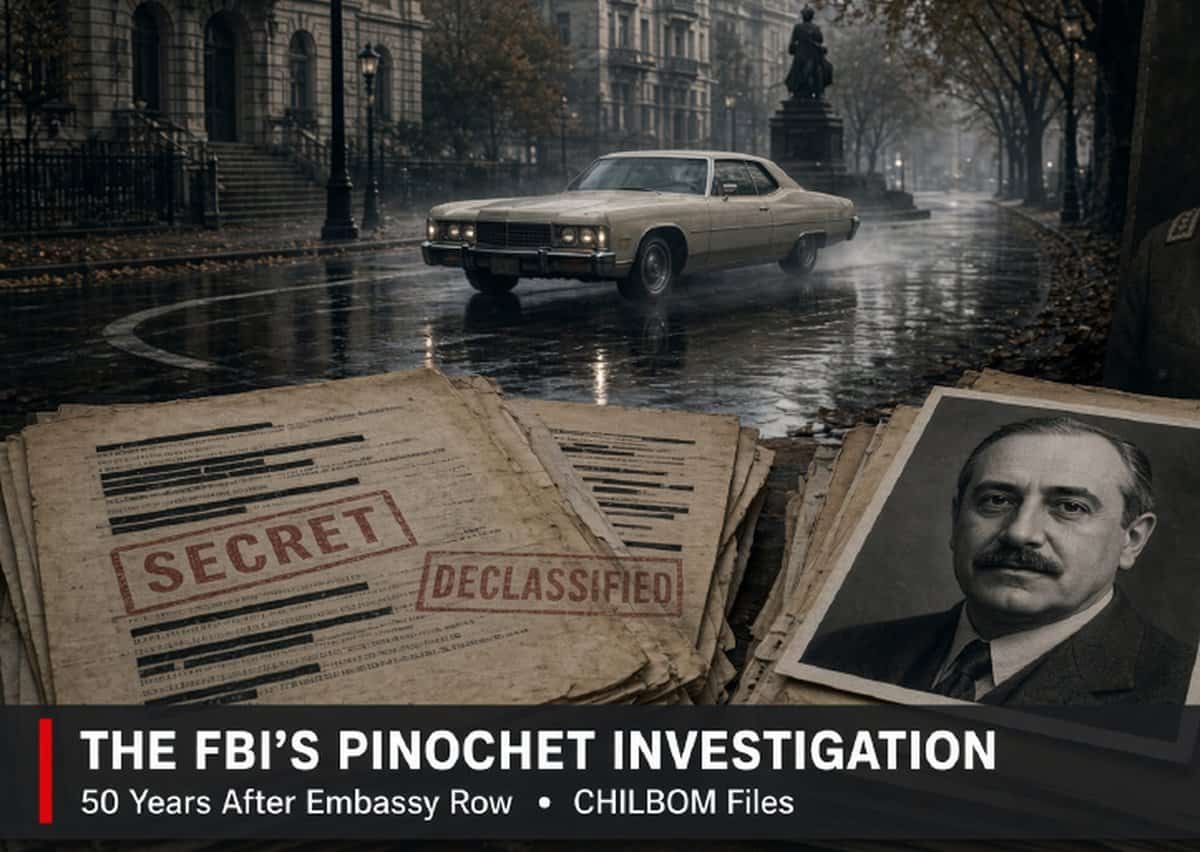
Fifty years ago this week, on the morning of September 21, 1976, a bomb planted under Orlando Letelier’s car exploded on the stretch of Massachusetts Avenue in Washington, D.C., known as Embassy Row. It killed Letelier — Salvador Allende’s former ambassador to the United States and the most prominent international critic of Chile’s military regime — and his 25-year-old colleague at the Institute for Policy Studies, Ronni Karpen Moffitt. Her husband, Michael Moffitt, was in the car and survived.
On the anniversary, the National Security Archive posted a set of FBI records it had been requesting under the Freedom of Information Act for more than a decade. They document a chapter most accounts of the case skip: a federal investigation launched in 1999, codenamed CHILBOM, whose stated purpose was to find out whether the trail led all the way to General Augusto Pinochet. We went through the twelve documents in the collection. Here’s what they show — and what’s still missing.
What Washington already knew
The first lead came within a week. On September 28, 1976, FBI attaché Robert Scherrer cabled from Buenos Aires that “Chile is the center for ‘Operation Condor,’” a secret alliance of South American security services that tracked and killed their opponents abroad, and he raised the possibility that the Letelier bombing was a Condor operation. It took investigators close to two more years to pin the attack on DINA, Chile’s secret police, and identify two of its agents: the American-born Michael Townley and Army officer Armando Fernández Larios. Townley’s confession led to U.S. indictments of DINA director Manuel Contreras, his deputy Pedro Espinoza, and Fernández Larios.
What the U.S. government knew about Pinochet himself stayed secret far longer. In January 1987, Fernández Larios defected; a small U.S. team debriefed him for ten hours in a CIA safe house in Santiago, and he later pleaded guilty in Washington to being an accessory after the fact. Secretary of State George Shultz then asked the CIA to review its files. The agency’s May 1, 1987 assessment, titled “Pinochet’s Role in the Letelier Assassination and Subsequent Coverup,” said it had convincing evidence that Pinochet “personally ordered his intelligence chief to carry out the murder.”
In an October 1987 memo to President Reagan, Shultz called the bombing a blatant case of a head of state directly involved in state terrorism — in the U.S. capital, by a government considered friendly. He raised the question of indicting Pinochet without answering it. At the time, the U.S. took no steps to do so.
CHILBOM: the case that came back
The question returned after Pinochet was detained in London on October 16, 1998, on an Interpol warrant filed by Spain. On February 8, 1999, Attorney General Janet Reno authorized a renewed “major case” investigation. An FBI overview from around May 2000 states its objective plainly: to determine whether admissible evidence showed that additional people, “up to and including General Augusto Pinochet,” were involved in the murders.
The files show a serious effort. FBI investigators went to Santiago in January 2000 for a full review of archival records. From March 20 to April 20, 2000, a Justice Department and FBI delegation spent a month in Chile taking sworn testimony from 38 of the 46 witnesses it had requested; five had died, and two were fugitives on unrelated matters. The Americans weren’t allowed to question witnesses directly. A Chilean lawyer representing the U.S. government asked the questions while FBI and DOJ officials watched over closed-circuit TV from an adjacent room.
One of the people deposed was Contreras, the former DINA chief. The FBI’s summary of his May 2000 deposition is almost entirely redacted.
The Kissinger interview
The document getting the most attention is a summary of a formal FBI interview with former Secretary of State Henry Kissinger, conducted in his New York office on May 25, 2000. Kissinger told the agents about a private meeting with Pinochet in Santiago in 1976, roughly three months before the bombing. According to the summary, Kissinger recalled Pinochet bringing up Letelier’s name when he referred to contacts between regime opponents and members of the U.S. Congress. Kissinger “could not recall if Pinochet became angry” when discussing Letelier.
It’s worth being precise about what this document does and doesn’t say. It records Kissinger’s recollection, 24 years after the fact, that Pinochet raised Letelier’s name in a conversation about congressional contacts. It does not say Kissinger knew of any plan, and nothing in this release suggests he did. What it does show is that federal investigators treated that conversation as relevant enough to a possible case against Pinochet to interview a former secretary of state about it. The name of the aide who accompanied Kissinger to that meeting is redacted in the FBI’s summary; the Archive identifies him as Assistant Secretary of State William Rogers.
Where it stopped
Contreras and Espinoza were eventually convicted in Chile in the early 1990s. Pinochet was a different matter. According to the Archive, Justice Department lawyers gave Reno evidence summaries and recommendations on indicting him around August 2000. Reno deferred the decision to the incoming Bush administration, which appears to have shelved the investigation. The record released so far shows no indictment.
Those recommendations are still classified. So are the FBI’s evidentiary records — including a December 2000 investigative summary of CHILBOM that the FBI identified but withheld from its release to the Archive. That’s the redaction that matters most here. Fifty years after a car bomb killed two people in the nation’s capital, the government’s own final judgment on whether it could charge the head of state that its intelligence agency concluded had ordered the attack is still not public. The Archive has called on the Justice Department to release it.
Until then, the documents that are public are worth reading yourself — starting with the 2000 interview that put a former secretary of state on the FBI’s witness list.
Primary source: FBI, interview summary, [Formal FBI Interview with Henry Kissinger], May 25, 2000. Full context: National Security Archive Briefing Book #930, “The Letelier-Moffitt Case at 50: The Verdict of History on Pinochet’s Role,” ed. Peter Kornbluh, Sept. 21, 2026.
Sources
- FBI, cable, “[Condor: Chilbom],” Secret, September 28, 1976 (document)
- State Department, cable, [Highlights of Ten-Hour Debriefing with Fernandez Larios], Top Secret Eyes-Only Roger Channel, January 15, 1987 (Document 7)
- CIA, Intelligence Assessment, “Pinochet’s Role in the Letelier Assassination and Subsequent Coverup,” Secret, May 1, 1987 (Document 9)
- State Department, Memorandum to the President, “Pinochet and the Letelier-Moffitt Murders: Implications for US Policy,” Secret, October 6, 1987 (Document 10)
- FBI, [Request for Three Investigators to go to Chile to Conduct Inquiry], March 20, 2000 (Document 3)
- FBI, summary, [Deposition of former DINA Director, Gen. Manuel Contreras], May 3, 2000 (Document 5)
- FBI, status report, “CHILBOM Investigation: Overview/Update,” ca. May 2000 (Document 2)
- FBI, interview summary, [Formal FBI Interview with Henry Kissinger], May 25, 2000 (Document 1)
- FBI, “Investigative summary on CHILBOM investigation,” December 11, 2000 (Document 6)
- National Security Archive, Briefing Book #930, “The Letelier-Moffitt Case at 50: The Verdict of History on Pinochet’s Role,” ed. Peter Kornbluh, September 21, 2026 (briefing book)