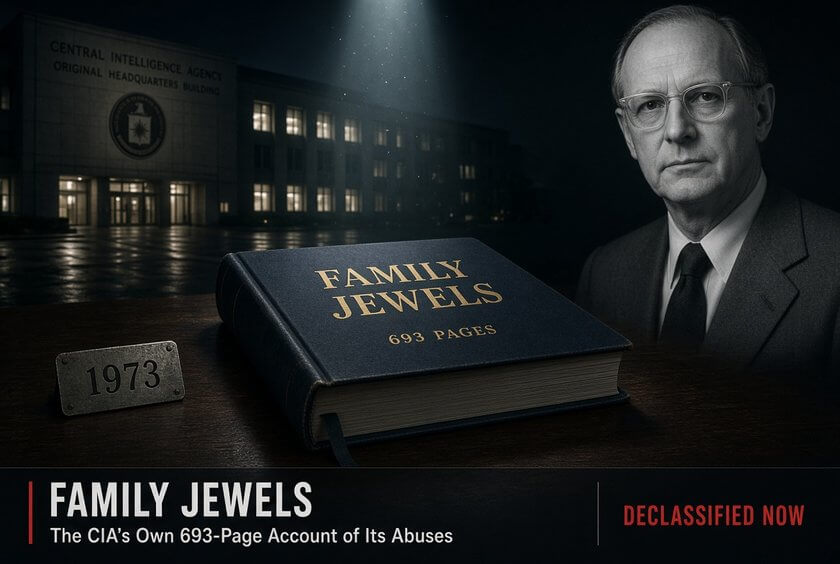
On May 9, 1973, in the aftermath of the Watergate break-in, CIA Director James Schlesinger directed agency employees to report, in writing, any activity they believed might have exceeded the agency’s charter. The resulting compilation — nearly 700 pages, later nicknamed the “family jewels” — documented roughly 25 years of CIA conduct, from the early 1950s through 1973.
Portions of the material reached the public before the government acknowledged its existence. New York Times reporter Seymour Hersh broke the story on December 22, 1974, describing a domestic CIA spying operation against American antiwar activists. Director William Colby briefed the Justice Department five days later and briefed President Ford on January 3, 1975. The document itself remained classified for decades afterward; the CIA declassified it in full and released it to the National Security Archive on June 26, 2007, 15 years after the Archive’s original FOIA request.
The compilation catalogs activity across several categories. Domestic surveillance entries describe wiretaps placed on journalists Robert Allen and Paul Scott, and physical surveillance of columnist Jack Anderson, journalist Brit Hume, and Washington Post reporter Michael Getler. A separate program, MHCHAOS, tracked foreign support for the U.S. antiwar movement and compiled files on more than 9,900 Americans connected to it.
Mail-opening programs ran for two decades: outgoing and incoming correspondence with the Soviet Union was opened from 1953 to 1973, and correspondence with China from 1969 to 1972, under a project at times referred to as SRPOINTER or HTLINGUAL, conducted at New York’s JFK Airport. The document also describes break-ins at the homes and offices of former CIA employees and Soviet defectors, and assassination plots directed at Cuban premier Fidel Castro, Congolese prime minister Patrice Lumumba, and Dominican Republic president Rafael Trujillo. A separate entry describes a polygraph experiment conducted with a San Mateo County, California sheriff’s office. The document’s account of behavior-modification testing on unwitting subjects overlaps with, but is broader than, the MKULTRA-specific record examined separately in Sidney Gottlieb’s Church Committee testimony.
The “family jewels” compilation, together with related press reporting, became a direct catalyst for the congressional investigations that followed: the Rockefeller Commission, convened by President Ford in January 1975, and the Senate’s Church Committee, which began hearings later that year. Then-Director Michael Hayden, announcing the 2007 declassification, described the material as offering “a glimpse of a very different time and a very different Agency.”
Sources
- Central Intelligence Agency, “Family Jewels” compilation, May 1973, declassified June 2007 (full document)
- Central Intelligence Agency, Schlesinger directive materials, 1973 (schlesinger_jewels.pdf)
- Ford White House memo on briefing, Jan. 1975 (family_jewels_wh1.pdf)
- Full briefing book: National Security Archive, “The CIA’s Family Jewels,” ed. Thomas Blanton, June 2007