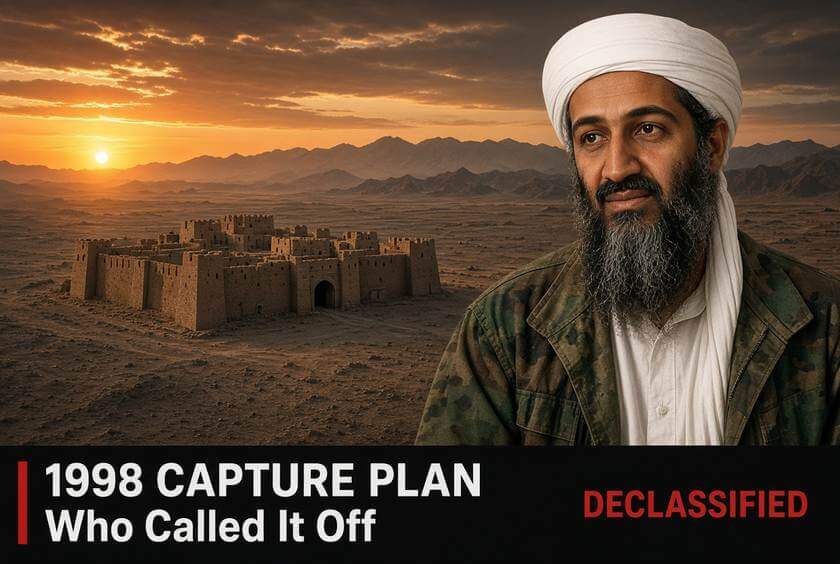
For twenty years, one version of the pre-9/11 story has refused to die: the CIA had a plan to grab Osama bin Laden in 1998, and the Clinton White House wouldn’t let it go forward. ABC’s 2006 miniseries The Path to 9/11 gave it a scene, with National Security Advisor Sandy Berger declining to approve a strike on bin Laden while agents waited on the line.
A 9/11 commissioner called the scene fictional, and it was removed from the version shown in the United States. The belief outlasted the edit.
On Sept. 11, the government released the sworn record behind that fight. Among the documents the Interagency Security Classification Appeals Panel declassified for the 25th anniversary are the 9/11 Commission’s memos of its interviews with the four men at the center of the May 1998 plan: Michael Scheuer, who ran the CIA’s bin Laden unit; CIA Director George Tenet; Berger; and Richard Clarke, the White House counterterrorism coordinator.
We read each man’s account of the plan. On who called it off, the four accounts agree. On whether the plan could ever have worked, they flatly don’t.
The plan: kidnap him from Tarnak Farms
The idea, as Scheuer laid it out to Commission staff in January 2004, was to have the CIA’s Afghan tribal agents seize bin Laden at his compound near Kandahar, hide him at a redoubt southeast of the city that “even the Soviets had never discovered,” and then fly him out from an airstrip the agency had chosen. Scheuer called it “the perfect operation” and “a no brainer.”
It showed no U.S. hand, he said, and needed little more than “a plane that could fly at night” and a pilot. The memo says complete rehearsals were run, including a full command-post rehearsal.
Scheuer was also frank about the agents. The memo paraphrases him calling them “really just thugs,” but good at kidnapping.
Who turned it off
This is the part the myth gets wrong, and the new memos are unusually consistent about it.
Tenet, interviewed Jan. 22, 2004, told the Commission the cancellation came from inside his own building. His deputy director for operations, Jack Downing, his counterterrorism chief, Geoff O’Connell, and his Near East division chief gave a “strong and unanimous recommendation” to cancel, citing operational impediments and the risk of collateral damage.
The memo says Tenet then decided to “turn off” the operation. He called Berger to inform him, not to ask him. Per the memo, he “did not offer Berger a choice,” and Berger did not push back.
Berger, interviewed Jan. 14, 2004, said he didn’t think he was aware of the plan at the time. He believed it was “killed by and at CIA” and “never presented to the White House for a decision.” He called it “not a big deal at the White House,” though a big deal at CIA, and allowed that Tenet may well have mentioned it to him.
Clarke, in his first interview on Dec. 18, 2003, said the plan was briefed at the White House but that the DCI did not approve it. Senior officials up the CIA chain, he said, “laughed at it.” When Berger asked Tenet at a meeting whether he approved, Clarke recalled, Tenet said no.
Scheuer is the one who comes closest to leaving the door open. In his December 2003 interview, taken under oath, he said O’Connell called him in on May 29, 1998, while final preparations were underway. O’Connell said he had just met with Tenet, Downing, Downing’s deputy Jim Pavitt and the Near East chief, and the operation was off.
Scheuer asked whether the decision came from “downtown,” meaning the White House, or from “this building.” According to the memo, O’Connell didn’t answer.
So even the person most aggrieved by the cancellation described it being handed down inside CIA headquarters, and got no answer when he asked whether anyone outside it was behind it. The 9/11 Commission Report reached the same bottom line in 2004. It wrote that “impressions vary,” noted that Pavitt thought it was “Berger’s doing,” and then reported Tenet’s statement that he “alone had decided.”
What’s new is the underlying testimony, which lets you see how thin the other impressions were.
Thirty percent, sixty percent, or zero
Where the four stop agreeing is on the plan itself.
Scheuer insisted it had been approved all the way up the CIA’s operations and intelligence directorates. “Everyone approved it,” the memo quotes him. By his account, the agency agreed on a 20–30% chance of complete success, and the Islamabad station chief cabled that he thought it had a 50–60% chance (after first thinking it wouldn’t work at all).
In his first interview he gave those figures as 30% and 60%. He also said a contact in New York told him O’Connell had briefed federal prosecutors there that the plan had a 0% chance. That claim is secondhand in the memo, and nothing in the eleven documents confirms it.
Tenet’s memo puts the agreed odds at “less than 30%.” He said the decision rested on the judgment of his three senior operations officers, who were in effect telling him “this is ridiculous.”
Clarke’s description of Tarnak Farms is the bleakest. When the White House counterterrorism group asked for better photos, he said, they showed a large, heavily fortified compound with two tanks, machine-gun nests, and women and children inside, and nobody knew which house bin Laden slept in.
He “figured the tribals would get slaughtered before they got over the Tarnak wall.” His verdict, as recorded: the raid “would have succeeded only in getting all of the CIA’s limited assets in the country killed.”
Scheuer anticipated exactly that criticism. He told the Commission that anyone who called it a “cowboy operation” should be put under oath and asked again.
The Saudi question nobody settled
Scheuer offered one more explanation in his second interview. He believed the capture plan was dropped partly “because the Saudis said they could do this,” meaning persuade the Taliban to hand bin Laden over. His staff wrote a memo arguing they never would. He accompanied Tenet to Saudi Arabia in May 1998 for talks with Crown Prince Abdullah on that effort.
Tenet rejected the link outright. His memo says the trip was “entirely unrelated” to the cancellation.
We can’t adjudicate this from these documents. Much of Scheuer’s Saudi discussion in his first memo sits under “25X1” markings, the exemption code covering intelligence sources and methods and relationships with foreign intelligence services, and whole lines are blacked out. What’s left is two sworn accounts that point in opposite directions.
What the record does and doesn’t say
These are memos written by Commission staff summarizing interviews, not transcripts, and they record what each man said five years after the fact. None of them settles whether the raid would have worked. That question has no document behind it.
What they settle is narrower. Three of the four officials closest to the May 1998 plan describe the decision to kill it as a CIA decision. The fourth, Scheuer, who most wanted it to go ahead, watched it come down through CIA’s own chain. None of them describes a White House refusal.
Berger, in the same interview, also dismissed another durable story, that Sudan had offered to hand bin Laden over in 1996. He said he knew of no one in the process who recalled such an offer, apart from one Sudanese official.
The myth needed a villain on the phone. The record has a room at Langley and a question Scheuer never got answered. Our earlier report on the Sept. 11 release itself covers the rest of what came out that day. The memos are there too. Read them yourself.
Primary source: 9/11 Commission, Memorandum for the Record, interview of George Tenet, Jan. 22, 2004. Full context: ISCAP 2026-201, 9-11 Commission Memoranda for the Record (11 documents).
Sources
- ISCAP, 2026-201: 9-11 Commission Memoranda for the Record, 11 documents, declassified Sept. 8, 2026
- 9/11 Commission, MFR, interview of Mike Scheuer, Dec. 11, 2003 (Document 6)
- 9/11 Commission, MFR, interview of Mike Scheuer, Jan. 6, 2004 (Document 7)
- 9/11 Commission, MFR, interview of George Tenet, Jan. 22, 2004 (Document 10)
- 9/11 Commission, MFR, interview of Samuel Berger, Jan. 14, 2004 (Document 1)
- 9/11 Commission, MFR, interview of Richard A. Clarke, Dec. 18, 2003 (Document 2)
- The 9/11 Commission Report, Chapter 4, “Responses to Al Qaeda’s Initial Assaults,” 2004
- Information Security Oversight Office, “ISCAP Declassification of Records Relating to 9/11,” Sept. 11, 2026
- Wikipedia, “The Path to 9/11” (production and controversy)