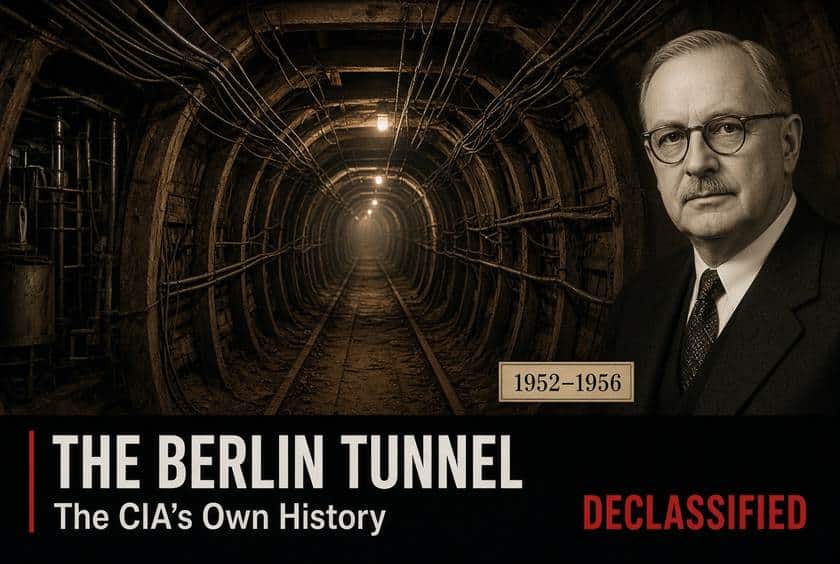
The Berlin Tunnel was a joint operation of the Central Intelligence Agency and the British Secret Intelligence Service (MI6). It tapped Soviet and East German communications cables from a 1,476-foot tunnel dug from the American sector of Berlin into the Soviet sector (CIA Museum, “The Berlin Tunnel”). Collection ran from May 1955 until the tunnel was discovered in April 1956 (ibid.).
The principal U.S. government account is the CIA’s internal history, Clandestine Services History: The Berlin Tunnel Operation, 1952–1956, Clandestine Services Historical Paper No. 150. It was prepared in August 1967 and published June 24, 1968, in two copies (CSHP 150, title page). This entry summarizes the operation as documented in that history and in later CIA publications.
Origins
According to CSHP 150, U.S. intelligence officers became interested “as early as 1948” in tapping Soviet and satellite landlines on a larger scale. The loss of certain sources had left gaps in intelligence coverage (CSHP 150, ch. I). The history states that the tunnel project “came into being sometime in 1952,” and that “the exact date cannot be established” (preface).
By January 1953, sample recordings had been obtained from the prime target circuit. The longest continuous sample was 29 minutes (ch. II). The history records that the DCI approved the project’s terms of reference in December 1953 (ch. II). The CIA Museum dates approval to January 1954 and the start of work to February 1954 (“The Berlin Tunnel”).
The history’s author served as Headquarters case officer on the project from the winter of 1952–1953 until the summer of 1954, and then as field case officer until February 1955 (preface). The author records that Director of Central Intelligence Allen W. Dulles ordered “as little as possible” about the project to be put in writing (preface). The name of the author is redacted in the released versions.
Construction, 1954–1955
The operation was run from a fenced compound in the Rudow district of West Berlin, roughly the size of a city block. It held a one-story warehouse with a basement, barracks and kitchen facilities, and a generator building (CSHP 150, ch. II; fig. 2). The compound’s sanitation was a cesspool, which turned out to lie only a few feet from the tunnel’s path (ch. II). Contemporary press accounts, reproduced in the history’s Appendix C, describe the site as an Army radar station.
By Aug. 17, 1954, the compound was complete and supplies were in Berlin. These included 125 tons of steel tunnel liner shipped from the United States and carried across the East Zone by freight train, double-crated and drop-tested for security (ch. III). The organization that provided tunneling assistance is redacted in the released text (ch. II).
The target was a set of three cables about two inches in diameter, buried 27 inches below the main highway from East Berlin to Schönefeld airport (ch. III). In late August 1954, work began on a vertical shaft about 16 feet in diameter in the warehouse basement.
Groundwater was struck at 16 feet rather than the predicted 32, and the history attributes this to a “perched water table” above a clay lens. The decision was taken to proceed with less than half the planned overhead cover (ch. III).
Digging stopped whenever East German guards patrolled over the tunnel line. The tunnel was lined with sandbags, and spoil was hauled back to the warehouse basement by a converted electric forklift on a wooden track (ch. III). The history records one surveying expedient: engineers organized a baseball game to put an object of known size into the East Zone as a reference point.
The attempt failed because East German guards kept returning the ball (ch. III). The tunnel was completed on Feb. 28, 1955. The tap chamber was built between March 10 and March 28, 1955, when the three target cables were exposed (ch. III).
The history sets out the posture approved in advance for the tunnel’s discovery (ch. III):
- The United States would adopt “flat denial” of any knowledge of the tunnel.
- Demolition charges were placed where the tunnel crossed the sector border, capable of collapsing it if Soviet forces attempted forcible entry into the compound.
- A steel-and-concrete door sealed the tunnel about 15 yards from its terminal end. It was lettered in German and Cyrillic: “Entry is forbidden by order of the Commanding General.”
Discovery, April 1956
CSHP 150 dates the discovery to April 21, 1956, “after 11 months and 11 days of operation” (ch. IV). A later CIA review gives the date as April 22, 1956 (Keeley, Studies in Intelligence 64, no. 2, 2020). A staff analysis dated Aug. 15, 1956, reproduced as Appendix A, examined traffic on the tapped cables, audio from a microphone installed in the tap chamber, and observations from the site.
It concluded that the discovery was “purely fortuitous” (App. A). According to that analysis, heavy rains flooded cables between Karlshorst and Mahlow beginning on the night of April 16, and repair crews digging up faulty sections found the tap (App. A; ch. IV).
The history records that the project’s managers had expected the Soviets to suppress news of the tunnel rather than admit the breach (ch. VI). Instead, the acting commandant of the Soviet Berlin garrison, Col. Ivan A. Kotsyuba, invited the Berlin press corps to a briefing and tour of the tunnel (ch. VI). The history describes the worldwide reaction as favorable to U.S. prestige. Appendices C and D reproduce American and East German press coverage.
Collection
The yield figures are redacted in the 2007 release of CSHP 150. The CIA Museum gives them as 50,000 reels of tape; 443,000 fully transcribed conversations; 40,000 hours of telephone conversations; 6,000,000 hours of teletype traffic; and 1,750 intelligence reports (“The Berlin Tunnel”).
The Blake betrayal
George Blake, an MI6 officer working for the KGB, informed the Soviets of the operation during its planning stages (CIA Museum, “The Berlin Tunnel”). His role became known after his arrest in 1961 (Keeley, 2020). The Aug. 15, 1956, analysis therefore predates any U.S. knowledge of the betrayal, and CSHP 150’s conclusion on the cause of discovery does not reflect it.
For decades after Blake’s arrest, published accounts assumed that the Soviets had used the tapped cables to pass disinformation. A 2020 review in the CIA’s Studies in Intelligence summarizes the later literature. Most authors since 1996, drawing in part on KGB officer Sergei Kondrashev’s testimony, concluded that the Soviets did not feed disinformation through the circuits, because any attempt would have endangered Blake (Keeley, 2020).
The reviewer adds that “the final word on this may not yet have been written.”
Release history
CSHP 150 has been released repeatedly, with fewer redactions each time. According to the 2020 Studies in Intelligence review, CIA released versions in 1977, 1997, three times in 2007, in 2012 and in 2019 (Keeley, 2020, note). The 2007 release, available in the CIA’s electronic reading room, does not name the British partner, and it withholds the number of personnel cleared for the project, and the content of Appendix B, which summarized the intelligence derived. A further version was approved for release on June 28, 2023 (CIA document C01225490).
Sources
- Central Intelligence Agency, Clandestine Services History: The Berlin Tunnel Operation, 1952–1956, CS Historical Paper No. 150, prepared Aug. 25, 1967, published June 24, 1968; approved for release 2007. Preface; chapters I–VI; Appendices A–D.
- Central Intelligence Agency, CSHP-150, “The Berlin Tunnel Operation 1952–1956,” document C01225490, approved for release June 28, 2023.
- Central Intelligence Agency, CIA Museum, “The Berlin Tunnel”.
- Gary Keeley, review of Steve Vogel, Betrayal in Berlin: The True Story of the Cold War’s Most Audacious Espionage Operation, Studies in Intelligence 64, no. 2 (June 2020): 51–53.
- National Security Archive, “Central Intelligence Agency, The Berlin Tunnel Operation, 1952-1956, June 24, 1968”, Document 15 in “The CIA and Signals Intelligence,” March 20, 2015.
- Internet Archive, “The Berlin Tunnel Operation 1952-1956” (copies of multiple CSHP 150 releases).