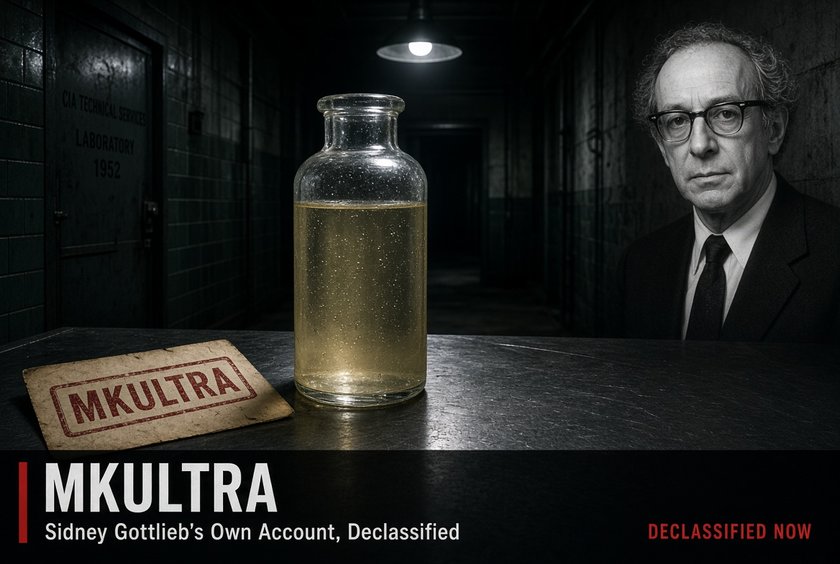
Sidney Gottlieb directed the Central Intelligence Agency’s Technical Services Division from 1951 to 1973 and originated Project MKULTRA, the agency’s most extensive behavior-modification research program. On October 15–18, 1975, Gottlieb testified in closed session before staff of the Senate Select Committee to Study Governmental Operations with Respect to Intelligence Activities — the Church Committee — regarding MKULTRA, its 1951 precursor Project ARTICHOKE, and CIA plans to assassinate Cuban premier Fidel Castro. The National Security Archive published the testimony transcripts on October 30, 2025, along with sixteen supporting CIA memoranda dated 1952 to 1973.
Then-Director Richard Helms ordered most MKULTRA records destroyed in 1973, before Congress began its investigations. The surviving record of the program’s internal operation therefore consists largely of Gottlieb’s own account, given under a grant of immunity, plus the small number of memos that survived the 1973 destruction order (Document 2, Oct. 16, 1975).
Gottlieb distinguished ARTICHOKE, which used simulated medical settings, from later MKULTRA and MKDELTA operations, which administered drugs covertly and without a subject’s knowledge (Document 1, Oct. 15, 1975). Two federal narcotics agents, working from CIA-operated safehouses in New York and San Francisco, administered LSD to unwitting subjects as part of this covert testing (Document 3, Oct. 17, 1975). Army scientist Frank Olson died in November 1953, days after receiving an undisclosed dose of LSD during a work retreat at Deep Creek Lake, Maryland; Gottlieb was questioned about the incident directly (Document 2, Oct. 16, 1975).
Testimony on the Castro operation described three methods considered or attempted: cigars treated with a botulinum toxin, a contaminated diving suit intended as a gift to Castro, and an aerosolized LSD device meant to disorient him during a public address (Document 4, Oct. 18, 1975). None of the three was carried out as planned.
Gottlieb also testified to a proposal, raised during the Vietnam War, to use LSD on a larger scale in prisoner interrogation; the proposal was not adopted (Document 4, Oct. 18, 1975). Assessing the program’s results, Gottlieb told the committee the agency had seen “as many failures as successes” from LSD-based interrogation, and that accounting for “the money expended, the effort expended, the security risk involved,” MKULTRA was “probably not a high pay-off program” (Document 2, Oct. 16, 1975).
The 1975 transcripts themselves remained classified for four decades. They were declassified via a Freedom of Information Act request connected to a 1995 civil suit brought by the estate of Stanley Glickman, an artist who was administered LSD without his knowledge at a New York safehouse in 1957.
Sources
- U.S. Senate Select Committee to Study Governmental Operations with Respect to Intelligence Activities, “Report of Proceedings,” Testimony of Sidney Gottlieb, Oct. 15, 1975 (Document 1)
- Same, Oct. 16, 1975 (Document 2)
- Same, Oct. 17, 1975 (Document 3)
- Same, Oct. 18, 1975 (Document 4)
- Full briefing book: National Security Archive, “The Top Secret Testimony of CIA’s MKULTRA Chief, 50 Years Later,” Oct. 30, 2025