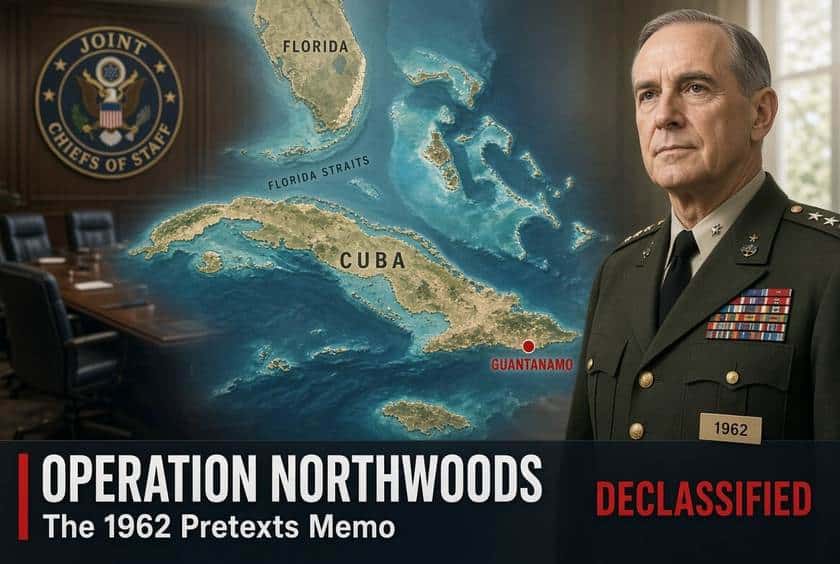
Operation Northwoods is the name attached to a set of proposed pretexts for a U.S. invasion of Cuba, drafted by the Joint Staff in March 1962 and forwarded to Secretary of Defense Robert McNamara under the signature of Gen. Lyman L. Lemnitzer, Chairman of the Joint Chiefs of Staff. “Northwoods” was the code word on the Joint Staff paper, JCS 1969/321, dated March 12, 1962 (JCS 1969/321, p. 2165). The file is 15 pages long. It was classified Top Secret Special Handling NOFORN, and the National Archives released it in 1997 among records reviewed by the Assassination Records Review Board.
Origin in Operation Mongoose, March 1962
The paper answered a request from Brig. Gen. Edward Lansdale, the “Chief of Operations, Cuba Project,” the covert program against the Castro government also known as Operation Mongoose. Lansdale’s memorandum of March 5, 1962, subject “Operation MONGOOSE,” asked the Joint Chiefs for a “brief but precise description of pretexts” that would justify U.S. military intervention in Cuba, with their views due by March 13 (memo, pp. 1, 4, 5).
The file records the Joint Chiefs’ own reasoning. On March 7, 1962, they had stated that a finding that “a credible internal revolt is impossible of attainment during the next 9-10 months” would require a U.S. decision to develop a Cuban “provocation” (JCS 1969/313, quoted in Enclosure B, p. 12). The Navy had separately proposed “generated instances” around Guantanamo in a March 8 memorandum titled “Instances to Provoke Military Actions in Cuba” (p. 2, footnote). The paper notes that the State Department was understood to be preparing its own courses of action to the same end (Enclosure B, p. 12).
The paper gives its timing rationale plainly. Intervention would hold good only while the Soviet Union had no mutual defense agreement with Cuba and no bases on the island, so “all projects are suggested within the time frame of the next few months” (pp. 2–3).
From the Caribbean Survey Group to the Secretary of Defense
The document moved through the Joint Staff in five days:
| Date | Document | Page |
|---|---|---|
| March 5, 1962 | Lansdale requests pretexts (“Operation MONGOOSE” memo to Gen. Craig) | 2, 5 |
| March 9, 1962 | Report by the DoD and JCS representative on the Caribbean Survey Group, “Cuba Project” | 4 |
| March 12, 1962 | Note by the Secretaries to the Joint Chiefs, “Northwoods,” JCS 1969/321 | 2 |
| March 13, 1962 | Joint Chiefs approve the paragraph 8 recommendations; decision attached as top sheet | 3 |
| March 13, 1962 | Lemnitzer memorandum to the Secretary of Defense, “Justification for US Military Intervention in Cuba” | 1 |
The decision sheet records that the Commandant of the Marine Corps took part under Title 10 of the U.S. Code because he had stated a direct Marine Corps interest (p. 3). The recommendations sent the paper to the Secretary of Defense for approval and transmittal to Lansdale. They barred distribution to unified and specified commanders, to U.S. officers assigned to NATO, and to the chairman of the U.S. delegation to the United Nations Military Staff Committee (p. 3).
Lemnitzer’s covering memo calls the package “a preliminary submission suitable for planning purposes” and recommends that the Joint Chiefs be given responsibility for “both overt and covert military operations” (p. 1).
The nine proposals in the annex
The annex, titled “Pretexts to Justify US Military Intervention in Cuba,” lists nine numbered courses of action and states they are “arranged neither chronologically nor in ascending order” (pp. 7–11). The table below sorts each by what its text says about casualties.
| No. | Proposal (paraphrased) | What the text says about casualties |
|---|---|---|
| 1 | Cover and deception plan, harassment and feints to provoke a Cuban reaction | Not addressed |
| 2 | Staged attack on Guantanamo by “friendly Cubans”: rumors, sabotage, burning aircraft, mortar rounds, a ship sunk near the harbor entrance | Funerals “for mock-victims”; real damage to installations |
| 3a | “Remember the Maine”: blow up a U.S. ship in Guantanamo Bay and blame Cuba | Not specified |
| 3b | Blow up an unmanned drone vessel near Havana or Santiago | “Non-existent crew”; casualty lists to run in U.S. newspapers |
| 4 | “Communist Cuban terror campaign” in Miami, other Florida cities and Washington | Sinking a boatload of Cubans “(real or simulated)”; attempts on Cuban refugees “even to the extent of wounding”; plastic bombs |
| 5 | Simulated Cuban-backed raid on a neighboring country, with night cane-burning raids over the Dominican Republic | Not addressed |
| 6 | U.S. pilots in MiG look-alikes harass civil aircraft, attack shipping and destroy U.S. drones | Not addressed |
| 7 | Hijacking attempts on civil air and surface craft made to appear Cuban-condoned | Not addressed |
| 8 | Fake shootdown of a chartered airliner flying from the U.S. to Jamaica, Guatemala, Panama or Venezuela | Passengers boarded under aliases land at Eglin AFB; a drone copy is destroyed by radio signal |
| 9 | Fake MiG shootdown of a U.S. Air Force F-101 off Cuba | Pilot lands at an Eglin auxiliary field and resumes his identity; debris scattered at sea |
The best-known proposal, No. 8, depended on a substitution. An aircraft at Eglin Air Force Base would be painted as an exact duplicate of a civil aircraft owned by a CIA proprietary company in the Miami area. The passengers would board the duplicate, which would fly to an auxiliary field at Eglin. The genuine aircraft, converted to a drone, would fly the filed route and broadcast a “MAY DAY” before being destroyed over Cuba by radio signal. The plan relied on ICAO radio stations, not the U.S. government, to report the loss (pp. 10–11).
Other entries call for real harm. Proposal 4 contemplates wounding Cuban refugees in the United States and a boat sinking that may be “real,” and proposal 3a does not say whether the ship would be crewed (pp. 8–9).
The meeting with the President, March 16, 1962
Three days after Lemnitzer signed the memo, President Kennedy met Lansdale and senior officials on Mongoose. Lansdale’s memorandum for the record shows that the military’s contingency plans for intervention came up, including plans for creating plausible pretexts. Kennedy replied “bluntly” that they were not discussing the use of U.S. military force (Lansdale, “Meeting with the President, 16 March 1962”).
A State Department covering memo of the same date, published in the Foreign Relations of the United States series, records that Kennedy expressed skepticism that circumstances would arise to justify overt military action. It adds that no decision approving the use of U.S. forces was “expressed or implied,” though contingency planning would continue (FRUS 1961–1963, Vol. X, Doc. 314).
Classification history and release
A review stamp on the first page reads “systematically reviewed by JCS” in May 1984, “classification continued” (p. 1). The memo was declassified under the President John F. Kennedy Assassination Records Collection Act. On Nov. 18, 1997, the National Archives at College Park released 84 documents reviewed by the Assassination Records Review Board. Those records came from the files of Joint Chiefs Chairmen Lemnitzer, Maxwell Taylor and Earle Wheeler, from the Joint Chiefs’ central files and from the files of Joseph Califano, and they covered U.S. policy toward Cuba from 1962 to 1964 (NARA media advisory, Nov. 17, 1997). The National Security Archive posted the memorandum online in 2001 and credits the Review Board, through author James Bamford, as its source (National Security Archive document page).
Sources
- Chairman, Joint Chiefs of Staff (L. L. Lemnitzer), Memorandum for the Secretary of Defense, “Justification for US Military Intervention in Cuba (TS),” March 13, 1962, with JCS 1969/321, “Northwoods,” March 12, 1962, and enclosures. 15 pp. National Security Archive (PDF).
- National Security Archive, document page for the March 13, 1962 memorandum. nsarchive.gwu.edu.
- Brig. Gen. Edward Lansdale, Memorandum for the Record, “Meeting with the President, 16 March 1962.” National Security Archive.
- Foreign Relations of the United States, 1961–1963, Vol. X, Cuba, January 1961–September 1962, Document 314, “Guidelines for Operation Mongoose,” March 14, 1962, with covering memorandum of March 16, 1962. Office of the Historian.
- National Archives and Records Administration, media advisory, “National Archives Releases Additional Materials Reviewed by the Assassination Records Review Board,” Nov. 17, 1997. archives.gov.
- National Security Archive, “Kennedy and Cuba: Operation Mongoose,” briefing book, Oct. 3, 2019. nsarchive.gwu.edu.