OPINION
You ever notice how the most organized thing some people do all year is schedule the day they’ll get organized? The gym membership that starts in January. The garage that gets cleaned after the holidays. Congress, it turns out, is one of those people, and this year it got organized early.
On Saturday, Aug. 8, 53 days before the government’s money ran out, the Senate voted 90 to 6 to keep it running. The House followed on Sept. 1, 370 to 48, and the president signed it the next day. In Washington, that is practically turning in your homework the week it’s assigned.
The homework, though, was a note saying the homework would be done later.
Seventy-two days of certainty
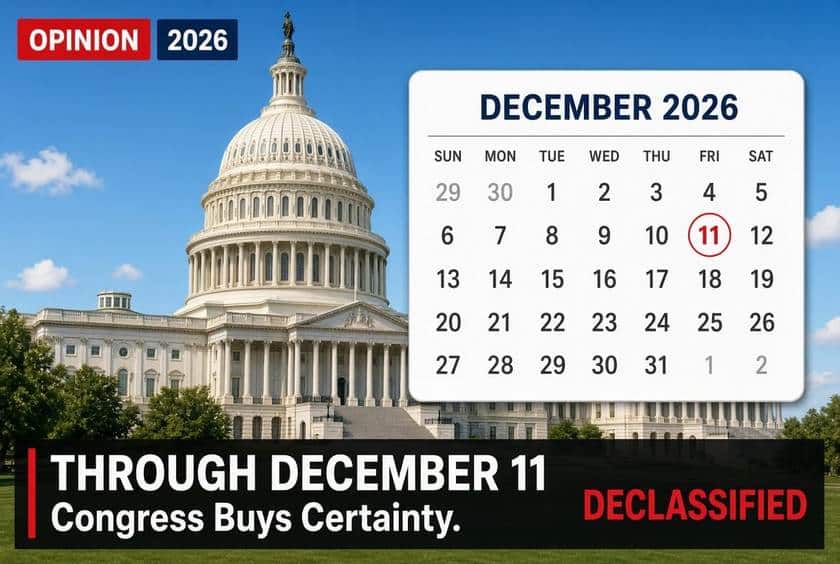
The Continuing Appropriations and Extensions Act, 2027, keeps the government funded at last year’s levels until Dec. 11. That covers 72 days of a 365-day fiscal year. Dec. 11 also happens to fall five and a half weeks after Election Day, which I’m told is a coincidence the way it’s a coincidence that the dentist appointment always lands after the candy holiday.
When the House passed the bill, the 12 regular spending bills for the new year were not close. Three had passed the full House. None had cleared the Senate Appropriations Committee, CBS News reported.
House Appropriations Chairman Tom Cole said the measure trades the old brinkmanship for “certainty.” He’s right. It is now certain that the government is funded through Dec. 11. Cole also told reporters to expect “crunch time” in December, ending in either a yearlong stopgap or a shutdown. So that’s certain too.
Four times since 1977
According to Pew Research Center, Congress has passed all of its spending bills on time four times since the current system started in fiscal 1977. The last time was fiscal 1997, which means anyone who remembers Congress doing it on time also remembers the Macarena. Since fiscal 1998, the final spending bill has become law an average of 117 days into the fiscal year. In 13 of the 15 fiscal years through last year, not a single regular bill was done by Oct. 1.
Last year went worse than average. The government shut down on Oct. 1, 2025, and stayed shut until Nov. 12, the longest shutdown on record. The last big package of fiscal 2026 bills became law on Feb. 3, 2026, after a second, four-day partial shutdown. By the time the year’s budget was finished, the year was more than a third over.
Measured against that, a stopgap passed in the summer by 90 votes is progress. It’s the kind of progress where you’re not late for work anymore because you called in sick ahead of time.
The case for passing the stopgap early
Here is the strongest argument for what Congress did, and it’s a good one. Shutdowns cost real money. The Congressional Budget Office estimated last fall that the 2025 shutdown would permanently cost the economy between $7 billion and $14 billion, depending on its length, and about $11 billion at six weeks. That money doesn’t come back when the lights come on. A stopgap passed two months early takes that risk off the table for federal workers, contractors and anyone waiting on a permit or a paycheck during a campaign season built for brinkmanship. Sen. Susan Collins praised the bill for carrying no “poison pills,” and a 90-to-6 vote on anything is rare enough to be worth something. If the realistic choice was a clean stopgap in August or a standoff in October, Congress picked the one that doesn’t hurt anybody. That’s a fair defense, and after last year, a persuasive one.
It’s still worth noticing what the choice was between. Nobody’s option in August was to pass the 12 bills. By then, the only live question was which kind of delay to have.
The bills will get done eventually. They always do, mostly, in a big package, some time after they were due. Until then the government has certainty, through Dec. 11, and after that it’ll have some more certainty. It just won’t be the same kind.
Sources:
- H.R. 6500, Continuing Appropriations and Extensions Act, 2027 (enrolled bill), GovInfo
- CBS News, “Senate approves bill to fund government into December,” Aug. 8, 2026
- CBS News, “Congress passes funding bill to avoid October shutdown, pushing fight past midterms,” Sept. 1, 2026
- House Appropriations Committee, “House Sends Bill to President Trump’s Desk, Averts Partisan October Shutdown,” Sept. 1, 2026
- ACCT, “Congress Passes Extension through December 11,” Sept. 3, 2026
- Pew Research Center, “Congress has long struggled to pass spending bills on time,” Oct. 1, 2025
- Congressional Budget Office, “A Quantitative Analysis of the Effects of the Government Shutdown on the Economy Under Three Scenarios,” Oct. 29, 2025
- Congressional Research Service, “The 2025 (FY2026) Government Shutdown: Economic Effects”
- GovTrack, H.R. 7148, Consolidated Appropriations Act, 2026 (enacted Feb. 3, 2026)