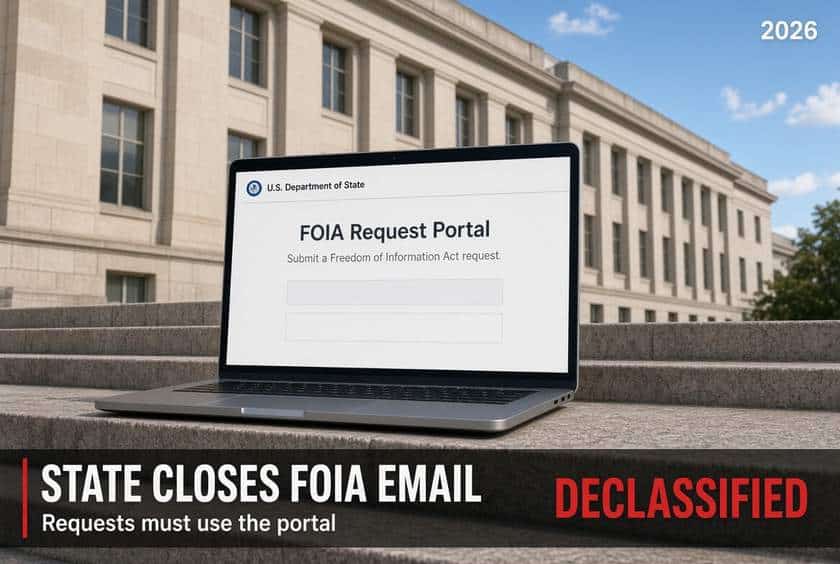
WASHINGTON — Freedom of Information Act requests sent to the State Department by email will no longer be accepted after October 20. A final rule published in the Federal Register on September 21 says the department “will only accept electronic FOIA and Privacy Act request submissions” through FOIA.gov or its own FOIA website.
State joins the Department of Homeland Security, which closed its email inbox to FOIA requesters in January, and the Federal Trade Commission, which did so on September 24. None of the three took public comment before making the change.
State held about 8 percent of the federal government’s 339,671 backlogged FOIA requests at the end of fiscal 2025, according to the Justice Department’s annual FOIA summary.
Three agencies close the inbox, one keeps it open
We compared four FOIA rules published in the Federal Register since December. Three drop email. The fourth, from the U.S. Access Board, keeps it.
| Agency | In effect | Email requests | What remains |
|---|---|---|---|
| Homeland Security | Jan. 22, 2026 | Ended | DHS web portal or other approved websites; mail and fax also generally ended, with exceptions for requesters without internet access |
| U.S. Access Board | Sept. 23, 2026 | Kept | Email, FOIA.gov or postal mail |
| Federal Trade Commission | Sept. 24, 2026 | Ended | FTC portal, FOIA.gov or postal mail; fax also ended |
| State | Oct. 21, 2026 | Ended | State’s FOIA website, FOIA.gov or postal mail |
The State rule has two exceptions. Requests for records of State’s Office of Inspector General can still be made by email, as can Privacy Act requests to amend or correct a person’s records.
Each agency cited data entry
All three agencies gave the same reason. Portal forms collect the details a request needs and feed them straight into case-tracking systems, so staff spend less time typing.
The State rule says its changes aim to increase efficiency “by reducing the need to manually enter data into the Department’s case management system.” DHS said the shift would let its FOIA staff “spend less time on data entry and administrative tasks” and more time searching and reviewing records. The FTC said requests sent through the portals “are automatically received” by the commission. It called fax “a rarely used transmission method.”
All three published as final rules without a comment period. State and the FTC said the changes concern agency procedure, which the Administrative Procedure Act exempts from notice and comment. DHS cited the same exemption and added a finding that comment was “unnecessary,” saying “the vast majority of requesters” already use its portal. The Access Board did take comments. It received eight and revised its rule on response timing and expedited processing, among other points.
The national portal Congress created in 2016
FOIA.gov, which every one of the four rules names, exists because of the FOIA Improvement Act of 2016. That law required a single website where the public could file a request with any agency, the FTC rule notes.
The State rule makes other changes. It asks requesters to search the department’s FOIA Library before filing, citing State’s “release-to-one, release-to-all” policy. It consolidates the rules for describing the records sought, such as visa records, and for verifying identity on Privacy Act requests. Requesters must still give a phone number, email address or mailing address so the department can reach them.
In August, State settled a lawsuit over FOIA delays brought by law professor Ryan Scoville, agreeing to ask the National Archives’ FOIA ombudsman to review its FOIA operations. We covered that agreement in State Department Settles FOIA Delay Suit With a Non-Binding Backlog Review.
What’s next: The State rule takes effect October 21. Agencies’ annual FOIA reports for fiscal 2026 are due to the Justice Department’s Office of Information Policy by November 13.
Primary source: Department of State, “Public Access to Information,” final rule, 22 CFR part 171 (Sept. 21, 2026).
Sources
- Department of State, “Public Access to Information,” Federal Register document 2026-19223 (Sept. 21, 2026). Used for: State’s new submission rules, exceptions, stated reasons, the notice-and-comment exemption and other changes.
- Department of Homeland Security, final rule on FOIA and Privacy Act request procedures (published as “Privacy Act of 1974”), Federal Register document 2025-23783 (Dec. 23, 2025). Used for: DHS’s portal requirement, effective date, reasons and good-cause finding.
- Federal Trade Commission, “Rules of Practice,” Federal Register document 2026-19597 (Sept. 24, 2026). Used for: the FTC’s removal of email and fax, its reasons and the FOIA Improvement Act background.
- U.S. Access Board, “Revision of Freedom of Information Act Regulations,” Federal Register document 2026-19448 (Sept. 23, 2026). Used for: the Access Board’s retained email option and comment process.
- U.S. Department of Justice, Office of Information Policy, “2025 Annual FOIA Report Summary” (July 1, 2026). Used for: the government-wide backlog and State’s share.
- U.S. Department of Justice, Office of Information Policy, “Announcing Upcoming FOIA Reporting Deadlines” (Sept. 30, 2026). Used for: the Nov. 13 annual report deadline.
- FOIA Advisor, “Monthly Roundup: September 2026” (Sept. 27, 2026). Used for: locating the State, FTC and Access Board rules.
Filed under: U.S. Department of State