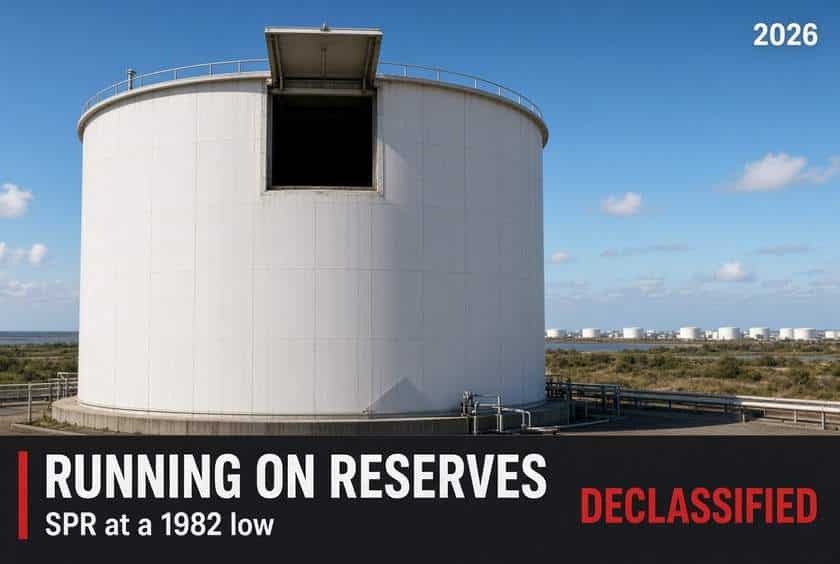
On Friday, Oct. 2, the U.S. Strategic Petroleum Reserve held 282,983,000 barrels of crude oil. That is the lowest weekly figure since October 1982, according to the Energy Information Administration’s own data, and about 132 million barrels below where the reserve stood in mid-March, when the first emergency barrels began to flow.
The number explains a good deal about the oil crisis now in its eighth month. Since the U.S. war with Iran began on Feb. 28, the world has made up much of the oil it can’t get out of the Persian Gulf by drawing on what it had stored. The agencies that track that oil, and the chief executive of Saudi Aramco, now say the cushion is getting thin.
“Scarily thin” was how Saudi Aramco chief executive Amin Nasser put it on Monday, Oct. 5, speaking at the Energy Intelligence Forum in London, according to Kuwait Times, which carried the agencies’ report, and Fortune. Two days later, member governments of the International Energy Agency backed speeding up the stock releases they had already promised.
How much Gulf oil is still offline
Less than at any point since the war began, by the EIA’s estimate. In its October Short-Term Energy Outlook, published Oct. 6, the agency put crude oil production shut in by the Hormuz disruption at 4.8 million barrels a day in September. That is down from 5.8 million in August and from a peak of 10.9 million in May.
The EIA’s country-by-country estimate shows where the losses sit now:
| Country | Feb. 2026 output (b/d) | Shut in, Sept. (b/d) |
|---|---|---|
| Saudi Arabia | 10,500,000 | 1,700,000 |
| Iran | 3,390,000 | 1,200,000 |
| Kuwait | 2,560,000 | 930,000 |
| Iraq | 4,400,000 | 760,000 |
| Qatar | 557,000 | 100,000 |
| Bahrain | 193,000 | 80,000 |
| UAE | 3,600,000 | 0 |
| Total | 25,200,000 | 4,770,000 |
The IEA’s September Oil Market Report, published Sept. 11, describes a larger gap. It says “more than 10 mb/d of Gulf output” was still shut in during August and puts Gulf oil exports that month at around 13 million barrels a day, nearly half their pre-war level. The two agencies are not measuring the same thing. The EIA’s table counts crude production only. The IEA’s figures refer to Gulf output and total oil exports, refined products included. By the IEA’s count, crude export losses had narrowed to just below 45 percent in August, while exports of refined products and liquefied petroleum gas were still nearly 60 percent below February. Net diesel exports from the Gulf were just over a quarter of pre-war levels.
The picture has moved since both reports. Middle East oil exports excluding Iran surpassed pre-war levels in the week before Oct. 5, according to the ship-tracking firm Kpler, as cited by Kuwait Times. Kpler said 40 percent of the region’s exports now bypass the Strait of Hormuz. That bypass has its own risks. Attacks on Saudi Arabia’s East-West pipeline in September temporarily halted flows on a line the EIA estimates had been carrying more than 5 million barrels a day to the Red Sea port of Yanbu. It partially resumed on Sept. 22.
The stockpile math
On March 11, IEA members agreed to make 400 million barrels of emergency oil available, the largest coordinated release in the agency’s history. By March 19, pledges totaled 426 million barrels. The U.S. share was 172.2 million, all from the Strategic Petroleum Reserve.
Those barrels have not all arrived. In a statement after the Oct. 7 meeting, IEA Executive Director Fatih Birol said about 325 million barrels had been released so far, with some countries releasing more than they pledged. Completing the rest would bring roughly 100 million more barrels to market. Reuters reported that analysts and some governments said this did not necessarily amount to a new intervention of that size.
Energy Secretary Chris Wright pointed at Europe. In a Sept. 29 Department of Energy statement, he said the United States and Japan were delivering on their commitments while “several European member countries have released only a fraction” of what they pledged. The IEA’s Oct. 7 statement does not break releases down by country.
Commercial and government inventories together have taken the strain. The IEA counts a 507-million-barrel fall in global observed oil inventories from February through August, an average of 2.8 million barrels a day. August alone saw a drop of 95 million barrels. The draw was uneven. Stocks outside the OECD, led by China, fell by 52 million barrels in August, while OECD stocks rose by 23 million.
The IEA says its members still hold about 1.1 billion barrels in publicly held emergency stocks, including more than 200 million barrels of diesel, and that it “stands ready” to release more. Nasser urged caution about headline reserve figures. Much of what countries report is the minimum volume needed to keep storage systems working, he said, according to Kuwait Times.
What the U.S. reserve has left
The weekly data show the U.S. drawdown in two phases. Withdrawals peaked at nearly 10 million barrels a week in May. Since early September they have run below 1 million barrels a week, leaving 282.98 million on Oct. 2.
Most of the U.S. pledge has now gone out. The Department of Energy said on Sept. 29 that it had awarded 133 million barrels across five earlier solicitations. It then offered up to 40 million more as an exchange, to be delivered in November and December, describing the offer as continuing the 172-million-barrel release. With the 133 million already awarded, it would complete the U.S. pledge. Several outlets reported it as an additional release. Bids were due Oct. 6, and we found no announcement of the results as of Oct. 8.
Exchanges are loans, not sales. Companies that take the oil must return it later with extra barrels. DOE says earlier exchanges returned a 25 percent premium. Demand for them has varied. A 40-million-barrel offer in June drew a commitment from one company for about 500,000 barrels, the Oil & Gas Journal reported.
The reserve’s ability to move oil was strained before this year’s drawdown began. The GAO, in a report published in May and made public in June, said that “the SPR’s operational capability to meet mission demands is at risk.” As of December 2025, DOE estimated the reserve could draw oil at 61 percent of its design rate and refill at 56 percent, and DOE attributed the shortfall to construction outages, aging infrastructure and low inventory.
What crude and fuel cost now
There are two prices for Brent crude right now, and they are far apart. Brent futures, the contract most headlines quote, settled at $100.20 a barrel on Oct. 7, Reuters reported. The EIA’s daily spot price for physical Brent cargoes was $125.44 on Oct. 6, the most recent day published. Futures settled at $100.58 that day, a gap of nearly $25.
The EIA explained a similar gap in April. Buyers scrambling to replace oil stuck behind Hormuz show up first in prices for prompt physical cargoes, it wrote, while futures price oil for later delivery. Spot Brent’s highest close of the year, $138.21, came on April 7. Its second highest, $135.51, came on Oct. 2. In February, before the war, spot Brent traded between about $68 and $73.
Prices at the pump have followed, and diesel has risen furthest. The EIA’s weekly survey shows:
| Fuel | Feb. 23 | Oct. 5 | Change |
|---|---|---|---|
| Regular gasoline | $3.07 | $4.50 | +46% |
| Diesel | $3.81 | $6.20 | +63% |
Diesel’s record in the EIA series was $6.53 a gallon, on Sept. 21. The IEA reported that U.S. diesel prices passed $200 a barrel in early September, 94 percent above pre-war levels. Our earlier analysis of why refining, not crude, has driven diesel breaks that gap down.
Where the shortfall lands this winter
The tightest spot in the U.S. is the East Coast, which uses more diesel and heating oil than its refineries make. The EIA says distillate inventories there were 32 percent below their 2021–2025 average for September. It expects them to stay 20 to 30 percent below average through the winter, because low global stocks will make it hard for importers to bring in more.
That matters most for the roughly 3 percent of U.S. households, mostly in the Northeast, that heat with oil. The EIA’s Winter Fuels Outlook puts heating oil prices up more than 30 percent from last winter. It expects spending on heating oil to rise about 21 percent, offset partly by a forecast for a milder Northeast winter. Households that heat with natural gas or propane, about half the country, are expected to spend less than last winter.
What the forecasters expect
The EIA raised its price forecast this month. It now expects Brent spot to average $105 a barrel in the fourth quarter, $14 more than it forecast in September, falling to $87 by the second quarter of 2027 and $74 by the end of next year. It expects crude shut-ins to average 4.5 million barrels a day this quarter and 2.7 million in the first quarter of 2027, with most Gulf production back to pre-war levels by the end of next June. It expects retail diesel to stay above $6 a gallon in October.
Two caveats come from the EIA itself. Its model inputs were finalized on Oct. 1, so the forecast does not account for the G7’s Oct. 2 agreement to release 100 million barrels of crude and refined fuel, which we covered in our executive brief. And it warns that continued attacks are likely to produce more short-term price swings than its forecast shows.
The IEA, in September, forecast that world oil demand would fall by 2.5 million barrels a day this year, with losses concentrated in middle distillates such as diesel and jet fuel, and in petrochemical feedstocks, especially in Asia. It deferred the expected recovery in Gulf supply to 2027.
Still developing
Several pieces of this picture will change within days. The IEA’s Governing Board meets next week, according to the Oct. 7 statement. DOE has not yet said how many of the 40 million exchange barrels were taken. Reuters reported on Oct. 7 that forecasters expected a storm forming in the Gulf of Mexico to become the season’s first Atlantic hurricane and likely to hit oil and gas facilities. Citing the EIA, Reuters said Gulf of Mexico wells produced 2.05 million barrels a day in September, around 15 percent of U.S. crude output. And attacks on tankers around Hormuz hit their highest weekly count of the war in the week to Oct. 5, as we reported Oct. 7.
Sources
- EIA, weekly U.S. ending stocks of crude oil in the SPR. Used for: the Oct. 2 level, the March level, the 1982 comparison and the weekly drawdown pace.
- EIA, Short-Term Energy Outlook, October 2026 (PDF, Oct. 6, 2026). Used for: shut-in estimates and the country table, the East-West pipeline, East Coast distillate inventories, the winter heating outlook and the price forecasts.
- EIA, Europe Brent spot price FOB, daily. Used for: spot prices on Oct. 6 and Oct. 2, the April 7 high and February levels.
- EIA, “Brent crude oil spot prices surge past futures price in April” (April 24, 2026). Used for: why spot and futures prices diverged.
- EIA, weekly U.S. regular gasoline retail price and weekly U.S. diesel retail price. Used for: the price table and the diesel record.
- IEA, Oil Market Report, September 2026 (Sept. 11, 2026). Used for: Gulf output and exports, inventory draws, demand forecast and diesel prices.
- IEA, statement by the Executive Director on the Oct. 7, 2026, meeting of member governments. Used for: barrels released, barrels outstanding and remaining public stocks.
- IEA, member country contributions to the collective action (March 19, 2026). Used for: the 426-million-barrel pledge total and the U.S. share.
- U.S. Department of Energy, “The United States Energy Department Continues Execution of Strategic Reserve Release Commitments” (Sept. 29, 2026). Used for: the 40-million-barrel exchange, the 133 million barrels awarded, the 25 percent premium and Secretary Wright’s statement.
- GAO, “Energy Security: Congress and DOE Need a Unified Plan to Align Priorities and Investments for the Strategic Petroleum Reserve,” GAO-26-106918 (May 2026). Used for: operational risk and drawdown and fill capability.
- Reuters, “Oil prices settle down as IEA agrees to accelerate oil stock release” (Oct. 7, 2026), via Yahoo Finance. Used for: futures settlements, the reaction to the IEA decision and the Gulf of Mexico storm.
- Kuwait Times (agencies), “Mideast oil exports top pre-war levels, but stockpiles ‘thin'” (Oct. 5, 2026). Used for: Nasser’s remarks and Kpler’s export data.
- Fortune, U.S. Strategic Petroleum Reserve report (Oct. 5, 2026). Used for: Nasser’s remarks (second source).
- Oil & Gas Journal, “US seeks to release another 40 million bbl from SPR despite low inventory levels”. Used for: the result of the June exchange offer.