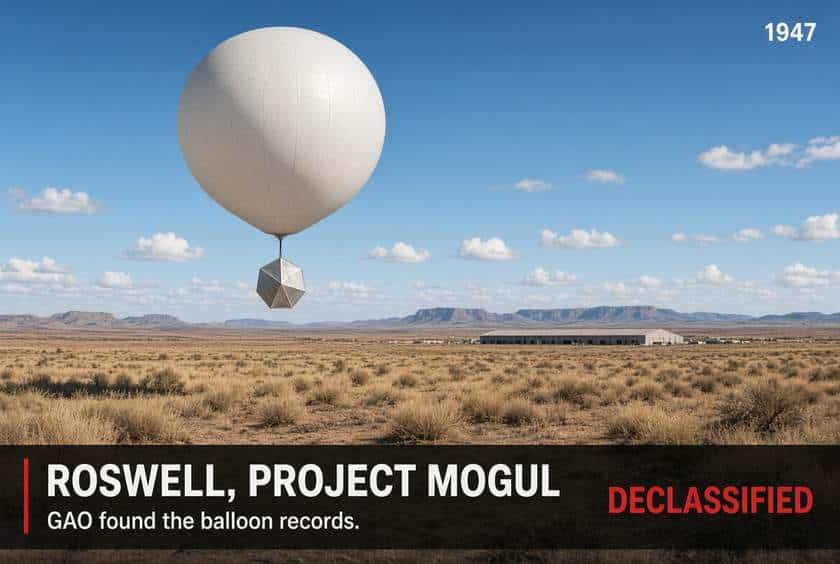
The Roswell Incident is the name given to the recovery of balloon debris on a New Mexico ranch in the summer of 1947 and to the claims that grew from it over the following five decades. The government’s documentary record of the event is small. A 1995 search by the General Accounting Office (GAO), conducted at the request of Rep. Steven H. Schiff of New Mexico, found only two government records originating in 1947 that refer to it. It also found that a block of records from Roswell Army Air Field covering the same period had been destroyed, with no record of who destroyed them or under what authority (GAO, NSIAD-95-187, July 28, 1995).
The recovery and the two announcements, July 1947
In June 1947, a rancher found debris on a ranch about 75 miles northwest of Roswell, during what the Air Force later described as the first wave of flying saucer reports in the United States (Air Force, The Roswell Report: Case Closed, 1997, Section One). The Roswell Daily Record of July 9, 1947, identified him as W. W. Brazel, 48, who operated the J. B. Foster ranch southeast of Corona.
According to the paper, Brazel and his son came upon the wreckage on June 14, describing it as “rubber strips, tinfoil, a rather tough paper and sticks,” and returned on July 4 to gather it. After hearing reports of flying disks, he told Sheriff George Wilcox in Roswell, who contacted Roswell Army Air Field. Maj. Jesse A. Marcel went to the ranch to collect the remaining pieces (Roswell Daily Record, July 9, 1947, transcribed in Case Closed, Fig. 7).
On July 8, 1947, the public information office at Roswell Army Air Field reported the crash and recovery of a “flying disc,” crediting personnel of the 509th Bomb Group. The following day, the press reported that the commanding general of the Eighth Air Force, at Fort Worth, Texas, had announced that the object was a radar-tracking weather balloon (GAO, NSIAD-95-187, Letter).
The two 1947 records located by GAO date from these days. The first is a teletype sent on July 8, 1947, by the FBI office in Dallas to FBI headquarters and the Cincinnati field office. It reports that an Eighth Air Force headquarters official had informed the Dallas office by telephone of the recovery near Roswell of a hexagonal disc suspended by cable from a large balloon, that the disc and balloon were being sent to Wright Field, Ohio, for examination, and that the object resembled a high-altitude weather balloon with a radar reflector. It states that the FBI was conducting no further investigation. An FBI spokesperson confirmed the message’s authenticity to GAO, and a Dallas office abstract of July 12, 1947, summarized it (GAO, NSIAD-95-187, “Search for Records”; FBI, Roswell UFO file).
The second is the combined history of the 509th Bomb Group and Roswell Army Air Field for July 1947. It records that the base public information office “was kept quite busy” answering inquiries on the “flying disc,” and that “the object turned out to be a radar tracking balloon.” The base commander certified the history as a complete and accurate account of the month (GAO, NSIAD-95-187, “Search for Records” and Appendix I).
Both 1947 records describe a balloon.
Project Mogul
The Air Force’s 1994 research identified the most likely source of the debris as a balloon train from Project Mogul (GAO, NSIAD-95-187, “Department of Defense”). Mogul was an Army Air Forces effort to detect Soviet nuclear explosions and ballistic missile launches acoustically, using sensors carried on trains of balloons more than 600 feet long. The trains also carried ML-307B/AP radar targets, built of aluminized paper glued and taped to balsa wood frames, so that they could be tracked by radar (Case Closed, Section One). Charles B. Moore, the New York University project engineer under contract to the Army Air Forces, launched the train associated with the Roswell debris on June 4, 1947 (Case Closed, Fig. 10 caption).
The two later government accounts describe Mogul’s secrecy differently. GAO’s 1995 report calls it “a highly classified U.S. effort” at the time of the recovery. The Air Force’s 1997 report states that most Mogul records, including those that identified the 1947 debris, described balloon research that was never classified, and that records on the military use of the acoustic sensors were declassified under Executive Order 11652 of March 6, 1972 (GAO, NSIAD-95-187; Case Closed, Introduction).
The GAO search, 1994 to 1995
Schiff asked GAO to determine the requirements in 1947 for reporting air accidents similar to the Roswell crash and to identify any government records about it. GAO conducted the review from March 1994 to June 1995 at locations including the National Archives, the National Personnel Records Center in St. Louis, the Air Force Safety Agency, and the headquarters of the FBI, CIA and National Security Agency (GAO, NSIAD-95-187, “Scope and Methodology”).
| Question | GAO finding |
|---|---|
| Accident reports | Army regulations in 1947 required air accident reports to be kept permanently. Four Army Air Forces accidents were reported in New Mexico in July 1947, all after July 8, at or near Hobbs, Albuquerque, Carrizozo and Alamogordo. No report was filed on Roswell, and Air Force officials said none was required for a weather balloon. |
| Destroyed records | Roswell Army Air Field administrative records from March 1945 to December 1949 and outgoing messages from October 1946 to December 1949 had been destroyed. The disposition form did not show who destroyed them, when, or under what authority. |
| Wright Field | Air Materiel Command records from 1947 to 1950 contained no mention of the crash or of any examination of debris from it. |
| Other agencies | The National Security Council, the White House Office of Science and Technology Policy and the Department of Energy reported no records. The CIA reported on May 30, 1995, that a search for “Roswell, New Mexico” across all of its databases produced no documents related to the crash. |
| Blue Book | Project Blue Book Special Report No. 14, the Air Force analysis of sightings from 1946 to 1953, did not mention the crash. |
On the destroyed records, the chief archivist of the National Personnel Records Center told GAO that, in his experience, many Air Force organizational records of the period were destroyed without a citation of the governing disposition authority. GAO noted that destruction forms for other records, including Roswell’s outgoing messages for 1950, supported that account. GAO’s report adds that “some records we wanted to review were missing and there was not always an explanation,” and that it did not independently verify the written responses it received from agencies (GAO, NSIAD-95-187, “Search for Records” and “Scope and Methodology”).
The CIA’s response contained a qualification. In March 1995, the agency’s executive director told GAO that earlier CIA searches on unidentified flying objects had found nothing on Roswell, but that it was unclear whether the CIA had ever searched specifically for Roswell records. The May 1995 database search followed (GAO, NSIAD-95-187, “Central Intelligence Agency”).
The Air Force reports of 1994 and 1997
The Air Force completed its research in July 1994 and published it, with supporting documents, as The Roswell Report: Fact vs. Fiction in the New Mexico Desert in 1995. The work was conducted by Col. Richard L. Weaver and 1st Lt. James McAndrew. It concluded that the Army Air Forces had recovered material near Roswell in July 1947 and that the material came from a Mogul balloon train. It did not examine claims of bodies at length (Case Closed, Introduction and author note).
Those claims are the subject of the second report, The Roswell Report: Case Closed, written by McAndrew and published in 1997. According to that report, accounts of alien bodies first appeared in the late 1970s and were based largely on second- and third-hand recollections gathered decades later. The report cites Charles Berlitz and William L. Moore’s 1980 book The Roswell Incident among the sources of those accounts (Case Closed, Section One and notes).
Case Closed reached four conclusions. Air Force activities spanning many years had been compressed into accounts of two or three days in July 1947. The “aliens” described in the desert were probably anthropomorphic test dummies carried aloft by Air Force research balloons. The military recovery operations described by witnesses matched dummy and balloon recovery crews. Reports of bodies at the base hospital were most likely a combination of a 1956 KC-97 accident, in which 11 Air Force members were killed, and a 1959 manned balloon mishap, in which two Air Force pilots were injured (Case Closed, Introduction).
The dummy program the report relies on did not exist in 1947. The Air Force Aero Medical Laboratory used anthropomorphic dummies in high-altitude escape research, including Projects High Dive and Excelsior, from 1953 to 1959. Forty-three high-altitude balloon flights carrying 67 dummies were launched and recovered in New Mexico between June 1954 and February 1959 (Case Closed, Section 1.2). The report attributes the gap in dates to errors in the witness accounts, which it says placed events from the 1950s in 1947.
Roswell Project Mogul and the Missing Base Records
Sources
- U.S. General Accounting Office, Government Records: Results of a Search for Records Concerning the 1947 Crash Near Roswell, New Mexico, GAO/NSIAD-95-187 (July 28, 1995). Also at gao.gov.
- Federal Bureau of Investigation, Dallas office teletype to the Director and SAC Cincinnati, July 8, 1947 (FBI Vault, “Roswell UFO”). Reproduced as Appendix II of the GAO report.
- Headquarters, U.S. Air Force, The Roswell Report: Case Closed, by Capt. James McAndrew (Washington: U.S. Government Printing Office, 1997), full text via Project Gutenberg. Includes a transcription of the Roswell Daily Record, July 9, 1947.
- Headquarters, U.S. Air Force, The Roswell Report: Fact vs. Fiction in the New Mexico Desert, by Col. Richard L. Weaver and 1st Lt. James McAndrew (Washington: U.S. Government Printing Office, 1995), GPO Stock No. 008-070-00697-9. Contains the July 1994 Report of Air Force Research Regarding the Roswell Incident; cited here through the GAO report and Case Closed.
- University of North Texas Libraries, “75 Years after the Roswell Incident, What Have We Learned?” (July 7, 2022). Guide to the government publications on the incident.