OPINION
When Donald Trump first called Canada the “51st state,” plenty of Canadians laughed. Nearly two years later, nobody in Ottawa is laughing.
Taken one at a time, each American move against Canada can be explained away as hardball trade politics. Taken together, they describe something else: a sustained effort to weaken Canada, cut off its alternatives, and leave it supplying raw materials to an economy that keeps the factories.
Anne Applebaum makes a version of this argument in her article in The Atlantic’s October issue, which describes American foreign policy turning into an instrument of private gain and ideological reach. Speaking with historian Timothy Snyder, she was blunter about Canada: as she understands it, the aim is to weaken Canada’s economy, break up the country if possible, and absorb parts of it. Look at the record, and her reading is hard to dismiss.
Start with what Washington says. Trump has named his instrument: “economic force.” He calls Canada’s prime minister a “governor.” Last year he offered Canada a place in his Golden Dome missile shield for $61 billion, or for nothing if Canada became the 51st state. His National Security Strategy pledges to enforce the Monroe Doctrine and secure American access to strategic territory across the hemisphere. After the raid on Venezuela, he embraced a name for it: the “Donroe Doctrine.”
Then look at what Washington does. Tariffs remain on Canadian steel, aluminum, autos and lumber. In July, the White House dusted off a Depression-era statute to impose 50 per cent tariffs on Canadian wine, cement and hockey sticks. Last year, the threat of tariffs was enough to make Ottawa scrap its digital services tax, a Canadian policy effectively decided in Washington. On July 1, while Canada and Mexico asked to renew CUSMA for another 16 years, the United States refused. The continent’s core trade agreement now goes under review every year until 2036. That isn’t a negotiation; it’s a leash.
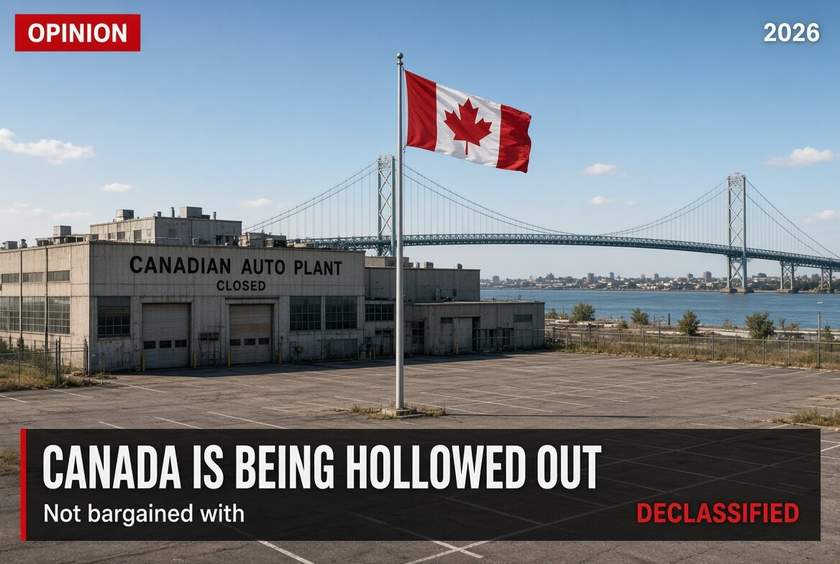
Meanwhile, the factories are moving. Stellantis took Jeep Compass production from Brampton to Illinois. GM shifted Silverado work from Oshawa to Indiana. Bringing manufacturing home is Trump’s signature promise, and he is keeping it at Canada’s expense.
Now watch what happens when Canada looks for other partners. When Ottawa moved toward a limited deal admitting some Chinese electric vehicles, Trump vowed not to let the Gordie Howe bridge open, a $6.4-billion crossing Canada paid for entirely, until the U.S. was “fully compensated” and owned, perhaps, “at least one half” of it. The bridge opened in July only after Ottawa agreed to split its net toll profits with the United States for 15 years once its costs are repaid. Yet by China’s count, the United States and China still traded about $560 billion in goods last year, and in September Trump said he’d be fine with Chinese automakers building plants on American soil. The problem isn’t China. It’s Canada choosing for itself.
Follow the money, too. Applebaum’s central claim is that this administration uses public power for private gain. The family that owns the Ambassador Bridge, the aging crossing that has carried about a quarter of Canada–U.S. trade, fought the Gordie Howe bridge for decades to protect its tolls. On January 16, Matthew Moroun gave $1 million to MAGA Inc., the super PAC backing Trump. In February, he reportedly met Commerce Secretary Howard Lutnick hours before Trump’s threat to block the bridge. The U.S. ambassador to Canada denies the donation had anything to do with it. But when public policy lines up this neatly with a private interest, Canadians are entitled to ask whom it serves.
The pressure reaches into security as well. One of Trump’s closest advisers reportedly pushed to expel Canada from the Five Eyes intelligence alliance as a way to force concessions. He denied it, but the fact that the idea was floated at all shows how far the leverage is meant to go.
At home, Washington has opened a door to those who would break the country apart. State Department officials met repeatedly with Alberta separatists, and Treasury Secretary Scott Bessent called the province “a natural partner for the U.S.” Alberta’s grievances with Ottawa are real and homegrown, and American officials say they promised nothing. But no previous administration would have entertained a close ally’s secessionists at all.
Why would Washington want a weaker Canada? Look at its record elsewhere in the hemisphere. In Venezuela, after removing Nicolás Maduro, it backed his unelected vice-president, declined to press for an election date, and secured majority U.S. government control over 65 billion barrels of oil. In Colombia, Trump endorsed a naturalized American citizen and Republican donor who, once in office, reopened oil exploration and signed a critical-minerals deal with Washington. Canada isn’t Venezuela or Colombia. But the priorities on display, political alignment in exchange for resources, are the same, and Canada has oil, critical minerals and vast reserves of fresh water.
Trump insists America doesn’t need Canada’s oil or lumber. Yet when he imposed his emergency tariffs last year, before the Supreme Court struck them down, Canadian energy and potash got a lower rate than almost everything else, and his administration justifies its steel, aluminum and lumber tariffs on national-security grounds. Greenland shows where that logic leads: first the resources are strategic, then they’re a security imperative, then a bill appears in Congress authorizing annexation. Saying you don’t need something is also the oldest way to pay less for it.
Piece by piece
None of this requires a secret master plan. It only requires taking the president at his word and noticing the direction of travel: manufacturing moving south, resources flowing south, Canada’s trade deal made conditional, its alternatives punished, its divisions courted. That is how a sovereign partner becomes a resource outpost, not in one dramatic move but piece by piece.
Canada’s own choices are part of the story. For decades the country sold most of what it makes to a single customer and was too slow to build the pipelines, ports and trade links that would have given it options. That dependence is exactly what makes this pressure work.
The answer that record points to is clarity, not panic. Ottawa can keep diversifying trade even when Washington objects, and it can build the refineries, plants and export routes that let Canada sell to the world rather than to one customer. And Canadians who disagree about Ottawa still share one fact worth keeping in view: the party that gains most from a Canada too divided to bargain as one is not in Canada.
Related: Glass Houses: Is Washington Deeper Into China Than Ottawa?
Sources
- Anne Applebaum, “MAGA Is Making the World Safe for Corruption,” The Atlantic, October 2026 issue
- Applebaum and Timothy Snyder on Canada (Hvylya)
- Trump threatens “economic force” to make Canada the 51st state (The Canadian Press via National Newswatch)
- Golden Dome offer of $61 billion or free as the 51st state (CBC)
- National Security Strategy and the “Donroe Doctrine” (ABC News via Yahoo)
- U.S. declines to renew CUSMA; annual reviews until 2036; sectoral tariffs on steel, aluminum, autos and lumber (Blakes)
- 50 per cent Section 338 tariffs on wine, cement and hockey sticks; Supreme Court ruling on the 2025 emergency tariffs (Cascadia Daily News)
- Canada rescinds its digital services tax to restart trade talks (CBC)
- Stellantis moves Jeep Compass production from Brampton to Illinois (Global News)
- GM moves production from Oshawa to Fort Wayne, Indiana (CBC/Radio Canada International)
- Gordie Howe bridge threat and the China EV deal (Detroit Free Press via Yahoo)
- Bridge opening, toll-profit sharing deal and $6.4-billion cost (BTPM/WBFO)
- Moroun’s $1-million MAGA Inc. donation and meeting with Lutnick (CTV News, citing The New York Times)
- U.S. ambassador Pete Hoekstra denies the donation delayed the bridge (Global News)
- Ambassador Bridge share of trade and the Moroun family’s opposition (Crain’s Detroit)
- China–U.S. trade of $560 billion in 2025, per China’s customs data (RSA)
- Trump open to Chinese automakers building U.S. plants (TimesLIVE)
- Five Eyes report and Navarro’s denial (Kyiv Post, citing the Financial Times)
- State Department meetings with Alberta separatists and Bessent’s remarks (The Hill)
- Venezuela oil deal and 65 billion barrels (NPR)
- Trump on Venezuelan elections (Los Angeles Times via Yahoo)
- Trump endorses De la Espriella (Colombia Reports)
- De la Espriella’s U.S. citizenship (Finance Colombia)
- De la Espriella’s donations to Trump and the Republican National Committee (BBC News Mundo)
- Colombia reopens oil exploration (MercoPress)
- Critical-minerals agreement with Rubio (AFP via China-Global South)
- Trump says the U.S. doesn’t need Canada’s oil, gas, autos or lumber (CBC)
- Lower 2025 tariff rates for Canadian energy and potash (Pillsbury)
- Greenland national-security framing and annexation bill (CBS News)