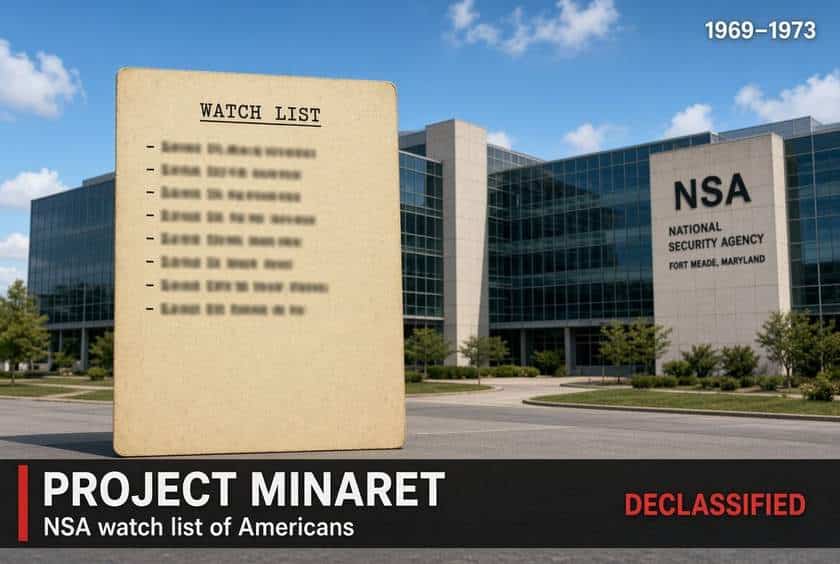
Project MINARET was the code name the National Security Agency gave in 1969 to its watch list of American citizens and organizations whose international communications it intercepted and reported to other agencies. The program grew out of a 1967 expansion of NSA’s watch lists and ran until the fall of 1973. Its targets included Martin Luther King Jr., Muhammad Ali, two sitting U.S. senators and two nationally known newspaper columnists. No warrants were obtained. The Senate’s Church Committee documented the program in 1975 and 1976, and the NSA’s own declassified history later described it as an operation its participants understood to be “disreputable if not outright illegal” (NSA, American Cryptology during the Cold War, Book III, p. 85).
Watch lists before 1967
From the early 1960s until 1973, NSA selected and disseminated intercepted international communications of named Americans and groups on the basis of lists supplied by other agencies (Church Committee, Book III, “National Security Agency Surveillance Affecting Americans,” p. 740). The earliest lists concerned possible threats to the president and drug traffickers (Electronic Briefing Book No. 441). From 1970, similar lists were used to gather intelligence on international drug traffic (Book III, p. 744), and the Bureau of Narcotics and Dangerous Drugs submitted about 450 American names for a separate drug watch list (Book III, p. 742).
The 1967 expansion and the “foreign influence” question
In 1967, amid antiwar protests and urban riots, President Lyndon Johnson asked whether the domestic antiwar movement was receiving help from abroad. He tasked CIA Director Richard Helms with finding out, and the CIA “came up with very little,” according to the NSA history (Book III, p. 85). The Army was assigned to monitor communications on the same question. On Oct. 20, 1967, Maj. Gen. William P. Yarborough, the Army’s assistant chief of staff for intelligence, asked NSA for help (NSA history, p. 85; Church Committee, Hearings, Vol. 5, Exhibit 1).
NSA responded by adding to its watch lists the names of individuals, groups and organizations involved in domestic antiwar and civil rights activity, “in an attempt to discover if there was ‘foreign influence’ on them” (Book III, p. 740). The FBI was the main source of names (NSA history, p. 85). The same presidential concern produced the CIA’s domestic program, Operation CHAOS (National Security Archive, Electronic Briefing Book No. 441).
The July 1969 MINARET charter
On July 1, 1969, an NSA assistant director issued a charter formally establishing Project MINARET (Book III, pp. 740, 749; charter reproduced in Hearings, Vol. 5, Exhibit 3). The charter covered information on foreign efforts to influence U.S. organizations or individuals “who may foment civil disturbance,” and on U.S. organizations or individuals whose activities “may result in civil disturbances or otherwise subvert the national security of the U.S.” It added that an “equally important aspect” of MINARET would be to “restrict the knowledge that such information is being collected and processed by the National Security Agency” (Book III, p. 749).
Under the charter, all communications to, from or mentioning U.S. citizens on the list were classified Top Secret, marked “For Background Use Only,” and issued without serial numbers or any identification with NSA (Book III, p. 749). The NSA history adds that the reports “were designed to look like HUMINT reports rather than SIGINT,” so that readers could not identify the originating agency (Book III, p. 85). Names were no longer accepted by telephone or word of mouth after 1969 (Book III, p. 750).
Scale of the program
Published totals for MINARET vary because sources count different lists at different points in time. The table reconciles the main figures.
| Figure | What it counts | Source |
|---|---|---|
| About 1,200 | Americans on the civil disturbance watch list, cumulative, 1967–1973 | Church Committee, Book III, p. 747 |
| About 950 | Of those, names submitted by the FBI | Book III, p. 747 |
| About 450 | Americans on the separate drug watch list | Book III, p. 742 |
| Over 1,600 | Total names on the watch list, as stated in NSA’s internal history | NSA history, Book III, p. 85 |
| 600 Americans, 6,000 foreigners | Names on the lists at their height, early 1973 | Book III, p. 748 |
| About 2,000 | Reports disseminated to other agencies; NSA estimated 10 percent came from communications between two Americans | Book III, pp. 744, 748 |
Other contributors to the civil disturbance list were the Secret Service (about 180 names), the Defense Intelligence Agency (20 Americans who had traveled to North Vietnam), the CIA (about 30) and the military investigative services. NSA itself contributed about 50 to 75 names (Book III, p. 748). The NSA history says NSA added 13 names on its own account, all but two of them agency employees who had defected or spied (Book III, p. 85).
The Church Committee found “no evidence … of any significant foreign support or control of domestic dissidents” in the material the watch lists produced (Book III, p. 744).
Named targets
The NSA history, in passages whose names were first declassified in July 2013 after an appeal by the National Security Archive to the Interagency Security Classification Appeals Panel, names several prominent Americans on the list (NSA history, Book III, p. 85; Electronic Briefing Book No. 441, Sept. 25, 2013):
- Martin Luther King Jr. and Whitney Young, civil rights leaders
- Muhammad Ali, heavyweight boxing champion
- Art Buchwald, Washington Post humor columnist, and Tom Wicker, New York Times columnist
- Sen. Frank Church (D-Idaho) and Sen. Howard Baker (R-Tenn.)
The Archive’s editors, Matthew M. Aid and William Burr, noted that King’s status as an NSA target had been known since the 1970s and that most of the named individuals had publicly criticized the Vietnam War. They described Baker, a supporter of the war, as the hardest case to explain (Electronic Briefing Book No. 441). Church later chaired the Senate committee that investigated the program.
Suspension and termination, 1973
Gen. Lew Allen Jr. learned of MINARET less than two weeks after becoming NSA director in 1973, from his chief lawyer, Roy Banner (NSA history, Book III, p. 85). Banner pointed to a federal ruling in a case involving members of the Weathermen that required agencies, including NSA, to disclose any illegal wiretaps of the defendants. In August 1973, Allen suspended dissemination of watch-list reports. In September he asked the submitting agencies to recertify their requests (Book III, p. 740).
Assistant Attorney General Henry Petersen had learned of the watch lists while checking for electronic surveillance connected to a criminal prosecution. He reported that the Justice Department had “no previous knowledge” of them, and in one case the government dropped a prosecution after NSA disclosed relevant surveillance (Book III, p. 740, n. 18). On Oct. 1, 1973, Attorney General Elliot Richardson wrote to Allen that the watch lists were of “questionable legality” (Book III, p. 740; Hearings, Vol. 5, Exhibit 7). NSA’s position in reply was that Americans’ communications had been collected “as an incidental and unintended act” of foreign intelligence collection. The civil disturbance and drug watch-list activity ended in 1973 (Book III, pp. 740, 756).
Disclosure and legacy
Allen described the watch lists in public testimony before the Church Committee on Oct. 29, 1975 (Church Committee, Hearings, Vol. 5). The committee’s account appeared in 1976 in Book III of its final report. MINARET and NSA’s separate SHAMROCK telegram program contributed to the case for congressional intelligence oversight and to the Foreign Intelligence Surveillance Act of 1978, which established a court to approve foreign intelligence surveillance inside the United States (Electronic Briefing Book No. 441). The full list of names had not been released as of the National Security Archive’s 2013 posting.
Project MINARET: The NSA’s Watch List of Americans, 1967–1973
Sources
- U.S. Senate, Select Committee to Study Governmental Operations with Respect to Intelligence Activities (Church Committee), Final Report, Book III: Supplementary Detailed Staff Reports on Intelligence Activities and the Rights of Americans, “National Security Agency Surveillance Affecting Americans,” pp. 733–783 (1976).
- Thomas R. Johnson, National Security Agency, American Cryptology during the Cold War, 1945–1989, Book III: Retrenchment and Reform, 1972–1980, p. 85, DOCID 523696, as released July 2013: declassified page.
- Matthew M. Aid and William Burr, eds., “‘Disreputable if Not Outright Illegal’: The National Security Agency versus Martin Luther King, Muhammad Ali, Art Buchwald, Frank Church, et al.,” National Security Archive Electronic Briefing Book No. 441 (Sept. 25, 2013).
- Church Committee, Hearings, Vol. 5: The National Security Agency and Fourth Amendment Rights (Oct.–Nov. 1975), including Exhibit 1 (Yarborough cable, Oct. 20, 1967), Exhibit 3 (MINARET charter, July 1, 1969) and Exhibit 7 (Richardson letter, Oct. 1, 1973), as cited in Book III.