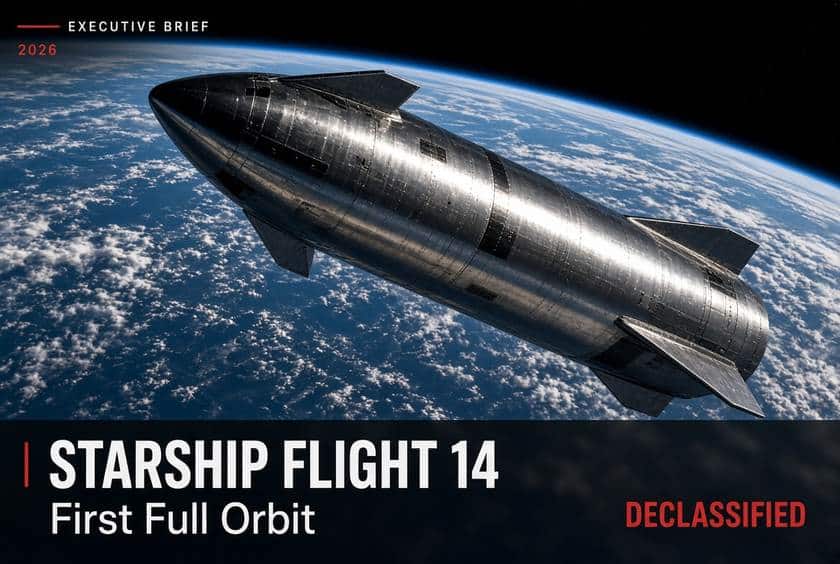
On Sept. 28, 2026, Starship, the giant SpaceX rocket that NASA is testing as a future moon lander, completed its first full orbit of Earth on its 14th test flight, deploying 26 Starlink V3 satellites before SpaceX cut the mission short over an engine problem.
SpaceX’s smaller Falcon 9 reaches orbit routinely; it flew the company’s 80th Starlink mission of the year on Sept. 6, according to Spaceflight Now. Earlier Starship test flights followed suborbital paths that fell short of a full orbit, ABC News and TechSpot reported.
Starship lifted off from Starbase, Texas, at 8:48 a.m. Eastern time. One of the ship’s six engines shut down early during the climb, but it entered orbit about 25 minutes after launch and released all 26 satellites over roughly half an hour, Payload reported.
SpaceX had planned a flight of about 10 hours and six orbits. “Out of an abundance of caution given the engine issue experienced during ascent,” the company said, flight controllers limited the time on orbit.
The ship splashed down in the Pacific north of Hawaii about three hours after liftoff, ABC News reported. The Super Heavy booster splashed down in the Gulf of Mexico, though TechSpot reported that two of its engines appeared to fail.
NASA restructured its Artemis moon program in February. Administrator Jared Isaacman announced that Artemis III will test rendezvous and docking with one or both commercial landers, from SpaceX and Blue Origin, in low Earth orbit, NBC News reported. Artemis IV, planned for 2028, is to become the program’s first crewed lunar landing, according to NASA.
Artemis III is scheduled to launch by mid-2027.
Correction, Sept. 30, 2026: An earlier version of this brief said SpaceX’s statement on the shortened flight was posted on X; the outlets that reported it do not say where it was published.
Sources
- TechSpot, “SpaceX’s Starship finally reaches orbit and puts 26 Starlink satellites into space,” Sept. 2026 (quotes SpaceX’s statement)
- ABC News, “SpaceX Starship splashes down after successful 1st orbital flight test,” Sept. 28, 2026
- Payload, “Starship Reaches Orbit on 14th Test Flight,” Sept. 28, 2026
- Spaceflight Now, SpaceX’s 80th Starlink mission of 2026, Sept. 6, 2026
- NASA on X, Artemis III and Artemis IV plans
- NBC News, “NASA announces major overhaul to its Artemis moon program,” Feb. 27, 2026
Filed under: SpaceX; NASA