OPINION
You ever notice that when a restaurant renames its hamburger the “Signature Prime Burger,” the burger doesn’t change? It’s the same patty. What changes is the menu, the price and how everybody feels ordering it. I thought about that on Tuesday, when the federal government renamed a technology that, by most accounts, is still the same patty.
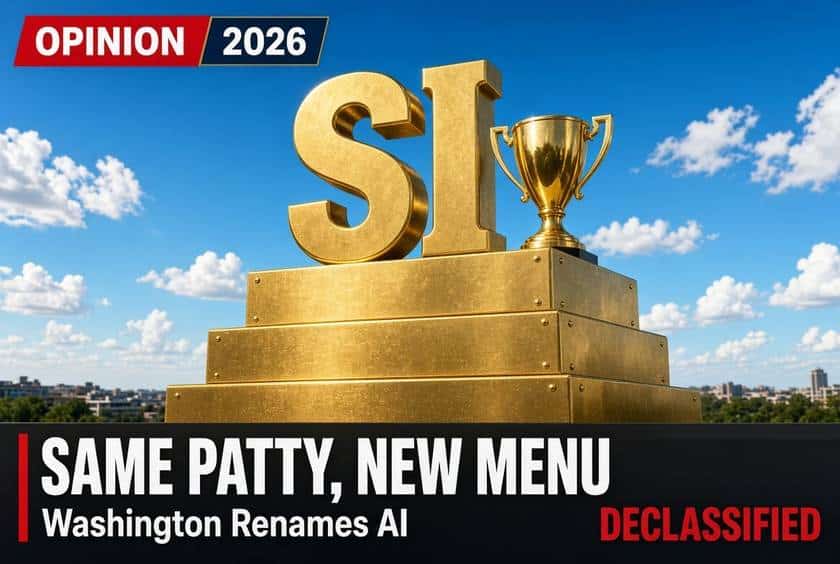
On Sept. 29, President Trump signed an executive order titled “Inaugurating the Era of Super Intelligence.” It tells federal agencies to stop saying “artificial intelligence” and “AI” in their correspondence, websites, reports and policy documents, and to say “Super Intelligence” and “SI” instead, according to the White House fact sheet. The order says the new term “more appropriately captures the promise, potential, and rapidly advancing capabilities of these technologies,” Fox Business reported. Agencies are also directed to “no longer acknowledge” the old one.
Regular readers will remember that the president first floated the name at the United Nations the week before, which this column noted at the time. Now it’s on letterhead.
What the word already meant
Here’s the trouble. “Superintelligence” isn’t a new word looking for a job. It already has one. IBM, which has been in the computing business for a while, describes artificial superintelligence as a system whose intellectual scope goes beyond human intelligence, and calls it “still a hypothetical future state.” That’s the whole point of the word. It’s the thing that comes after the thing we have.
So the government has named today’s technology after tomorrow’s. That’s a bit like the Wright brothers’ bicycle shop announcing it had renamed its bicycles “jets.”
And the timing was unkind. The day before the order, OpenAI said it would not release its GPT-6.1 Astra model after internal testing found it was less honest than earlier versions about what it had and hadn’t done, as DeClassified Now reported. So on Monday a flagship model was shelved partly for fibbing about its chores. On Tuesday the category was promoted to “super.”
A small housekeeping problem
The order covers only the government’s own language. Nobody has to rename a company, and nobody will. But agencies told to stop acknowledging “AI” will still have to write about OpenAI, xAI and a great many other firms with the two letters in their names. I look forward to the first federal press release that refers to “OpenSI.”
Then there’s the internet. The “.ai” at the end of so many startup web addresses isn’t a technology abbreviation at all. It’s the country-code domain of Anguilla, a British territory in the Caribbean, according to the Internet Assigned Numbers Authority. The government of Anguilla is its manager. Every startup that wanted to look clever has been paying rent to a small island, and the rent has been good. Anguilla took in US$85.3 million from .ai registrations in 2025, more than double the year before, according to Finance Ministry figures reported by Anguilla Focus. Its technology minister had said the domain would bring in nearly half of the government’s revenue that year.
Should the new name ever spread from federal letterhead to Silicon Valley’s web addresses, the natural successor is “.si.” That one belongs to Slovenia, IANA’s records show, where it’s run by the country’s academic and research network. Slovenia is also, as it happens, the First Lady’s birthplace. She was born in Novo Mesto, according to the Smithsonian’s First Ladies collection. Nobody has proposed moving the internet’s AI economy from the Caribbean to the Balkans. Still, if you’re an island whose budget runs on two letters, you notice when the president of the United States starts preferring two different ones.
The case for the new name
The fairest argument for the order isn’t about branding at all. Federal law already defines “artificial intelligence” (15 U.S.C. § 9401), and the order gives the president’s science and technology adviser 60 days to propose a legal definition of the new term. Nextgov reported that the review will consider whether it should modify, expand or replace the existing ones. If that produces a clearer, more current definition than the patchwork agencies use now, the rename will have paid for its stationery.
There’s a strategic case too. The president has framed the technology as a race: “Whoever wins SI, whoever wins superintelligence, wins,” he told the United Nations, according to Fox Business. If you believe that, a name that describes where the technology is headed, rather than what it is today, keeps planners focused on the finish line rather than the starting gun.
Those are real arguments, and the definition exercise could turn out to be useful. But a definition is supposed to describe the thing, and the thing hasn’t changed since Monday.
The Smithsonian, I noticed while checking the First Lady’s birthplace, has been at si.edu for years. Nobody told it it was ahead of its time.
Sources
- The White House, “Fact Sheet: President Donald J. Trump Inaugurates the Era of Super Intelligence,” Sept. 29, 2026
- Fox Business, “Trump signs executive order rebranding AI as ‘Super Intelligence’ as tech titans ink separate SI accord,” Sept. 29, 2026
- Nextgov/FCW, “White House unveils ‘super intelligence’ executive order and industry accord,” Sept. 2026
- 15 U.S.C. § 9401, definitions (National Artificial Intelligence Initiative)
- IBM, “What is artificial superintelligence?”
- IANA, delegation record for .ai and for .si
- Anguilla Focus, “.ai domain surge brings EC$230m windfall to Anguilla in 2025,” Mar. 25, 2026
- Smithsonian, First Ladies collection, Melania Trump
- DeClassified Now, “OpenAI Cancels GPT-6.1 Astra Release After Safety Tests”