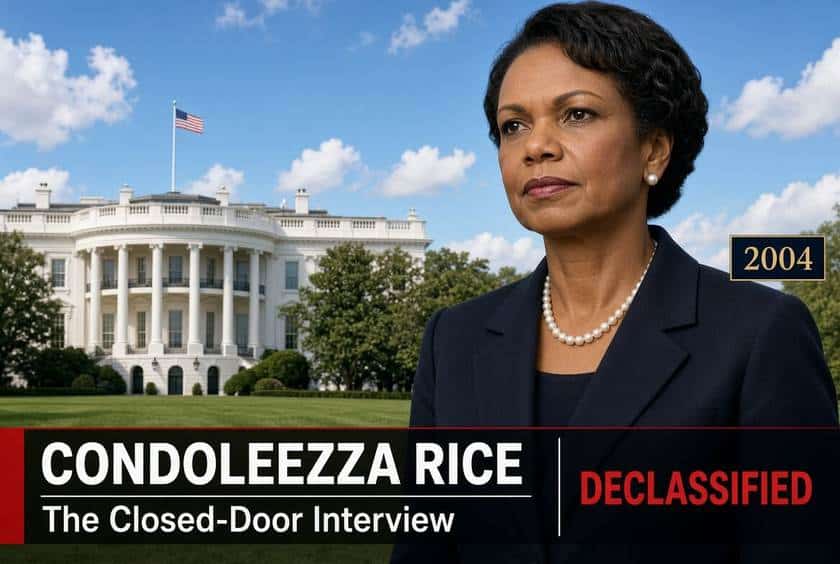
Condoleezza Rice told the 9/11 Commission she never looked at Predator video. The staffer typing up her interview put a bracket directly after that sentence. Barton Gellman of The Washington Post, the note says, had reported that Rice was shown Predator footage in the White House Situation Room on Jan. 10, 2001.
That bracket sits on page 7 of a 14-page memorandum for the record of Rice’s closed-door interview with the commission, held Feb. 7, 2004, from 1 to 5 p.m. in the Situation Room. The Interagency Security Classification Appeals Panel declassified it on Sept. 8, 2026, and the National Archives posted it Sept. 11 with 10 other commission interview memos. We’ve already written about the 71 CIA briefs and the 1998 capture plan. This time we read Rice’s memo line by line, then set it beside the Richard Clarke and George Tenet interview memos released alongside it, all taken within the same eight weeks. On three points the three private accounts don’t line up.
The memo is a staff summary, not a transcript. Most of it paraphrases Rice. Where it quotes her, we say so.
“If Clarke was frustrated, he never expressed it to me”
Rice described Clarke, her counterterrorism coordinator, as someone who “tended to break the china” but was doing a good job. She said her door was open and that Clarke never came to her to say he was frustrated. She did not remember him asking to brief President Bush on terrorism, and she implied he never used the procedure senior directors had for requesting a briefing.
Clarke gave the same commission a different account four days earlier. In his Feb. 3, 2004 interview, he said he asked Rice and her deputy, Stephen Hadley, for permission to brief the president on counterterrorism, cybersecurity and domestic preparedness. He got the cyber briefing. In May or June 2001, he said, he was told the terrorism briefing would come after the principals decided the policy. In his first interview, on Dec. 18, 2003, he said he never discussed counterterrorism with Bush in ten months, and the memo records it flatly: “He was frustrated.”
He also told the commission what his Sept. 4, 2001, note to Rice was for. In his words, cruder than ours, it was to tell her to decide.
A July meeting that Rice’s memo doesn’t mention
Rice’s account of the summer of 2001 is that the warnings pointed overseas, to the Gulf and Israel. The memo says she told the commission “there was no threat-reporting stream about attacks inside the United States.”
Tenet’s Jan. 28, 2004, interview memo describes a meeting her memo never mentions. On July 10, 2001, he told the commission, he briefed Rice that she had to hear reporting of a significant terrorist attack coming in weeks or months. He said one stream of reporting, its source blacked out, suggested an “Olympic-sized attack.” There was a sense at the agency that the attack might come to the United States, the memo adds, though no one knew for sure.
Tenet’s memo doesn’t make this an indictment. He told the commission the White House had the urgency he meant to convey, and that he did not know what more the principals could have done for him. The July 10 meeting became public in 2006. The State Department then confirmed it took place and said what Rice heard was “not new.”
Who would pull the trigger on the armed Predator
Most of the first paragraph of the memo’s Predator section is blacked out under exemption 25X1. What survives describes the Sept. 4, 2001, principals’ meeting as a “really impassioned discussion” about letting the CIA director, who sits outside the military chain of command, kill someone in peacetime. Rice said Tenet “very strongly argued” the shooter should not be him. The group even floated Rice firing it herself, which the memo says she “wasn’t enthusiastic about.” They would have settled it, she said, if the attacks hadn’t come a week later.
Tenet’s version of the same meeting puts him on the other side of that line. He said he was “intentionally provocative,” told the principals he was “perfectly willing to do it,” and warned they needed to get their minds around a spy chief holding strike authority. Both memos agree no one decided. The commission’s final report adds a third account. CIA officers Charlie Allen and A.B. “Buzzy” Krongard offered to pull the trigger themselves, and Tenet was appalled.
The Aug. 6 brief and a “crank call”
Rice told the commission the Aug. 6, 2001, President’s Daily Brief, titled “Bin Ladin Determined To Strike in US,” contained nothing current. The brief itself says the CIA and FBI were investigating a May call to the U.S. Embassy in the United Arab Emirates, warning that bin Laden supporters in the United States were planning attacks with explosives. According to the memo, Rice said that “seemed to be a crank call.”
The memo also records her private version of the most quoted line she ever gave on 9/11. At a May 16, 2002, press briefing, she said she didn’t think “anybody could have predicted” hijacked planes used as missiles. Two months before her public testimony, she told the commission she had misspoken and should have said that she couldn’t have imagined it. She said the same thing under oath on April 8, 2004, so that correction isn’t new. The follow-up question is. Counsel Dan Marcus raised the Italian air defenses around the July 2001 G-8 summit in Genoa, and Rice answered that she didn’t know why no one “made the leap of imagination.”
What else is in the margins
The Predator note isn’t the only bracket. Commission staff also flagged that one of Rice’s lines on the USS Cole echoed wording from Hadley, and that they had no evidence a March 2001 draft covert-action finding ever reached the other principals. On the morning of the attacks, Rice said she phoned the president on her way to the bunker. Staff noted that she had told journalist Evan Thomas in November 2001 that she made that call from the Situation Room before leaving, and that the Situation Room log shows a call at 9:40 a.m.
Rice also told the commission she did not favor creating a Director of National Intelligence. Congress created the office that December.
Primary source: 9/11 Commission memorandum for the record, interview of Condoleezza Rice, Feb. 7, 2004 (PDF). Full context: all 11 memos in ISCAP release 2026-201.
Sources
- MFR, Condoleezza Rice interview, Feb. 7, 2004 (ISCAP 2026-201, Document 5; declassified Sept. 8, 2026)
- MFR, Richard A. Clarke interview #3, Feb. 3, 2004 (Document 4)
- MFR, Richard A. Clarke interview #1, Dec. 18, 2003 (Document 2)
- MFR, George Tenet interview #3, Jan. 28, 2004 (Document 11)
- National Archives, ISCAP release 2026-201: 9-11 Commission Memoranda for the Record
- ISOO, “ISCAP Declassification of Records Relating to 9/11,” Sept. 11, 2026
- The 9/11 Commission Report, Chapter 6 (armed Predator and the Sept. 4, 2001 principals meeting)
- The 9/11 Commission Report, Chapter 8 (full text of the Aug. 6, 2001 PDB)
- White House, press briefing by National Security Advisor Condoleezza Rice, May 16, 2002
- 9/11 Commission, public hearing transcript, April 8, 2004
- White House, “The Rest of the Story: The Rice-Tenet Meeting,” Oct. 3, 2006