Details below are current as of Saturday, Sept. 26, 2026. The payload is classified, and nothing about it has been officially confirmed.
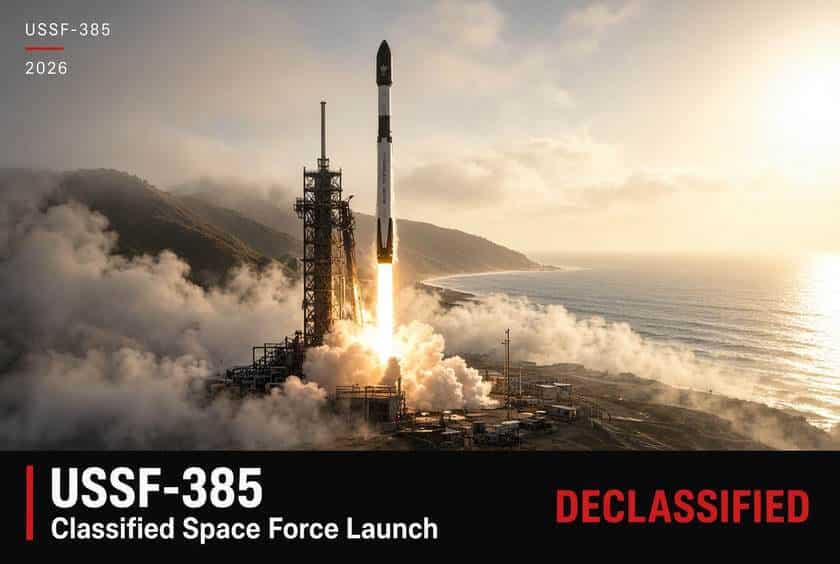
A SpaceX Falcon 9 lifted off through dense fog at Vandenberg Space Force Base, California, on Saturday morning with USSF-385, a classified mission for the U.S. Space Force. Liftoff from Space Launch Complex 4-East came at 7:00:54 a.m. PDT (10:00:54 a.m. EDT, 14:00:54 UTC), Spaceflight Now reported, and the rocket headed south after clearing the pad.
The launch itself is on the record. What went up is not. Neither SpaceX nor the Space Force has said what USSF-385 carried, how many spacecraft were aboard, or where they were going.
What is confirmed
Spaceflight Now and Space.com both report the same basic sequence. The first-stage booster, B1100, landed on the drone ship Of Course I Still Love You in the Pacific about eight and a half minutes after liftoff. It was the booster’s 10th flight. Before Saturday it had flown the NROL-95 mission for the National Reconnaissance Office and eight Starlink missions, Santa Barbara station KEYT reported ahead of the launch.
Beyond that, the public record is thin by design. SpaceX said it was not showing the payload or the second stage at its customer’s request, according to Spaceflight Now. Space.com reported that SpaceX ended its webcast shortly after the booster landed, as it usually does on national security flights. On most other missions it stays live through payload deployment.
KEYT noted before launch that payload details had not been made public and were likely classified, as they were for earlier Space Force launches.
What is only assessed, not confirmed
Spaceflight Now describes USSF-385 as thought to be the third in a series of flights deploying satellites built on Starshield, SpaceX’s version of its Starlink satellite for government customers. That is an outside assessment. Neither SpaceX nor the Space Force has confirmed it.
The assessment rests on the pattern of recent launches. According to Spaceflight Now:
- USSF-366 launched from Vandenberg on Aug. 15, and USSF-153 followed on Sept. 10. The Space Force released no details about either mission, but it cataloged 23 satellites in orbit after each one.
- USSF-259 went to a different orbit in mid-September and appeared to carry 17 satellites. The two outlets give different dates: Spaceflight Now says Sept. 17 and Space.com says Sept. 16. The difference may come from time zones. Neither outlet explains it.
A satellite count for USSF-385 had not been published as of this writing. TECHi, in its pre-launch coverage, warned that any Starshield label or exact satellite count is an open-source assessment, not a statement from SpaceX or the Space Force. We are treating it the same way.
A busy month at Vandenberg
According to Space.com, USSF-385 was SpaceX’s third Space Force flight in 16 days. Spaceflight Now reports it was the sixth and final Falcon 9 launch from Vandenberg in September. The California base has become SpaceX’s main Falcon 9 site as the company turns its Cape Canaveral operations toward Starship. Spaceflight Now says only one Falcon 9 flew from the East Coast this month.
Space.com puts SpaceX’s 2026 total at 108 Falcon 9 flights so far, about three-quarters of them for the company’s own Starlink network. The next major event on SpaceX’s schedule is Starship’s third flight of the year, set for Monday, Sept. 28, with a window opening at 8:15 a.m. EDT, Space.com reported. According to Space.com, Starship will attempt to reach orbit on that flight, which it has never done before.
Why a classified launch is on this site
Secret satellites launched from Vandenberg are not new. In the 1960s the base launched CORONA, the CIA and Air Force reconnaissance program, and the government kept the program’s existence classified until 1995. We covered its declassified history in CORONA: America’s First Spy Satellite Program, 1960–1972. For now, what USSF-385 carried is known only to the people who launched it. The public has a launch time, a booster number and a set of outside estimates.
What’s next: After USSF-366 and USSF-153, the Space Force cataloged the objects in orbit without saying what they were, according to Spaceflight Now. We will update this piece if the Space Force or SpaceX confirms the payload, or if catalog data shows how many objects USSF-385 deployed.
Sources
- Spaceflight Now — “SpaceX Falcon 9 launches classified mission for U.S. Space Force from West Coast,” Sept. 25–26, 2026
- Space.com — “SpaceX launches classified mystery mission for US Space Force from California,” Sept. 26, 2026
- KEYT News Channel 3-12 — “USSF-385 Mission Scheduled for Early Saturday Launch From Vandenberg SFB,” Sept. 25, 2026
- TECHi — “SpaceX USSF-385 Launch Today: What’s Confirmed About the Secret Mission,” Sept. 26, 2026
- DeClassified Now — “CORONA: America’s First Spy Satellite Program, 1960–1972”