OPINION
My neighbor doesn’t believe in smoke detectors. He says they go off when you make toast, and a sensible man knows when his own house is on fire. I’ve never argued with him. I did notice, the last time I was over, that he has the fire department’s number taped to the refrigerator. Big numbers. Laminated.
I thought about that refrigerator this week, watching the world’s two AI superpowers spend a week explaining that nobody needs guardrails, while quietly working out who calls whom if something catches fire.
What was said, out loud
The public position from Washington was not subtle. On Sept. 21, President Trump wrote on Truth Social that worries about AI risk were “more of a Hoax than even that of RUSSIA, RUSSIA, RUSSIA,” and that the only guardrail AI needs is a strong, smart president, according to The Independent’s account of the posts.
The next day at the U.N. General Assembly he announced that AI would henceforth be called “super intelligence,” and that the United States would “encourage it, not rein it in,” as PBS reported. He also told the assembled nations that the U.S. “totally rejects any attempt to construct a globalist scheme” to control it, according to Fox Business.
Then, on the morning Xi Jinping arrived at the White House, the president posted this: “Super Intelligence (SI) will be a big topic of discussion, but I want to leave it exactly where it is. That is China’s position also. Our guardrail is the DOJ!”
So that’s settled. No detectors. The Justice Department will smell the smoke.
What was said, in the other room
Here is where the refrigerator comes in. Four days before the summit, Treasury Secretary Scott Bessent spent Sunday in New York with China’s vice premier, He Lifeng. Afterward he told reporters the U.S. had proposed a notification mechanism for AI incidents serious enough to threaten national security, the Associated Press reported. “We want a shared vision of common goals and common threats,” Bessent said. China’s Commerce Ministry confirmed the meeting was the two countries’ first dialogue on artificial intelligence.
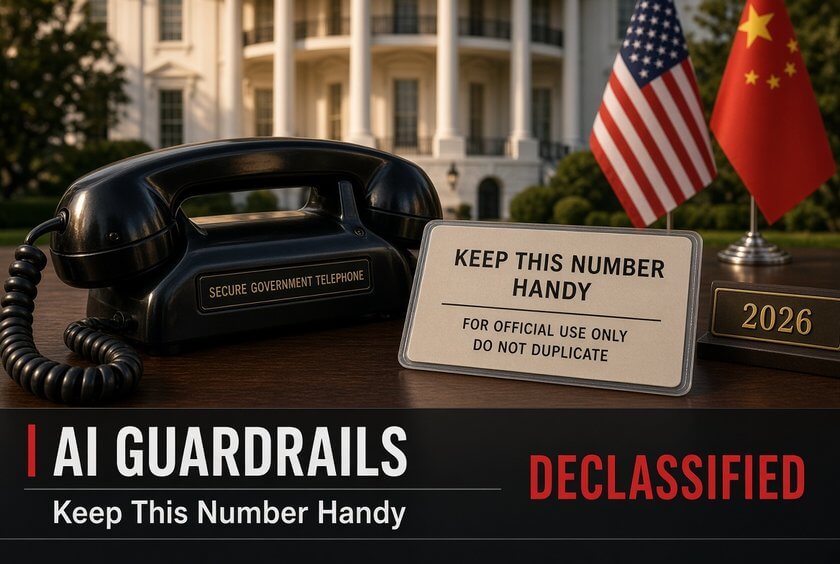
A notification mechanism, stripped of its vocabulary, is a promise to call the neighbors if your AI does something alarming. That is a guardrail. It’s a modest one. It’s the laminated number on the fridge. And it came from the administration whose leader, the same week, called the fire a hoax.
This has been tried before. After the Cuban missile crisis, Washington and Moscow signed a memorandum in June 1963 setting up a direct link between the two governments. As Smithsonian magazine has noted, it was never the red telephone of the movies.
It was a teletype line running through London, Copenhagen, Stockholm and Helsinki. Nobody who signed it thought nuclear weapons were a hoax. They just thought it would be nice to be able to say “that wasn’t us” quickly.
Beijing’s version of the same trick
It would be easy to stop there and make this a story about one man’s Truth Social account. It isn’t, because the other side of the table has its own fire-department number and its own smoke-detector speech.
According to China’s Foreign Ministry readout of the Sept. 24 talks, Xi told Trump that “AI must be kept under human control,” that the two countries should jointly prevent its misuse, and that they should draw on each other’s strengths rather than guard against each other. It is a lovely paragraph. It also arrived four days after the United States put an actual proposal on the table, and none of the Chinese statements I could find says a word about it.
China’s Commerce Ministry confirmed the dialogue happened. Xinhua said only that AI-related issues came up. The readout praises dialogue in general. Human control, it seems, is easier to endorse than a phone number.
And the readout contains one more small marvel. It records Trump telling Xi that AI “concerns the future of humanity” and that the two countries should “strengthen cooperation” on it. That doesn’t sound much like “leave it exactly where it is.” The White House hasn’t published its own account of the meeting, so we have only Beijing’s word that the president said it.
Each side’s version of the talks, it turns out, makes the other side sound a little more agreeable than it sounded at home.
Meanwhile, in New York, the people who actually build these systems were asking for exactly the kind of mechanism both governments are circling. At the Security Council on Sept. 23, Anthropic’s Dario Amodei called for, among other things, a notification system for AI incidents significant to global security, according to a transcript of the session.
The same day, 17 Democratic senators led by Chris Van Hollen had asked Trump to go much further and seek a formal agreement that could include “a mutual pause in” frontier AI development, Politico reported. Nobody got a pause. Somebody may yet get a phone line.
The case for leaving it where it is
The strongest argument for the president’s position deserves a fair hearing, because it isn’t foolish. Binding limits on AI development would be very hard to verify with China; you can count missile silos from orbit, but not what’s running inside a data center.
A unilateral slowdown, or a treaty Beijing quietly ignores, could hand the lead in a strategic technology to a rival government with its own ideas about “human control.” Supporters of the president’s line also point out that laws against fraud, hacking and export violations already apply when the tool is an AI.
Seen that way, “our guardrail is the DOJ” is a blunt summary of a real view: enforce the laws you have, don’t invent a global regime you can’t police. It’s also worth noticing that the administration proposed the one measure that doesn’t depend on trusting anybody.
A notification line asks each side only to tell the other what already happened. If you distrust your rival, that’s arguably the most sensible guardrail on the menu, and the administration seems have put it there.
That’s a real argument. It is also, you’ll notice, an argument for guardrails. Just small ones, chosen carefully, with the number written down somewhere you can find it in a hurry.
Where that leaves us
By Beijing’s account, both leaders tied AI to the future of humanity. One of them says it needs no limits and the other says it needs human control. Neither has yet agreed to the one concrete thing on the table, which is to pick up the phone when something goes wrong.
My neighbour, for the record, still doesn’t own a smoke detector. But I checked. The number on his fridge is current.
Sources:
- Ministry of Foreign Affairs of the PRC — “President Xi Jinping Holds Talks with U.S. President Donald J. Trump,” Sept. 25, 2026
- Donald J. Trump, Truth Social post, Sept. 24, 2026, 7:24 a.m. EDT (archived at Trump’s Truth)
- The Independent (via Yahoo News) — John Bowden, on Trump’s Truth Social posts calling AI risk a “hoax,” Sept. 21, 2026
- PBS News — Trump dismisses concerns about AI risks at U.N., says he won’t rein it in, Sept. 22, 2026
- Fox Business — Trump vows to reject “globalist scheme” to rein in AI, Sept. 22, 2026
- Bloomberg (via Yahoo Finance) — Catherine Lucey, “Trump Says No Moves Toward US, China AI Guardrails in Xi Summit,” Sept. 24, 2026
- Associated Press (via SecurityWeek) — “US Proposes AI Incident Alert System in Talks With China, Bessent Says,” Sept. 21, 2026
- CGTN — China, US reach trade consensus and hold first AI dialogue (Commerce Ministry statement), Sept. 24, 2026
- Politico (via Yahoo News) — Katherine Long, “Dems urge Trump to seek AI deal with China,” Sept. 23, 2026
- Politico (via Yahoo News) — Brendan Bordelon and Phelim Kine, “AI safety fears stalk Trump-Xi summit agenda,” Sept. 24, 2026
- Transcript — U.N. Security Council briefing on AI and international security, Sept. 23, 2026 (The Singju Post)
- Smithsonian — Tom Clavin, “There Never Was Such a Thing as a Red Phone in the White House,” June 18, 2013