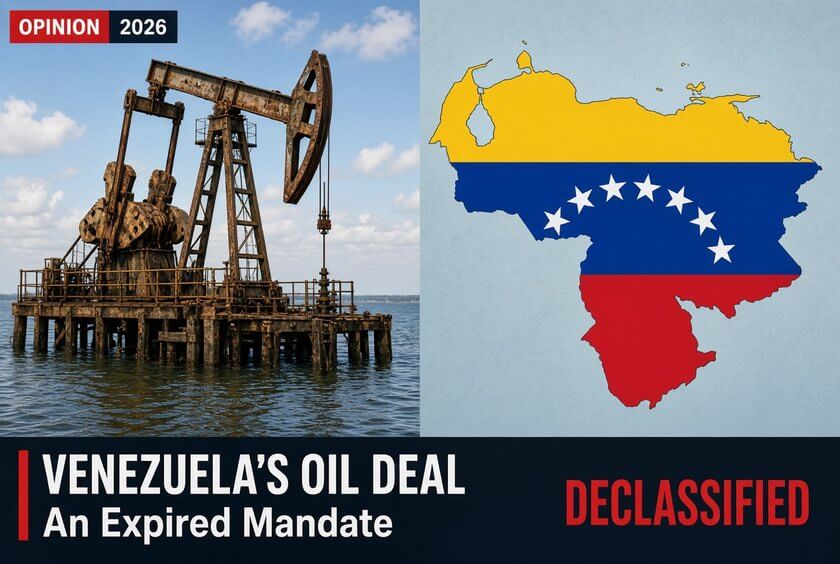
OPINION
You ever notice that the best time to negotiate with a man is while his car is up on the lift? He came in for a rattle. Now he’s standing in the waiting room with the vending machine coffee, and somewhere behind that door a fellow in coveralls is deciding what the rattle was. He is going to agree to things in that room he would not agree to in the parking lot. That is not a coincidence. That is the lift.
On January 3, 2026, American forces took Nicolás Maduro out of Caracas and put him in a federal courthouse in Manhattan on narco-terrorism and drug trafficking charges. Two days later, his vice president, Delcy Rodríguez, was sworn in as acting president. On January 4 — before she was even sworn in — the president of the United States warned her publicly that if she did not “do what’s right,” she would face an outcome worse than Maduro’s.
What was right, per the reporting at the time, included overhauling Venezuela to align with American interests, specifically by granting access to American energy companies.
Her car was on the lift. She had watched the mechanic work.
To her credit, the first week she made noise. She demanded Maduro’s immediate release and said her country’s territorial integrity had been savagely attacked. On January 6 she told an audience of government officials, in as many words, that her destiny was determined by God and not by those who threaten her.
The following day, the United States announced Venezuela would be providing 30 to 50 million barrels of oil. By January 20, Rodríguez confirmed Caracas had received $300 million from the sale.
God moves fast when He wants to.
From there the arc is tidy. On April 1, the Treasury Department’s Office of Foreign Assets Control removed Delcy Rodríguez from the Specially Designated Nationals list — the same week the ninety-day constitutional clock on her caretaker presidency ran out. Her assets were unfrozen. She could do business with Americans. She thanked Trump on Telegram, calling it a step toward normalizing relations, and asked for more.
Now, Rodríguez was put on that list in September 2018, along with her brother Jorge, for her role in helping Maduro maintain power and solidify his authoritarian rule. That was the stated offense. Undermining Venezuelan democracy.
In 2026 she has undermined Venezuelan democracy considerably more effectively than she ever managed in 2018 — she is nine months into a ninety-day term, with no election scheduled and no date proposed — and the list no longer has room for her. It is a funny thing about lists. They are only as principled as the week you read them.
Meanwhile, there is the matter of the man who actually won an election.
In July 2024, Venezuela held a presidential vote. Machado had been banned from running, so the opposition ran Edmundo González Urrutia in her place. The government withheld the tallies. Maduro declared victory. The opposition published receipts showing González winning better than two to one, and the United States — this United States, this administration’s State Department — recognized González as the legitimate winner. María Corina Machado, who spent most of the following year in hiding, was awarded the 2025 Nobel Peace Prize, and dedicated it to Donald Trump.
Asked on January 3 whether Machado might lead the country now that Maduro was gone, the president said she is a very nice woman, but she doesn’t have the respect.
The respect went to the woman the Treasury Department had sanctioned for propping up a dictatorship. Machado, for her part, called Rodríguez one of the main architects of torture, persecution, corruption and narcotrafficking, and said nobody trusts her.
By January 16 Machado was at the Heritage Foundation softening, allowing that the interim government would handle the “dirty work” of dismantling itself. By July, reporting had her plainly sidelined. The Nobel laureate is outside the building. The sanctioned official is inside it, signing.
What she signed is worth the walk-through.
Announced August 28, detailed September 1: a joint venture with North American Blue Energy Partners, run by businessman Alejandro Betancourt, gets development rights to seventeen oil fields holding roughly 65 billion barrels of proven reserves — about a fifth of everything Venezuela has. The Pentagon’s Office of Strategic Capital takes a 35 percent equity stake, structured through penny warrants so Washington doesn’t have to front much cash.
The State Department gets to buy 20 percent of the output at cost, with right of first refusal on the other 80. Signed by the Secretary of War and the Secretary of State.
Sixty-five billion barrels is a number that stops meaning anything, so: America burns about 20 million barrels a day of oil and related products. That’s a little under nine years of running the entire country.
Which raises the question nobody in the shop has thought to ask. Whose car is this?
Because it isn’t hers. Article 234 of the Venezuelan constitution gives an acting president ninety days, extendable once by the National Assembly. That is a power of attorney. It is the document you sign before they wheel you into surgery — limited, durational, and pointed at one job.
Rodríguez was handed the keys to have the rattle looked at. Article 12 of the same constitution says the hydrocarbon deposits belong to the Republic, are part of the public domain, and are inalienable and imprescriptible, which is lawyer for not yours to sell. What she signed was a bill of sale, and the term on it runs a hundred years, and her authority to hold the keys at all expired around the first of April.
Ninety days of mandate. A hundred years of obligation. That is a ratio of about four hundred to one, and the numerator had already run out five months before anyone announced the deal.
The owner, meanwhile, has a phone. Venezuela held an election in July 2024 and the receipts exist; the State Department has read them. Nobody dialed. Not in January, not in April when the ninety days lapsed, not in August. The owner is not outside the garage with his nose against the glass. The owner simply was never called, and the line has been out of service since spring.
There is one more thing about the paperwork, and it is the part to hang on the wall.
On January 29 — twenty-six days after Maduro was flown to New York, at a proposal Rodríguez herself submitted — the National Assembly unanimously rewrote the Organic Hydrocarbons Law. Among the changes: joint ventures no longer require prior legislative authorization.
The requirement was downgraded from approval by the National Assembly to notification of it. Also repealed was the 2006 provision guaranteeing the state at least half the value of each barrel, and the 2013 windfall tax on high prices. Analysts noted at the time that the government’s share was being meaningfully reduced.
So the consent mechanism wasn’t bypassed. It was repealed, three weeks before anyone needed to bypass it, by a legislature elected under Maduro on the motion of a president nobody elected at all.
Here is the case on the other side, and it deserves better than a wave of the hand.
Maduro’s indictment was not invented for the occasion — it dates to 2020, and he has pleaded not guilty in an American court that will test it. A snap handover to an exiled opposition with no command over the Venezuelan army was a genuine route to civil war; the military backed Rodríguez, and that fact does not care about anyone’s preferences.
Machado herself publicly accepted the sequencing in January, which is not nothing when the charge is that the opposition was robbed. Rodríguez has been indicted for no crime in the United States.
And the consent objection, pushed hard, proves more than its friends want: states are ordinarily bound by the acts of whoever effectively governs them, whatever that government’s democratic pedigree, because the alternative is that no agreement with any autocracy is worth the paper — which would be news to every country that ever signed a trade deal with one.
Nor do we know what Venezuelans think. Open protest has been thin, attributed variously to fear, to self-interest, and to nobody wanting to antagonize Washington; some Venezuelans may want the investment badly. The indictment here is not that they would have said no. It is that there is no longer a mechanism by which they could say anything.
And if a future elected government can void this — analysts widely think the legal footing is soft — then consent has been deferred rather than denied, which is the system working, slowly and expensively and from the wrong end.
All of that can be true. Nobody has produced a quid pro quo, either, because nobody signs those. What exists is a sequence: a threat in January, a repeal by the end of the month, a capitulation by spring, a delisting in April, a fifth of the national patrimony in August, and no election date in September.
As for the term, the two parties can’t agree. Washington says a hundred years. Rodríguez says twenty-five. The Hydrocarbons Law her own assembly passed in January caps joint ventures at twenty-five, renewable once for fifteen more.
So somewhere in there is a seventy-five-year discrepancy that exists nowhere in Venezuelan law, between two people arguing over the resale value of a car neither of them owns.
Sources:
The capture and its aftermath
- Congressional Research Service, “U.S. Capture of Venezuela’s Nicolás Maduro: Considerations for Congress,” IN12618, January 6, 2026
- UK House of Commons Library, “The US capture of Nicolás Maduro,” CBP-10452
- CNN, live coverage, January 3–4, 2026 (Rodríguez’s initial response; Supreme Tribunal order)
- NPR/AP, “Trump says US to get 30 million to 50 million barrels of oil from Venezuela at market price,” January 7, 2026 (Trump’s warning to Rodríguez; her “destiny” response)
- Reuters, January 20, 2026 (Rodríguez confirms $300 million received)
The constitutional clock
- Constitution of the Bolivarian Republic of Venezuela (1999), Articles 12, 150, 233 and 234
- Latin America Reports, on the April expiry of Rodríguez’s ninety-day term
The sanctions relief
- U.S. Department of the Treasury, Office of Foreign Assets Control, Specially Designated Nationals List actions, September 2018 and April 1, 2026
- NPR/AP, “U.S. lifts sanctions on Venezuela’s acting President Delcy Rodríguez,” April 2, 2026
- France 24, “Trump administration lifts sanctions on Venezuela’s interim leader,” April 1, 2026
- Al Jazeera, “US removes sanctions on Venezuela’s interim President Delcy Rodriguez,” April 1, 2026
The 2024 election and the opposition
- CBS News, interview with María Corina Machado, January 2026 (“nobody trusts her”; Trump’s “doesn’t have the respect”)
- Fox News Digital, via Malay Mail, January 7, 2026 (Machado on Rodríguez; plans to return)
- Al Jazeera, “‘Profoundly pro-American’: Machado outlines a vision for Venezuela’s future,” January 16, 2026 (Heritage Foundation remarks)
- Christian Science Monitor, July 8, 2026 (Machado sidelined)
The January 29 hydrocarbons reform
- Reuters, January 22, 2026 (Rodríguez submits the reform proposal)
- S&P Global Commodity Insights, January 29, 2026 (National Assembly approves the reform unanimously)
- Mayer Brown, “Venezuela Transforms Hydrocarbons Sector with New Hydrocarbons Law Amendment,” February 2026
- King & Spalding, “Venezuela Reforms Hydrocarbons Law: A Potential Sea Change for Foreign Investment in the Oil Sector?”, February 2026
- Hogan Lovells, “Venezuela opens oil and gas sector to full private participation,” February 2026
- Lexology, “Venezuela’s Hydrocarbons Law Reform: What Businesses Need to Know,” March 2026
The oil deal and its terms
- NPR/AP, “Days after Trump announces Venezuela oil deal, White House fills in some of the details,” September 1, 2026
- Wall Street Journal, via Investing.com, on the Office of Strategic Capital’s 35% stake and penny-warrant structure
- PBS NewsHour, “What we know about Trump’s deal giving U.S. access to vast oil reserves in Venezuela,” September 2026
- Al Jazeera, “Oil and politics: What Trump’s ‘historic’ deal means for Venezuela,” September 5, 2026
- Diplomacy & Law, “U.S.–Venezuela Oil Deal: Control, Ownership and Sovereignty Under International Law”
The election delay and the case for the deal
- Business Standard/ANI and NBC 6 South Florida, Oval Office remarks of September 2, 2026
- Forbes, James Broughel, “Trump’s Venezuela Oil Deal Is Better Than Its Critics Say,” September 5, 2026