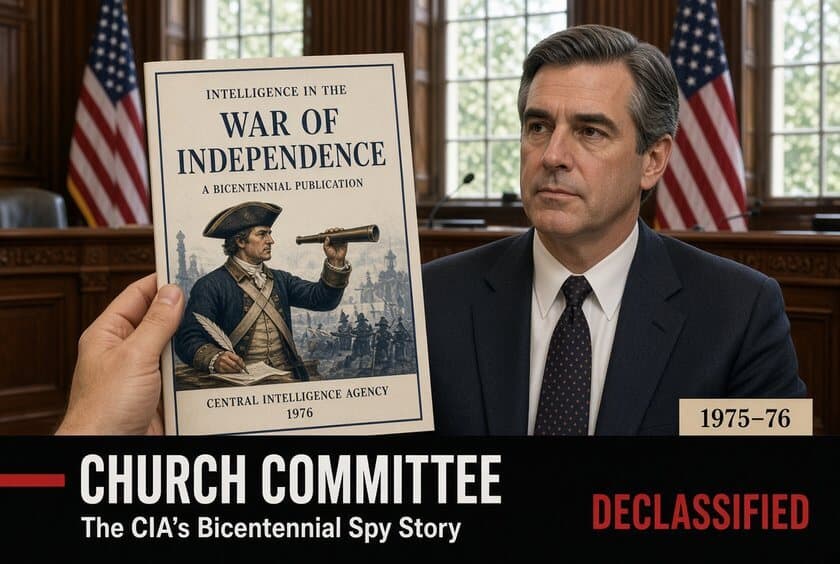
While the country spent this year marking 250 years since 1776, a familiar story came along for the ride: America’s founders were spymasters. Washington ran agents, Franklin ran deception from Paris, and secret intelligence is as old as the republic.
The story is largely true. What most people don’t know is that the CIA and the Ford White House deliberately pushed it 50 years ago. They did it at the moment the agency was under investigation for assassination plots and illegal mail opening.
The paper trail is public. The National Security Archive gathered it in July from the Gerald R. Ford Presidential Library and the CIA’s own online reading room. We read the set. It shows how a Bicentennial pamphlet became part of the agency’s defense against Congress.
A curator’s idea: “exploiting the Bicentennial”
At first the CIA wanted little to do with the celebrations. According to a 1976 internal chronology, William Colby told Bicentennial organizers in 1972 that the agency had little to contribute to the program. Colby was then the CIA’s executive director and later became its director.
That changed after December 1974, when Seymour Hersh’s New York Times exposé on CIA domestic spying set off the Rockefeller Commission, the Senate’s Church Committee and the House’s Pike Committee. On July 1, 1975, Deputy Director Vernon Walters gave the keynote at the national congress of the Sons of the American Revolution. Edward Sayle was in the audience. He was the curator of the CIA’s Historical Intelligence Collection.
Two and a half weeks later, Sayle wrote up his “thoughts on exploiting the Bicentennial.” The letter survives in the CIA’s reading room with the recipient’s name redacted. He had seen how the speech landed with community leaders. He argued the agency “might derive significant p.r. benefit” from an honor roll of Revolutionary War intelligence officers. The idea was that groups like the Sons of the American Revolution would then promote those men favorably.
The White House wanted “precedent for what we are doing today”
The Ford White House reached the same idea on its own. On Oct. 28, 1975, presidential counselor John O. Marsh wrote to his aide Wes Clark about working with the CIA. He wanted it to “develop interesting historical background as precedent for what we are doing today.”
Marsh helped coordinate both the Bicentennial and the administration’s dealings with the Church Committee. His memo lists what the founders did: psychological warfare, black propaganda, and a Jefferson and Franklin plan to encourage Hessian desertions.
A Nov. 5, 1975 CIA memo shows the White House had an even bigger venue in mind: an article in The New York Times Magazine. According to the memo, Clark floated a workaround for the obvious problem that the Times might not want a CIA byline. An agency staffer could write the article as an author not attributable to the CIA. The agency told him it was already doing a pamphlet instead.
This is where we have to be careful. The memo records that the idea was raised. Nothing in the set shows such an article was ever placed. What the record does show is how early the White House was thinking about the story’s reach.
The history, put to work
The talking points reached the airwaves quickly. On the Today show on Jan. 8, 1976, Colby was asked about congressional opposition to CIA operations in Angola. He answered with a line from the Continental Congress’s Committee of Secret Correspondence: Congress had “too many members to keep secrets.” He then complained that a new law required the agency to report to six committees.
Two days earlier, in Houston, Walters had gone further. According to the transcript in the CIA’s reading room, he described George Washington’s kidnapping plots against Benedict Arnold and Britain’s Prince William.
He also described Benjamin Franklin opening British mail and printing forged passports and currency in France. Then he made the point: the notion that “we pure Americans” don’t do spying and dirty work was, in his words, “just not true.”
That was the same season investigators were documenting the CIA’s own mail-opening program and assassination plots. The Revolutionary War examples are real history. The records show they were chosen because they matched the charges then before Congress.
What the pamphlet cost, and who noticed
“Intelligence in the War of Independence” came out in 1976, introduced by the new director, George H. W. Bush. It went to the Cabinet, Congress, the President’s Foreign Intelligence Advisory Board and CIA employees.
An internal CIA administration memo notes that the deputy director for operations, who ran covert action, kept asking for copies to hand to foreign liaison services and visitors. An April 1976 agency newsletter records a $1,000 Special Achievement Award for Sayle, crediting his research’s use by White House speakers.
Not everyone approved. A CIA legislative-counsel journal entry from Sept. 29, 1976 records a complaint from Rep. Ronald Dellums (D-Calif.). He objected to the $4,500 spent printing 10,000 copies, which he said might be agency lobbying “of questionable propriety.” The agency’s representative replied that it was following executive-branch instructions.
The pamphlet’s second life
The pamphlet outlived the Church Committee. On July 4, 2014, the CIA shared it from its then-new Twitter account. According to the agency’s own 30-day social media report, it became the account’s fifth-most-viewed post, with nearly a million impressions.
What the documents show is not that the founders’ spycraft was invented. It wasn’t. They show that a government agency under investigation picked which history to tell, and when.
It told that history to make the case that what Congress was examining was an American tradition. The pamphlet is still easy to find, and the memos that explain its timing are now online beside it.
Primary source: CIA Historical Intelligence Collection letter on “exploiting the Bicentennial,” July 18, 1975. Full context: National Security Archive Briefing Book No. 925. Read it yourself.
Sources
- National Security Archive — “‘Exploiting the Bicentennial’: The Church Committee, the CIA, and the Politicization of the Revolutionary War,” Briefing Book No. 925, ed. Arturo Jimenez-Bacardi, July 1, 2026
- CIA — “Intelligence in the War of Independence,” A Bicentennial Publication, 1976
- CIA Historical Intelligence Collection — letter, July 18, 1975 (CIA-RDP80R01731R001900020029-3)
- White House — John O. Marsh memorandum for Wes Clark, Oct. 28, 1975 (Gerald R. Ford Library)
- CIA — John F. Blake memorandum, “Bicentennial Article,” Nov. 5, 1975 (CIA-RDP77-00512R000100040197-7)
- Transcript — Today show interview with William Colby, Jan. 8, 1976 (CIA-RDP99-00418R000100110013-6)
- Speech — Lt. Gen. Vernon Walters, “The CIA and World Affairs,” Houston, Jan. 6, 1976 (CIA-RDP80R01731R002000120010-0)
- CIA Office of Legislative Counsel — journal entry, Sept. 29, 1976 (CIA-RDP78M02660R000300110005-9)
- CIA — memorandum, “Bicentennial Brochure,” with attachments, Sept. 29, 1976 (CIA-RDP79-00498A000600040001-0)
- CIA — “Suggestions and Achievements Awards Newsletter,” April 10, 1976 (CIA-RDP81-00142R000300020008-2)
- CIA — “Social Media Report: Our First 30 Days,” July 15, 2014