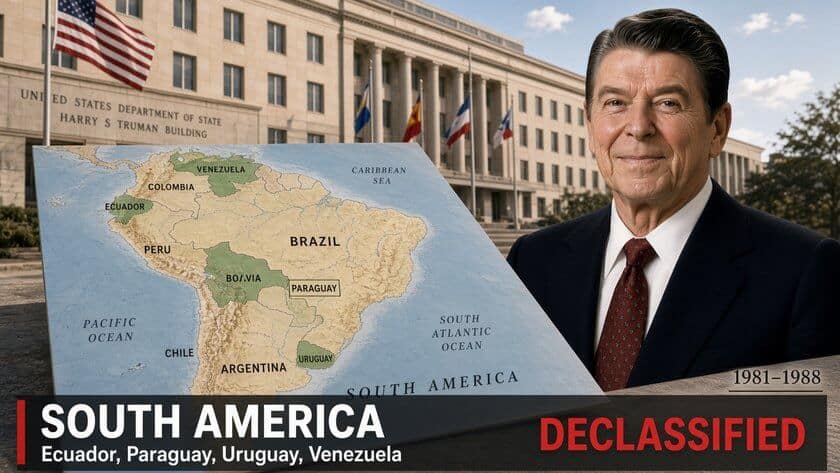
WASHINGTON — The State Department’s Office of the Historian has published four new chapters of Foreign Relations of the United States, 1981–1988, Volume XVI, South America, covering Ecuador, Paraguay, Uruguay and Venezuela. The department announced the release Sept. 18. The chapters hold 88 previously classified documents from the Reagan administration.
According to the department, the Paraguay chapter tracks U.S. policy toward the government of Gen. Alfredo Stroessner as it resisted democratization. The Uruguay and Ecuador chapters document U.S. support for democratic government in those countries.
Stroessner had ruled Paraguay since 1954 and was overthrown in a military coup led by Gen. Andrés Rodríguez on Feb. 3, 1989, three months after the last document in the Paraguay chapter.
Background: a 30-year clock
The State Department has published the Foreign Relations series since 1861. It is the government’s official documentary record of U.S. foreign policy. A 1991 law requires the department to publish volumes 30 years after the events they document. The records in this release date from 1981 to 1988.
The release is partial. The volume’s table of contents lists seven more chapters: a regional section plus Argentina, Bolivia, Brazil, Chile, Colombia and Peru. Nathaniel L. Smith edited the volume. Kathleen B. Rasmussen is the series’ general editor.
The chapters contain embassy telegrams, National Security Council memos, records of Oval Office conversations and CIA intelligence assessments. Ecuador has 30 documents, Paraguay 16, Uruguay 16 and Venezuela 26.
Shultz wanted the newspaper reopened before any meeting
Stroessner’s government shut ABC Color, which the State Department called Paraguay’s only independent newspaper, in March 1984. A July 20, 1984 action memo from Assistant Secretary of State Langhorne Motley proposed that Secretary of State George Shultz meet Paraguay’s foreign minister to help get the paper reopened.
It would have been the first such meeting since 1981. Shultz rejected the proposed order. His handwritten note asked for the reverse: a meeting guaranteed only once ABC Color reopened.
Police tear-gassed a reception for the U.S. ambassador
On Feb. 9, 1987, Paraguayan police fired tear gas at a reception held in honor of U.S. Ambassador Clyde Taylor. A State Department cable demanded a public apology and renewed security guarantees for U.S. personnel. In a Feb. 21 memo, Assistant Secretary Elliott Abrams wrote that Paraguay’s formal reply amounted to calling Taylor a liar.
He recommended that Under Secretary Michael Armacost summon Paraguay’s ambassador. Armacost did so Feb. 25. According to the volume’s editors, Paraguay sent an acceptable note of regret by April.
The CIA expected Stroessner to stay
A July 9, 1986 CIA intelligence memorandum, “Paraguay: Scenarios for Sudden, Unexpected Change,” judged that Stroessner remained firmly in control. It projected that he would be reelected in 1988. It called each scenario for an abrupt change of power “highly unlikely, but none can be discounted.” Part of its handling markings remains classified.
The chapter’s last document is an Oct. 28, 1988 cable from the new ambassador, Timothy Towell. Towell argued that three years of public criticism had achieved little on democratic reform. He proposed a shift toward private dialogue with Stroessner’s government.
Reagan lifted Carter-era limits to sell F-16s to Venezuela
Minutes of a June 1, 1981 National Security Council meeting record Reagan’s approval, in principle, of selling F-16A fighters to Venezuela. The minutes describe the decision as part of a new arms transfer policy replacing the Carter administration’s restrictions.
Officials cited Soviet-built MiGs in Cuba as a threat to Venezuela and said Venezuela would buy French Mirage jets if refused. Some participants raised the concern that the sale would set a precedent for first-line fighter sales to Latin America.
The minutes put the cost at about $30 million per aircraft, including support. Two passages about other countries’ interest in the F-16 remain redacted.
Ecuador asked for U.S. help when its president was taken hostage
On Jan. 16, 1987, renegade Ecuadorian Air Force personnel took President León Febres-Cordero hostage at Taura Air Base, near Guayaquil. An undated memo from National Security Adviser Frank Carlucci to Reagan covers that day.
According to the memo, Ecuador asked for a U.S. Air Force pilot to fly an Ecuadorian C-130 carrying Army Special Forces, and the U.S. ambassador authorized it. Ecuador also asked for U.S. hostage-rescue advisers. The memo says that request was under study. A notation shows Reagan saw the memo Jan. 20.
Six months later, a July 29, 1987 CIA paper was titled “Ecuador: The Danger of a Military Coup.”
Uruguay’s return to civilian rule
According to the department, the Uruguay chapter documents U.S. support for the country’s democratization. It also covers trade talks, economic reform and the military’s return to civilian control. It includes the record of a June 17, 1986 Oval Office meeting between Reagan and President Julio María Sanguinetti. It also includes CIA assessments from 1985 and 1986 on the new democratic government.
The chapter on Chile is among those still pending. Declassified Now has covered the FBI’s records on the 1976 Letelier-Moffitt assassination.
What’s next: The department said the remaining seven chapters of Volume XVI will be released as they are cleared for publication. It has not given a date.
Filed under: U.S. Department of State / Office of the Historian
Sources
- Office of the Historian — Foreign Relations of the United States, 1981–1988, Volume XVI, South America (volume page and table of contents)
- U.S. Department of State — “Office of the Historian, Bureau of Administration Releases Foreign Relations of the United States, 1981–1988, Volume XVI, South America: Ecuador, Paraguay, Uruguay, and Venezuela Chapters,” Sept. 18, 2026 (archived copy)
- Office of the Historian — About the Foreign Relations of the United States series (1861 origin; Public Law 102-138, 30-year requirement)
- Document 403 — Action Memorandum From Assistant Secretary Motley to Secretary Shultz, July 20, 1984
- Document 406 — CIA Intelligence Memorandum, “Paraguay: Scenarios for Sudden, Unexpected Change,” July 9, 1986
- Document 408 — Telegram From the Department of State to the Embassy in Paraguay, Feb. 12, 1987
- Document 409 — Action Memorandum From Assistant Secretary Abrams to Under Secretary Armacost, Feb. 21, 1987
- Document 413 — Telegram From the Embassy in Paraguay to the Department of State, Oct. 28, 1988
- Document 466 — Minutes of a National Security Council Meeting, June 1, 1981
- Document 390 — Memorandum From National Security Adviser Carlucci to President Reagan, Jan. 16, 1987
- Document 393 — CIA Paper, “Ecuador: The Danger of a Military Coup,” July 29, 1987
- Document 456 — Memorandum of Conversation, Reagan and Sanguinetti, June 17, 1986
- Deseret News — “Military Coup Ends 35-Year Paraguayan Rule,” Feb. 3, 1989
- Association for Diplomatic Studies and Training — “The Final Days of Paraguay’s Alfredo Stroessner”