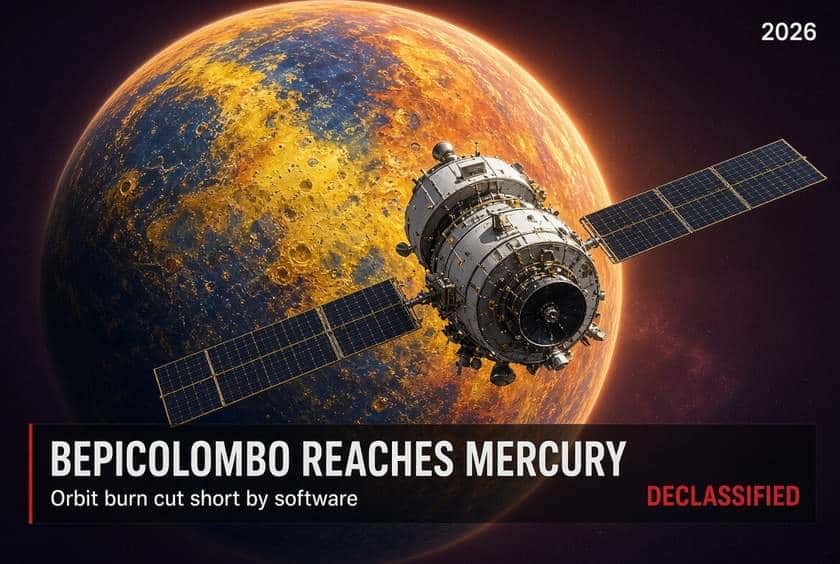
After eight years and nine planetary flybys, the European-Japanese spacecraft BepiColombo is in orbit around Mercury, only the second mission ever to get there. Getting it there didn’t go entirely to plan. The burn that slowed the spacecraft enough for Mercury to capture it began at 18:24 UTC on Saturday, Nov. 21, Space.com and The Next Web reported, and the mission team confirmed the capture that evening. A day later, the team added a caveat on X: during the maneuver, “the thruster burn was shorter than planned due to a software issue.” The spacecraft is safe, it said, and engineers at ESA’s operations center in Darmstadt, Germany, are working out what happened.
What nobody has said yet is how much the short burn matters. ESA has not published the orbit BepiColombo actually reached, how long the burn ran, or whether the next steps will need to change. It promised an update on Monday, Nov. 23, and as of this writing we had not found one.
Why Mercury is so hard to stop at
Mercury is the closest planet to the Sun, which sounds like it should make it easy to reach. It’s the opposite. A spacecraft falling toward the Sun picks up speed the whole way, and it has to shed a great deal of that energy to be captured by a planet as small as Mercury, Space.com explained. ESA’s own fact sheet puts it more starkly: placing a spacecraft into a stable orbit around Mercury takes even more energy than sending a mission to Pluto.
BepiColombo’s answer was patience. Instead of carrying enough fuel for one huge braking burn, it used electric thrusters and a long string of flybys of Earth, Venus and Mercury itself to bleed off speed a little at a time. The trip covered about 9.9 billion kilometers, Aerotime reported.
| Date | Milestone |
|---|---|
| April 2027 | Science operations planned to begin |
| March 2027 | ESA’s orbiter due to reach its final science orbit |
| Dec. 16, 2026 | Planned release of the sunshield protecting Japan’s orbiter |
| Dec. 9-10, 2026 | The two orbiters planned to separate |
| Nov. 21, 2026 | Orbit insertion; burn cut short by a software issue |
| Sept. 3, 2026 | Transfer module separates from the two orbiters |
| Jan. 8, 2025 | Sixth and final Mercury flyby |
| April 26, 2024 | Transfer module fails to deliver full power to the thrusters |
| Oct. 1, 2021 | First Mercury flyby |
| 2020-2021 | One Earth flyby and two Venus flybys |
| Oct. 20, 2018 | Launch on an Ariane 5 from French Guiana |
Dates are from ESA’s mission fact sheet, its Nov. 19 orbit-insertion briefing and its arrival updates page. ESA notes that planned dates can shift for operational reasons.
Not the first thruster trouble
This weekend’s glitch is the second propulsion problem on the way to Mercury. On April 26, 2024, as BepiColombo was about to start a maneuver, its transfer module failed to deliver enough electrical power to the spacecraft’s electric thrusters, ESA said at the time. Engineers restored most of the thrust, but not all of it, and the mission was replanned around the shortfall. That pushed arrival back from December 2025 to November 2026.
The transfer module that carried those thrusters is gone now. It separated on Sept. 3, leaving ESA’s Mercury Planetary Orbiter to steer the stack the rest of the way. Saturday’s burn used four of that orbiter’s thrusters to slow the spacecraft as it approached Mercury’s south pole, according to ESA’s orbit-insertion briefing. ESA had planned for the burn to put the pair into an elliptical orbit of about 590 by 11,640 kilometers. Whether they got there is the open question SpaceNews raised on Monday, when it reported that the premature shutdown had raised questions about the orbit.
Accounts of the burn itself differ. Space.com described a 37-minute burn, and Starlust reported that capture came after about 37 minutes of firing, while ESA has said only that the burn was shorter than planned. We could not find an ESA figure for how long it was meant to run or how long it actually did.
Two spacecraft, one stack
BepiColombo is really two science orbiters that have traveled bolted together. ESA’s Mercury Planetary Orbiter carries 11 instruments and will study the planet’s surface, composition and interior. Japan’s Mio, built by JAXA, carries five and will study Mercury’s magnetic environment and how it interacts with the solar wind. Once they separate, BepiColombo will be the first mission to fly two spacecraft around Mercury at once, ESA says.
The separation, planned for Dec. 9-10, is the next big test. Starlust reported that controllers want to understand the burn problem before committing to it. Space.com reported that science work is scheduled to start on April 6, 2027.
What MESSENGER left unanswered
The only spacecraft to orbit Mercury before was NASA’s MESSENGER, from March 2011 to April 2015. It ended the mission by crashing into the surface. It also left behind the puzzles BepiColombo is meant to work on.
Mercury’s surface holds far more potassium, an element that evaporates easily in heat, than a planet formed so close to the Sun should have. ESA project scientist Johannes Benkhoff has said no existing planet formation model properly explains it, and some scientists suspect Mercury formed farther out and was knocked inward by a giant collision. Such an impact could also explain why its iron core takes up more than 55% of its volume, according to ESA.
Then there’s the ice. MESSENGER saw what looked like water ice in craters near Mercury’s poles, on a planet whose surface reaches 450 °C. Benkhoff told ESA there are strong indications of ice in those craters, but “it has not been detected directly.” Mercury barely tilts on its axis, so sunlight never reaches the floors of those craters. ESA’s orbiter is meant to measure that water directly. MESSENGER also found small, shallow depressions called hollows, a landform not known on other planets, whose origin remains unexplained, ESA says.
For now, the mission’s most immediate unknown is closer to home: what a few lines of flight software did to Saturday’s burn, and what ESA’s next update says about the orbit it left behind.
Sources
- BepiColombo mission team on X, confirmation of orbit capture and the shortened burn (Nov. 22, 2026)
- ESA, “BepiColombo entering orbit around Mercury,” orbit-insertion briefing animation and description (Nov. 19, 2026)
- ESA, “Latest updates: BepiColombo’s arrival at Mercury” (updated through Oct. 29, 2026)
- ESA, BepiColombo fact sheet
- ESA, “Glitch on BepiColombo: work ongoing to restore spacecraft to full thrust” (May 15, 2024)
- ESA, “Top five Mercury mysteries that BepiColombo will solve” (April 9, 2020)
- SpaceNews, Jeff Foust, “Thruster glitch clouds BepiColombo arrival at Mercury” (Nov. 23, 2026)
- The Register, Simon Sharwood, “Software issues have even reached Mercury as BepiColombo probe arrives in uncertain state” (Nov. 23, 2026)
- The Next Web, Alina Maria Stan, “European Mercury probe BepiColombo enters orbit despite software glitch” (Nov. 23, 2026)
- Space.com, Mike Wall, “European-Japanese BepiColombo mission becomes 2nd ever to arrive in orbit around Mercury” (Nov. 22, 2026)
- Starlust, Harsh Vardhan, “BepiColombo ran into trouble during Mercury orbital insertion, reveals ESA a day after milestone” (Nov. 22-23, 2026)
- Aerotime, Gabriele Petrauskaite, “BepiColombo reaches Mercury orbit after nearly eight years in space” (Nov. 22, 2026)