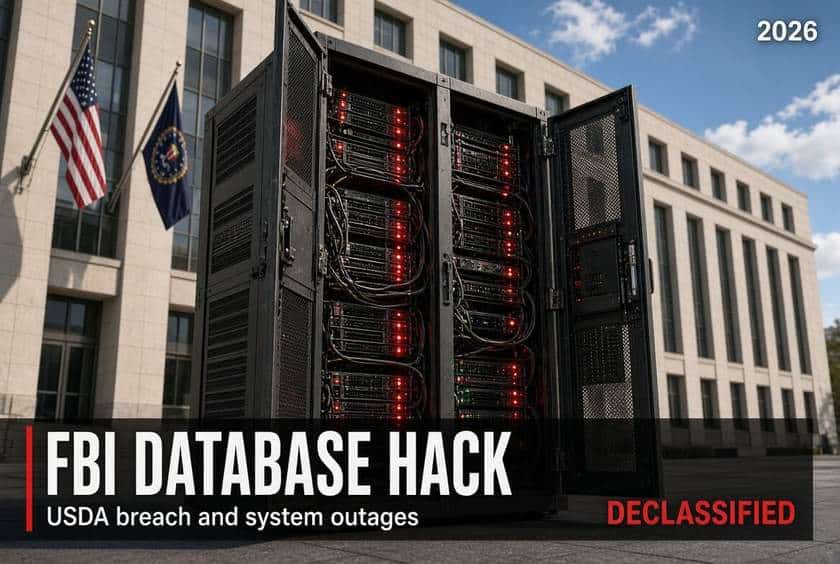
The FBI is investigating an apparent break-in at the National Crime Information Center, the database police across the country check when they run a name, a license plate or a gun background check. CNN first reported the intrusion on Nov. 20, citing two people briefed on the investigation. A law enforcement source confirmed it to ABC News, three sources confirmed it to Fox News, and the AP has also confirmed it, WFTV reported. The FBI itself has not said anything publicly, and it did not respond to requests for comment from the AP, CNN, Reuters or Fox.
The same weekend, the country’s top intelligence official told Americans to expect more technology failures. “We are going to have glitches, gaps, interruptions in service,” Director of National Intelligence Jay Clayton said in an interview with CNN, according to The Independent and WAPT. He tied the disruptions to an urgent upgrade of aging government and corporate systems, not to an attack.
Those are two different kinds of problems, and officials have said much more about one than the other.
What’s known about the FBI breach
Very little, officially. Investigators are working to find the unauthorized entry point, and it is unclear what information was compromised, Fox News reported, citing its sources. No one has said when the intrusion happened, how long it lasted or whether data was taken, Malwarebytes noted in a summary of the reporting.
The stakes are clear enough from what the system holds. The NCIC links federal, state and local law enforcement and stores wanted-person and warrant records, missing-person reports, criminal histories, protection orders, and records of stolen vehicles, firearms and other property. It held more than 19.3 million records in fiscal year 2025, according to Malwarebytes. It is also checked during firearm background checks, though none of the reports say the background check system itself was breached.
A former FBI official told CNN that officers rely on the database every day to identify wanted fugitives, and that an intrusion “could compromise the accuracy of the information that officers rely on,” ABC News (Australia) reported, citing CNN.
President Trump said in a Fox News interview on Saturday that he had only just heard about the hack. “I will say that it’s not good. I don’t like that,” he said, according to Fox News and AFP. He also suggested the breach might surface information about the Russia investigation or the 2020 election, AFP reported.
It is the second reported intrusion into FBI systems in about two months. In September, the hacking group ShinyHunters broke into the bureau’s job portal and claimed to have stolen personal information on almost every FBI agent, Fox News reported. The FBI confirmed the portal breach at the time but not its scale. A Canadian cybersecurity executive was arrested on Oct. 8 and faces sealed charges in the ShinyHunters investigation, Fox reported, citing Reuters and court records. Nothing reported so far connects the two incidents.
A second breach, at the Agriculture Department
The Agriculture Department has also been dealing with what its own staff were told was a security incident. Numerous USDA applications were taken offline over several days, including many of the financial tools the department uses to make payments to farmers and the applications farmers use to check the status of loans and other aid, Nextgov/FCW and Government Executive reported on Nov. 19, citing three people familiar with the matter and an internal email.
In that email, sent Monday, Nov. 16, Chris Rottler, acting assistant chief information officer for USDA’s Farm Production and Conservation Business Center, wrote that the department’s Cybersecurity and Privacy Operations Center had “uncovered a security incident.” Staff had to reset all database passwords in all environments, which meant resetting every application, he wrote. A technical bulletin warned that applications “may continue to experience intermittent outages throughout the week,” Nextgov reported.
The department has not commented publicly. It is not clear who carried out the intrusion or whether any data was taken, Nextgov reported, and the reports do not link it to the FBI breach.
Clayton’s warning, and Sunday’s Delta failure
Clayton’s message was about the other problem: the run of outages that have hit Microsoft, JPMorgan Chase, Apple, the Federal Aviation Administration and the National Security Agency, which the administration has called routine upgrades and fixes rather than attacks, WAPT reported. “Our systems are going to need to be upgraded,” he said, according to WAPT, and outages are “going to happen.” Americans should be prepared for “a great deal of investment in upgrading our systems,” he said, according to The Independent. Clayton has said before that investigators see no sign of a coordinated cyberattack or foreign government involvement in the U.S. outages, Euronews reported. None of the reports we read show him addressing the FBI breach directly.
Treasury Secretary Scott Bessent made a similar case on CBS. “The patches may cause a glitch,” he said, likening security updates to a vaccine, The Independent reported.
Delta Air Lines supplied the weekend’s example. A software fault at its Atlanta hub took down the tool that checks each plane is loaded within safe weight limits, forcing staff to fall back on manual procedures, Euronews reported. Euronews first put the number of late flights at more than 1,000, and said FlightAware data showed about 2,000 Delta flights, 58% of its schedule, running late by Sunday evening, with about 3% cancelled. Delta attributed about 70% of the disruption to the fault and the rest to weather. The FAA said on X that its own air traffic control equipment was not involved. Delta told WAPT the system was working again.
What hasn’t been explained
For the outages, officials have offered a cause, if not much detail: patches and upgrades, with no sign of an attack. For the two breaches, they have offered almost nothing in public. The FBI has not confirmed its own database was entered. USDA’s acknowledgment so far is an internal email. Lawmakers from both parties are demanding answers about the outages, WAPT reported.
We have covered the earlier failures in our explainers on the FAA, Outlook and fridge-hack incidents, the Chase outage and the NSA outage, and the September portal breach in what was confirmed and what ShinyHunters only claimed.
Sources
- WFTV (Cox Media Group), “FBI investigates apparent hack into National Crime Information Center database,” citing the AP, CNN and Reuters (Nov. 23, 2026)
- Malwarebytes, Pieter Arntz, “FBI crime database reportedly hacked” (Nov. 23, 2026)
- The Independent (via Yahoo News), Anthony Cuthbertson, “Prepare for more tech outages amid ‘urgent’ upgrades, says US intelligence chief” (Nov. 23, 2026)
- WAPT, Rachel Hirschheimer, “Are recent tech outages the new normal? Director of National Intelligence weighs in” (Nov. 23, 2026)
- Euronews (via Yahoo News), “US intelligence chief warns of more tech outages as Delta suffers fresh Atlanta failure” (Nov. 23, 2026)
- ABC News (Australia), AFP, “FBI’s criminal information database hacked, according to media outlets” (Nov. 22, 2026)
- Fox News, James Cirrone and David Spunt, “FBI crime database hacked, second cyberattack in months, sources say” (Nov. 21, 2026)
- Nextgov/FCW, David DiMolfetta and Jory Heckman, “USDA grapples with security breach as IT staff take multiple systems offline” (Nov. 19, 2026)