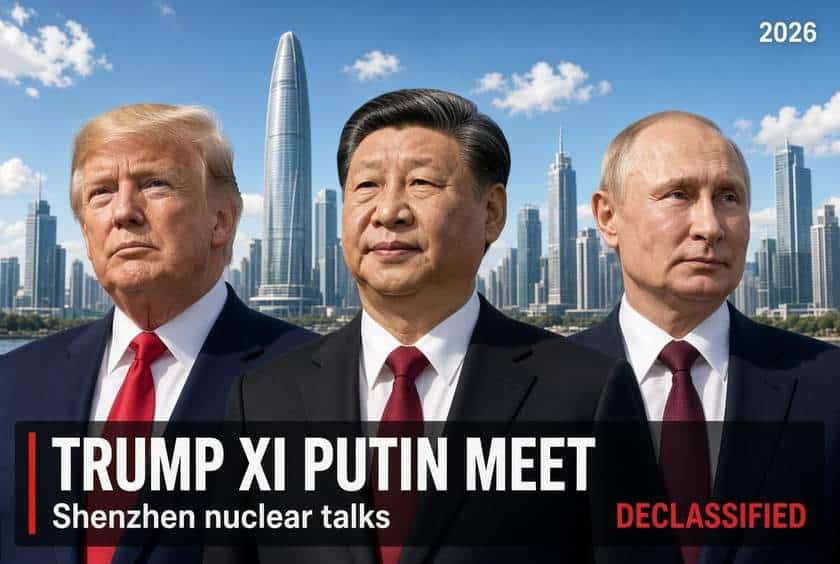
For the first time, the leaders of the United States, China and Russia are scheduled to sit at the same table. The White House said Friday that President Donald Trump will meet Xi Jinping and Vladimir Putin together in Shenzhen next week, on the sidelines of the Asia-Pacific Economic Cooperation summit.
Nuclear weapons top the agenda. White House spokesperson Olivia Wales told reporters the president “will discuss the reduction of nuclear weapons in the world,” and called their spread very dangerous.
The Kremlin has put a date on it. Kremlin spokesman Dmitry Peskov told the Russian news agency TASS on Saturday that the three had agreed to meet on Nov. 19, in Shenzhen. Beijing, the host, hadn’t publicly confirmed the meeting, Euronews and CNN reported.
China’s foreign ministry spokesperson Mao Ning talked up APEC’s prospects in areas such as trade and AI, but Euronews reported no comment from Beijing on the three-way meeting.
Since February, no treaty caps any of the three countries’ nuclear arsenals.
An introduction, by the White House’s own account
U.S. officials have set expectations low. A senior official briefing reporters said the administration doesn’t expect any agreement to come out of Shenzhen, and described the meeting to CNN as “the entry point, the first conversation” at the leader level. The same official framed it as a test for Beijing, saying it was time for China to come to “the adults’ table,” as RFE/RL reported.
Two other subjects are on the list, one in and one out. Officials said Trump intends to raise the Iran war with both leaders. Russia’s war in Ukraine won’t come up. Washington has a separate negotiating track with Moscow and Kyiv, the official said, and “China is not really a part of that track,” according to the Jerusalem Post.
Trump and Putin have no one-on-one meeting planned during the visit, RFE/RL and the Jerusalem Post reported. Trump does have bilateral talks and a working lunch with Xi on Nov. 19, and the Jerusalem Post reported the three-way meeting will close out his time in China.
The idea has been circulating for weeks. The Kremlin said on Oct. 21 that a meeting was being prepared. On Nov. 3, Peskov told reporters that China, as host, was “the main organizing force here,” The Moscow Times reported. Trump said on Nov. 8 that one of his China meetings would likely include both Putin and Xi, and that denuclearization would be among the topics.
Shenzhen arrives nine months after New START lapsed
New START, signed in 2010, capped the deployed strategic arsenals of the United States and Russia. It expired in February. Russia had proposed extending it for another year. Trump turned that down and called instead for a new, modernized arrangement that brings in China, according to RFE/RL and Al Jazeera.
The treaty’s verification side had stopped working well before it expired. Russia informally suspended verification after its 2022 invasion of Ukraine, halting on-site inspections, and in 2023 it stopped the data exchanges the two sides used to count each other’s forces. The State Department’s latest implementation report said that left Washington unable to determine whether Moscow was complying, the Foundation for Defense of Democracies noted in February. So the three leaders will be talking about arsenals that none of them can currently inspect.
The numbers are lopsided. Pentagon estimates put China at more than 600 warheads, against more than 5,000 each for the United States and Russia, RFE/RL reported. China is building fast, CNN noted, and the senior U.S. official accused Beijing of developing its arsenal without sufficient transparency.
Beijing’s position on joining arms talks hasn’t moved. China’s foreign ministry said last month that asking it to join trilateral nuclear disarmament talks at this stage is neither fair nor realistic, Al Jazeera reported.
Analysts quoted this week doubt Shenzhen will change that. Luke Coffey of the Hudson Institute told RFE/RL the meeting would work more like a bilateral one, with Washington on one side and Beijing and Moscow on the other, and Russia as the junior partner.
Sun Yun, director of the China program at the Stimson Center, put Beijing’s calculation more bluntly to Euronews: “China wants the image but not the costs.”
The 1945 summit whose minutes stayed secret for a decade
Three leaders deciding big questions in one room has brought back a comparison with Yalta. In February 1945, Franklin Roosevelt, Winston Churchill and Joseph Stalin met at the Crimean resort to settle the shape of postwar Europe. The Times of India reported Friday that Ukraine and other smaller countries fear a Trump-Xi-Putin meeting could produce understandings about territory or spheres of influence without them in the room. Crimea itself has been under Russian control since Moscow annexed it in 2014.
Yalta is also a case study in how long governments keep summit records to themselves. The State Department’s Office of the Historian has published an account of how the American record of the conference came out. The department began compiling it as a classified study in 1947. In 1950 it decided to keep the records secret, partly out of concern the minutes would embarrass the United States and Britain, and partly because the Soviets might answer with their own version.
Pressure from Congress reopened the question. Senate Majority Leader William Knowland pushed Secretary of State John Foster Dulles in 1952 to publish wartime conference records. Dulles held the Yalta volume until after the 1954 midterm elections. Britain’s foreign secretary, Anthony Eden, objected in January 1955 to releasing so much so soon after the event.
The release was untidy. On March 15, 1955, a State Department official handed the galleys to James Reston of The New York Times. After the Chicago Tribune found out and Sen. Everett Dirksen demanded a public release, the department gave copies to the press the next day. Churchill told Parliament that British records told a different story, but he didn’t open them. The Office of the Historian’s own verdict on the episode is that the volume was “embarrassing but not damaging.” The published book, “Conferences at Malta and Yalta, 1945,” is now online in full.
Nobody has said whether Washington will publish a readout of the Shenzhen meeting, or how detailed it will be.
Trump’s route to Shenzhen
Trump leaves Washington on Monday, Nov. 16, for the Philippines and the ASEAN summit in Manila, then goes on to Shenzhen. APEC’s leaders’ meeting runs Nov. 18 and 19. Elon Musk is traveling with Trump for parts of the trip but won’t attend the meeting with Xi and Putin, officials told reporters. This is a developing story. China’s confirmation of the date, and any agreed agenda from Beijing or Moscow, were still outstanding as of Saturday.
Primary records: the State Department Office of the Historian’s essay “Out of the Frying Pan Into the Fire”: The Politics of the Yalta FRUS and the full volume, Foreign Relations of the United States, Conferences at Malta and Yalta, 1945. Earlier coverage: The Xi–Trump Washington Summit: What Was Agreed, and What Wasn’t.
Sources
- CNN, Kevin Liptak, “Trump to meet with China’s Xi and Russia’s Putin at historic trilateral sit-down on nuclear non-proliferation” (Nov. 13, 2026). Used for: the White House announcement, “entry point” quote, China’s buildup, no Chinese confirmation.
- Euronews, Nathan Rennolds, “Trump, Xi and Putin to meet in China, White House says” (Nov. 14, 2026). Used for: the Wales quote, Ukraine exclusion, Mao Ning, travel schedule, Musk.
- Euronews, Gael Camba, “US President Donald Trump plans to meet Putin and Xi in China next week” (Nov. 9, 2026). Used for: the Kremlin’s Oct. 21 statement, Trump’s Nov. 8 remarks, Sun Yun quote.
- Anadolu Agency, Elena Teslova, “Kremlin says Putin, Xi, Trump to hold trilateral meeting in Shenzhen on Nov. 19” (Nov. 14, 2026). Used for: Peskov’s TASS interview and the Nov. 19 date.
- RFE/RL, Alex Raufoglu, “Trump To Discuss Iran, Nuclear Arms With Putin, Xi At Landmark Summit” (Nov. 14, 2026). Used for: “adults’ table” quote, no Trump-Putin bilateral, New START extension offer, Pentagon warhead estimates, Coffey.
- Jerusalem Post, Idan Kweller, “White House confirms Trump-Xi-Putin trilateral summit in China” (Nov. 14, 2026). Used for: the Ukraine-track quote, Nov. 19 Xi bilateral and lunch, no Trump-Putin bilateral, meeting order.
- Al Jazeera, Shola Lawal, “Trump-Xi-Putin trilateral meeting at APEC: What to expect” (Nov. 14, 2026). Used for: China’s foreign ministry position, New START extension offer.
- The Moscow Times, “Russia, China and U.S. Summit Under Discussion, Kremlin Says” (Nov. 3, 2026). Used for: Peskov’s Nov. 3 remarks.
- Foundation for Defense of Democracies, policy brief on New START’s expiration (Feb. 4, 2026). Used for: Russia’s suspension of verification and data exchanges, and the State Department compliance finding.
- Times of India, “Trump, Xi, Putin meet next week: Why the 1945 Yalta Conference is back in focus” (Nov. 14, 2026). Used for: the Yalta comparison and smaller countries’ concerns.
- U.S. Department of State, Office of the Historian, Joshua Botts, “Out of the Frying Pan Into the Fire”: The Politics of the Yalta FRUS. Used for: the history of the Yalta records’ secrecy and release.
- Foreign Relations of the United States, Diplomatic Papers, Conferences at Malta and Yalta, 1945 (GPO, 1955). Used for: the published volume.