Somewhere in the American South, a farmer stands at the edge of a field in April, looking at a fertilizer bill that has climbed faster than anything his crop will earn. He is deciding how much of his land to leave underfed this year.
Halfway around the world in Indonesia, a refinery that makes nickel for electric-car batteries is about to shut down half its production.
In the copper belt of the Congo, mines that supply the wiring in your walls are being quoted up to $1,900 a tonne for the same scarce cargoes. They can afford to outbid the fertilizer plants and battery refiners that need them just as badly.
These people will never meet. But all three are waiting on the same thing: a bright yellow element that oil and gas producers have spent decades treating as waste, sometimes paying just to store it.
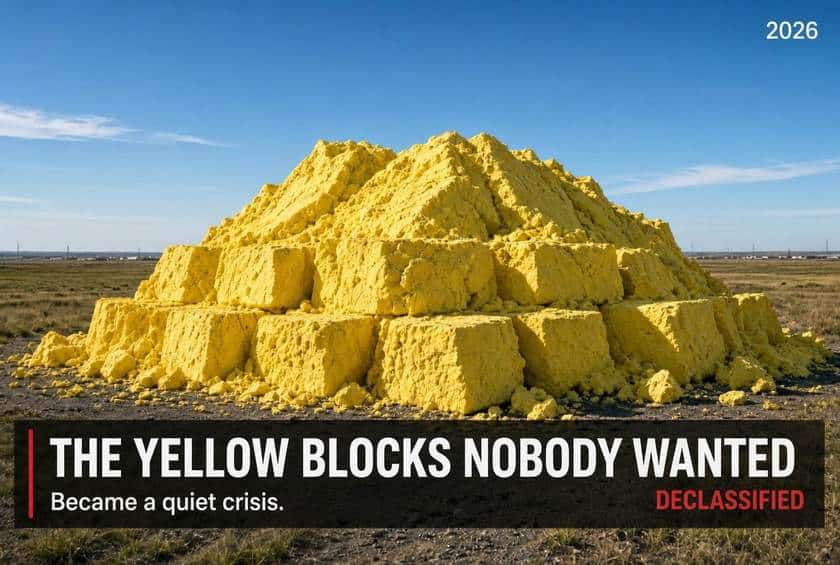
And the world’s largest stockpile of it sits in northern Alberta, stacked in giant yellow blocks.
That yellow substance is sulfur, and in 2026 the world ran short of it. Not of the element itself, which is abundant, but of cheap sulfur that could reach the right port at the right time. That turned out to be almost as bad.
A war, a closed shipping lane and a wave of export bans pulled the farmer, the refinery and the mine into the same crisis. It also exposed something Canada has been slow to see. Those yellow blocks in Alberta are no longer waste. They are a strategic asset, and the country is still treating them as an afterthought.
A leftover the economy can’t do without
Almost all of the world’s sulfur is a leftover. It is stripped out of natural gas and crude oil so that fuels burn cleaner, and the amount produced depends on how much fuel the world uses, not on how much sulfur anyone wants. A refinery will not process more oil just because sulfur got expensive. Analysts at CRU call this the defining feature of the market: supply is set independently of demand.
Most of that sulfur is burned to make sulfuric acid, the most widely used industrial chemical in the world. Two uses dominate:
- Fertilizer. Acid dissolves phosphate rock into the raw material for most of the phosphate fertilizer farmers spread on their fields. By volume, this is by far the biggest use.
- Metals. Acid pulls copper out of low-grade ore. In Indonesia, refineries use it under heat and pressure to dissolve nickel from clay-like ore for electric-car batteries, a process known as high-pressure acid leaching.
That makes sulfur a hinge between energy and food. When fossil-fuel trade breaks down, the leftover that farms and mines quietly rely on breaks down with it.
How the doors closed
The shock began in the Persian Gulf. The Middle East produces roughly a quarter of the world’s sulfur but ships about 45% of what is traded across borders, according to the Chinese commodity data firm SunSirs. When war broke out in late February, traffic through the Strait of Hormuz collapsed, and the strait has never properly reopened. October brought more attacks on commercial ships than any month since the war began, according to USNI News.
Then the backup suppliers shut their doors one by one, each protecting its own farmers.
| When (2026) | Who | What happened |
|---|---|---|
| Late February | Persian Gulf | War closes the Strait of Hormuz, cutting off the region that ships nearly half the world’s traded sulfur |
| April 7 | Turkey | Bans sulfur exports through September. A small supplier, but an important one around the Mediterranean (Argus) |
| May 1 | China | Halts sulfuric acid exports through the end of the year. By June shipments were down 99%, leaving Chile and Indonesia, its biggest customers, with nothing (Mining Weekly) |
| June 25 | Russia | Extends its sulfur export ban, in place since late 2025, to the end of 2026 (SMM) |
| June 27 | Kazakhstan | Halts all sulfur exports “until further notice.” It shipped about 4.6 million tonnes in 2025 and supplies about 44% of the sulfur used by Morocco’s state phosphate giant, OCP. Russia later reopened its rail lines to Kazakh sulfur, but as of August Kazakhstan’s own ban was still in force (CRU) |
Each ban made sense for the country imposing it. Together they removed most of the world’s backup supply at the moment it was needed. CRU estimated in May that 2026 supply could fall by 3 to 4 million tonnes, more than stockpiles could cover (CRU).
What happened to prices
Sulfur roughly doubled in price over the first half of 2026, on top of a rally that had already begun the year before as demand for battery materials grew.
- Before the war: In China, sulfur hit a 10-year high in 2025, according to the trade publisher SMM.
- The spike: Sulfur shipped from Vancouver went from about US$500 a tonne in January to as much as US$950 by April (SMM). On the U.S. Gulf Coast, it reached US$1,060 a tonne in May, according to S&P Global.
- The turn: By late summer, prices in major importing countries had fallen by US$40 to US$150 a tonne, according to the price agency ICIS, as fertilizer makers bought less and ran their plants slower (Global Risk Community).
The strange part is that prices eased while Hormuz stayed dangerous. Supply did not come back; buyers gave up. That is not a sign the problem is solved. It is a sign the damage has moved from the price chart into lost production.
Who is paying
The farmer
Fertilizer makers took the first hit. Mosaic, the largest U.S. phosphate producer, cut output by about 2 million tonnes rather than pay record prices for sulfur, according to the shipping-data firm Kpler. Morocco’s OCP, the world’s biggest phosphate exporter, received its last Gulf sulfur cargo in April and had to buy costlier supply from Russia and the U.S.
Farmers felt it at planting time. In an American Farm Bureau Federation survey of more than 5,700 farmers, taken April 3–11, 70% said they could not afford all the fertilizer they needed (RFD-TV). In the South it was nearly 80%. In the Midwest, where many farmers had booked supplies early, it was 48%.
Sulfur was not the only cause. The war also disrupted natural gas and nitrogen fertilizer. But it is a big part of why phosphate became so expensive.
The refinery
Indonesia’s nickel refineries are the most exposed industry of all. They use roughly 8 to 11 tonnes of sulfur for every tonne of nickel, according to estimates from the brokerage Bell Potter and the miner Nornickel. At that rate, every US$100 rise in the price of a tonne of sulfur adds roughly US$800 to US$1,100 to the cost of a tonne of nickel. Kpler estimates sulfur’s share of these plants’ running costs rose from 20–30% to 35–50%.
That is the refinery from the start of this story. On May 1, the Chinese battery-materials company Huayou put half the capacity at its Huafei plant in Indonesia on hold, citing sulfur costs (Argus). Unlike a copper mine, a plant like this cannot limp along on a short supply of acid. It is either on or off.
The mine
Copper miners have been the toughest bidders. In Congo and Chile, many mines extract copper by trickling acid through crushed ore; in Chile, that method produces around half of the country’s refined copper (Engineering News). Because sulfur is a much smaller share of copper’s costs, these miners can afford to pay more. One Congolese copper plant was quoted up to US$1,900 a tonne for sulfur delivered in June (SMM), and Kpler found Huayou could not outbid Congo’s copper producers for spot cargoes.
That is the quiet logic of a shortage. The sulfur goes to whoever can pay the most, and that is rarely the farmer.
Canada’s moment, and its limits
Canada became the world’s backup supplier almost by accident. Decades of processing sour gas and upgrading oil-sands bitumen left those yellow blocks in Alberta, the world’s largest sulfur stockpile, and Vancouver is the port that ships it. With Russia, Kazakhstan and Turkey banning exports, Canada was one of the few big sellers still open for business.
The money is real. Canadian sulfur exports rose 40.7% in 2025 to 4.25 million tonnes, worth a record US$1.53 billion, and early this year they were on pace for about 5.2 million tonnes, according to SMM. Alberta and British Columbia account for more than 95% of them.
The stockpile is real too, though it is shrinking. Alberta held about 11.7 million tonnes in mid-2025, the lowest since 2019, and producers have been drawing it down as prices rose, according to Argus. Getting it to market is slow work. The blocks have to be re-melted, moved by rail as liquid sulfur, formed into pellets and loaded at the coast. Rail cars and terminal space, not tonnage, set the limit.
Canada is also only one producer among many. The U.S. Geological Survey puts Canada’s 2025 output at about 5 million tonnes of an 84-million-tonne world total, roughly 6%. Its influence comes from being open when others closed, not from controlling the market.
The real lesson: we built food and batteries on a waste stream
Prices have eased, but the crisis has not ended. The Strait of Hormuz is still dangerous, Russia, Kazakhstan and China still have their bans in place, and the structural problem underneath will outlast all of them.
The world gets most of its sulfur from cleaning fossil fuels. As oil and gas use falls, so does that free byproduct. Meanwhile demand is rising from the industries the energy transition depends on: battery nickel, copper and the iron-phosphate batteries now common in electric cars.
A 2022 study by Mark Maslin, Livia Van Heerde and Simon Day in The Geographical Journal projected world demand for sulfuric acid rising from 246 million to 400 million tonnes a year by 2040, leaving an annual shortfall of 100 million to 320 million tonnes as the world decarbonizes. Those are scenarios, not forecasts, but they point at a gap almost nobody is planning for.
This year was a preview. It showed how fast countries will hoard sulfur when it gets scarce, and how quickly that scarcity reaches farm fields. Governments that treat lithium and cobalt as critical minerals have mostly ignored the yellow element that makes both fertilizer and battery metals possible.
Canada should not make that mistake. Ottawa and Alberta should treat sulfur as the strategic resource it has become. That means investing in the rail cars, re-melting plants and port terminals that turn Alberta’s stockpile into supply the world can actually use. It means giving sulfur the same attention as the critical minerals it helps produce. And it means planning now, before the next shortage, rather than scrambling during it.
What to watch next
- Whether Hormuz reopens to normal traffic, or October’s attacks continue
- Whether Kazakhstan lifts its export ban, and whether Turkey’s ban, due to end in September, was renewed
- Whether Russia and China extend their bans past the end of 2026
- Fertilizer prices and planted acres next spring, where the effect on food would show up
- Output at Indonesia’s nickel refineries, the first place a new squeeze would show
Next spring, that farmer in the South will stand at the edge of his field and look at another fertilizer bill. Whether he can pay it will depend on decisions being made now in Tehran, Astana, Moscow and Beijing, and on whether anyone in Ottawa or Edmonton starts treating a stack of yellow blocks as the strategic asset it has become.
Sources
- USGS – Mineral Commodity Summaries 2026: Sulfur
- Maslin, Van Heerde & Day (2022), The Geographical Journal
- USNI News – October marks highest number of Strait of Hormuz attacks
- Mining Weekly / Reuters – China’s sulphuric acid exports all but vanish in June
- Engineering News / Reuters – Chile faces acid supply crunch as China exports dry up
- SMM – H1 2026 Sulfur Industry Chain Review
- SMM – Sulfur Market 2025 Review and 2026 Outlook
- SMM – Sulphur and sulphuric acid prices remain high in DRC
- SunSirs – H1 2026 global sulfur review
- CRU / BC Insight – Kazakhstan ban and Lithuania supply
- CRU / BC Insight – Market Outlook, May 2026
- CRU / BC Insight – Sulphur inventory, availability and pricing
- Argus – Turkey bans sulphur exports
- Argus – Alberta sulfur inventories fall as exports climb
- Argus – Indonesia’s Huafei to cut MHP output on sulphur costs
- Kpler – Metals vs fertilizers: who pays more for sulphur?
- Global Risk Community – Sulphur price chart 2026
- RFD-TV – AFBF fertilizer affordability survey
- Metalnomist – Nornickel nickel surplus forecast
- Bell Potter – Nickel Industries note