OPINION
You ever notice that the people who laugh hardest at a man building something in his garage are the same people who later say they always knew he’d pull it off? The neighbors of the Wright brothers presumably had opinions, too. The first powered flight lasted about 12 seconds. Nobody at Kitty Hawk asked about the price.
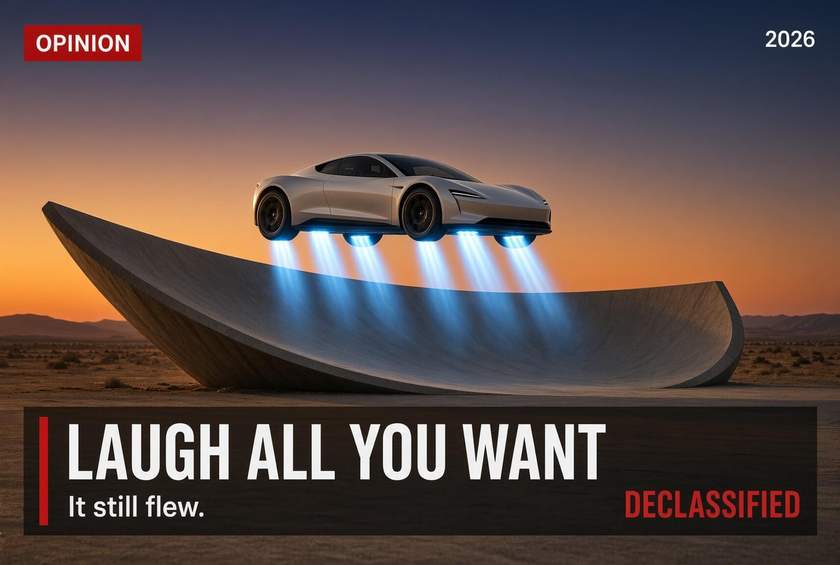
I bring this up because on Thursday, after nine years of jokes, many of them mine, Tesla’s Roadster turned upside down and stayed there.
At an event outside Waco, Texas, the car used high-powered fans and thrusters to drive up an inverted ramp, spin around and ease itself down to the pavement. Then it used the thrusters to lift itself over a Cybercab, Cybertruck, Tesla Semi, Model Y and Model 3 while in motion. That’s five vehicles. Most of us can’t parallel park beside one.
Take the pieces one at a time, because each is more interesting than the punchline. The suction system is in every version. The base “Performance” trim is described as the road-ready car with the suction system but no thrusters. Fans that pin a car to the road give it grip at slow speeds, where wings do almost nothing. Racing figured out this worked decades ago, and the rulebook’s prompt answer was to ban it. Now it comes standard.
The thrusters run on compressed air, not fuel. Engineering VP Lars Moravy said 10 thrusters are fed by 600 liters of compressed air, and the tank can be recharged. On the Thrust trim, rear thrusters take 0-60 mph to under one second, by the company’s claim. Underneath all the flight theatre is a serious electric sports car: every trim has a stated range of 300 miles and top speeds over 230 mph.
For context, the “flying car” industry has been one of the great empty promises of my lifetime. CBS put it gently, noting that technical and regulatory challenges have so far kept the sector from getting off the ground. Tesla didn’t solve that. But it put a car in the air in front of a livestream, which is more than the genre usually manages before the press release.
Now, fairness, because the skeptics have a real case. Tesla first promised production for 2020, with 10,000 units planned, and the current target is 2028. Executives named no price at the event. The flying model isn’t approved for public roads. One critic quoted by Electrek argues the thrusters add weight and cost and do nothing on an ordinary drive. Analyst Dan Ives says it won’t move Tesla’s volume or revenue needle. And by my own rough physics, not a Tesla figure, 600 liters of air buys something like five seconds of true hover. These are fair points. A demo isn’t a delivery, and nine years of missed dates did earn some doubt.
Yet .. the five-second objection cuts both ways. Five seconds isn’t much of a commute. It’s about half of Kitty Hawk. But every technology that ended up mattering started out looking like a stunt that didn’t last long enough. And unlike some promises, the money on the line can come back: the full $50,000 deposit is refundable.
Will the Roadster change how most of us get to work? Probably not. But somewhere in Texas a car drove on a ceiling, and the people who said it couldn’t be done now have to say something else.
By the way, my insurance agent still hasn’t called back. But for the first time, he’s asking what it does.
Sources: TechCrunch; Dataconomy; Fellow Press; The EV Report; CBS News/AFP; Gulf News; Wikipedia, “Tesla Roadster (second generation)”; Ascendants. The Kitty Hawk flight time and fan-car racing history are general historical knowledge. Hover-time figure is the author’s own estimate from Tesla’s stated 600-liter capacity.
Sources: