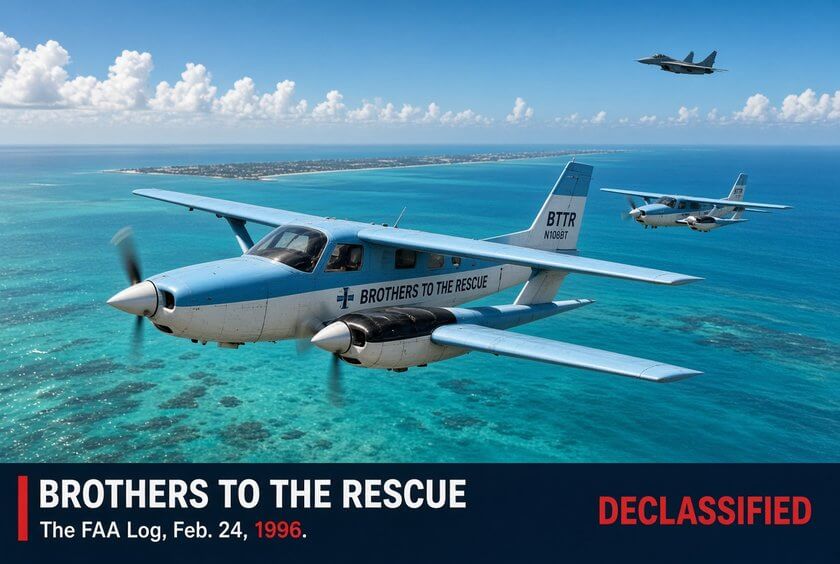
Since the Justice Department unsealed its indictment of Raúl Castro in May, the 1996 Brothers to the Rescue shootdown has been told in two versions. In Washington’s, Cuban MiGs destroyed two unarmed Cessnas flying outside Cuban territory. In Havana’s, the planes belonged to a group that had spent a year violating Cuban airspace, and Cuba defended its border.
The Federal Aviation Administration’s own records, released by the National Security Archive, don’t fit neatly into either story. We read the FAA’s minute-by-minute chronology of Feb. 24, 1996, and the warnings the agency logged in the year before.
The record supports the core of the U.S. case. It also shows how much of Havana’s account U.S. officials were writing down themselves at the time.
Twenty minutes over the Florida Straits
The FAA’s “Chronology of BTTR Shootdown, 24 February 1996” is two pages of timestamps, built largely from U.S. Customs radar. It opens that morning. Between 10:00 a.m. and noon, Cuban fighters went up in reaction to a believed incursion by the group’s aircraft, then returned to base without contact.
At 1:13 p.m., three Brothers to the Rescue planes left Opa-locka Airfield in Miami. Aircraft 1, N2506, was the light-blue Cessna flown by the group’s president, José Basulto. At 2:56 p.m., the pilots told Havana air traffic control they meant to operate south of the 24th parallel.
The controller warned them the area was “active and dangerous.” The chronology records their reply: they were aware of the danger and would fly south of the parallel anyway.
Then the timestamps tighten:
- 3:18 p.m. — Radar puts Basulto’s plane about 1 nautical mile north of Cuban territorial airspace, heading south. Aircraft 2 and 3 are about 8 miles north of it, headed east.
- 3:19 — Radar shows Basulto’s plane “has entered Cuban territorial airspace.”
- 3:20 — Cuban fighters request permission to fire on “a white and blue Cessna 337.” Ground controllers authorize it.
- 3:21 — A MiG-29 pilot reports Aircraft 2 destroyed. Radar last observed it about 5 nautical miles outside Cuban territorial airspace.
- 3:26 — Basulto’s plane reverses course and exits Cuban airspace.
- 3:28 — Aircraft 3 is destroyed. Its last radar fix is about 16 nautical miles from Cuban territorial airspace.
Basulto landed in Miami at 5:09 p.m. Carlos Costa, Armando Alejandre Jr., Mario de la Peña and Pablo Morales, aboard the other two planes, were killed.
So both versions hold part of the record. The only plane the FAA log places inside Cuban airspace is the one that flew home. The two that were destroyed were outside it, by the U.S. government’s own radar.
A year of “worst case” memos
The rest of the FAA file explains why nobody in Washington was surprised. A Miami district office status report describes the agency’s dealings with the group from 1993 on. It notes a July 1995 flight in which Basulto was filmed tossing the group’s bumper stickers over Havana.
On Aug. 9, 1995, FAA staff attended a Miami meeting chaired by Richard Nuccio, the White House point man on Cuba, ahead of a flotilla planned for Sept. 2. The report’s summary says: “A major fear is the possible downing of a BTTR aircraft by land-based gunfire.”
The public warnings were blunt, too. A draft FAA order, written after the shootdown, recites them. On Aug. 8, 1995, the State Department announced Cuba’s “firm determination” to defend its airspace. The department relayed Havana’s July 1995 warning that “any aircraft” entering could be “downed.”
Later that month, the FAA said it would issue a special notice to airmen warning pilots that they were subject to Cuba’s actions if they entered its airspace.
On Jan. 22, 1996, a month before the shootdown, FAA official Cecilia Capestany passed along State Department concern about another unauthorized flight. She called it “further taunting of the Cuban Government.” Then she wrote the line the Archive leads with: the worst case was that “one of these days the Cubans will shoot down one of these planes and the FAA better have all its ducks in a row.”
What the file doesn’t show is the FAA grounding Basulto before Feb. 24. It records warnings, an enforcement case, and a proposed action against his pilot certificate.
Only after the shootdown does the draft emergency order direct him and the group to “cease and desist” from flying in Cuban territorial airspace. It calls his operations “careless or reckless.”
The night before the flight, according to the 2014 book Back Channel to Cuba by William LeoGrande and Peter Kornbluh, Nuccio emailed National Security Advisor Sandy Berger. Tensions might “finally tip the Cubans toward an attempt to shoot down or force down the plane,” he warned.
The authors write that Nuccio asked the FAA in Miami to stop the flights and was refused. That email isn’t among the five documents the Archive posted, so we’re relying on the authors’ account for it.
What the investigators concluded
The International Civil Aviation Organization investigated in 1996. The U.N. Security Council summary of its report sets out the dispute. Cuban radar put the shootdowns inside Cuban territory. U.S. radar put them outside, at distances of roughly 5 and 10 nautical miles, a second figure that differs from the 16 miles in the FAA’s early chronology.
ICAO’s team relied instead on the logged positions of a nearby cruise ship, the Majesty of the Seas. That placed the two planes about 9 to 10 miles outside Cuban airspace.
The Council’s Resolution 1067, adopted in July 1996 with China and Russia abstaining, did not make location the whole question. It said the shootdown “violated the principle that States must refrain from the use of weapons against civil aircraft in flight.” That principle applies even inside a country’s own airspace.
What these files don’t settle
The FAA records say nothing about who in Havana gave the order. That is the heart of the indictment, which charges Castro, then Cuba’s defense minister, and five co-defendants. The charges include conspiracy to kill U.S. nationals, murder and destruction of aircraft.
They are allegations. Castro is 94, Cuba does not extradite to the United States, and Cuban Foreign Minister Bruno Rodríguez Parrilla has called the case “illegitimate and illegal.”
What the documents do settle is narrower, and harder for either side to wave away. The planes that went down were outside Cuban airspace by every U.S. and international measure in the record. And for a year before that afternoon, the U.S. government had predicted, in writing, how these flights could end.
The chronology is two pages. Read it yourself.
Primary source: FAA, “Chronology of BTTR Shootdown, 24 February 1996,” ca. March 1996. Full context: National Security Archive, “Cuba: Declassified Records on the Brothers to the Rescue Shootdown,” May 19, 2026.
Sources
- FAA, “Chronology of BTTR Shootdown, 24 February 1996,” ca. March 1996 (National Security Archive, Document 4)
- FAA, email from Cecilia Capestany, “Cuban Unauthorized Overflights,” Jan. 22, 1996 (Document 1)
- FAA, “Status Report Concerning ‘Brothers to the Rescue’ and Miami FSDO,” ca. January 1996 (Document 2)
- FAA, “Emergency Order to Cease and Desist and Order of Compliance” (draft), ca. March 1996 (Document 5)
- National Security Archive — “Cuba: Declassified Records on the Brothers to the Rescue Shootdown,” ed. Peter Kornbluh and William M. LeoGrande, May 19, 2026
- United Nations — Security Council press release on Resolution 1067 (1996) and the ICAO report, July 1996
- U.S. Department of Justice — “United States Unseals Superseding Indictment Charging Raul Castro and Five Castro Regime Co-Defendants,” May 20, 2026
- CBS News — “U.S. indicts Cuba’s Raúl Castro on murder and conspiracy charges for downing of planes in 1996,” May 20, 2026