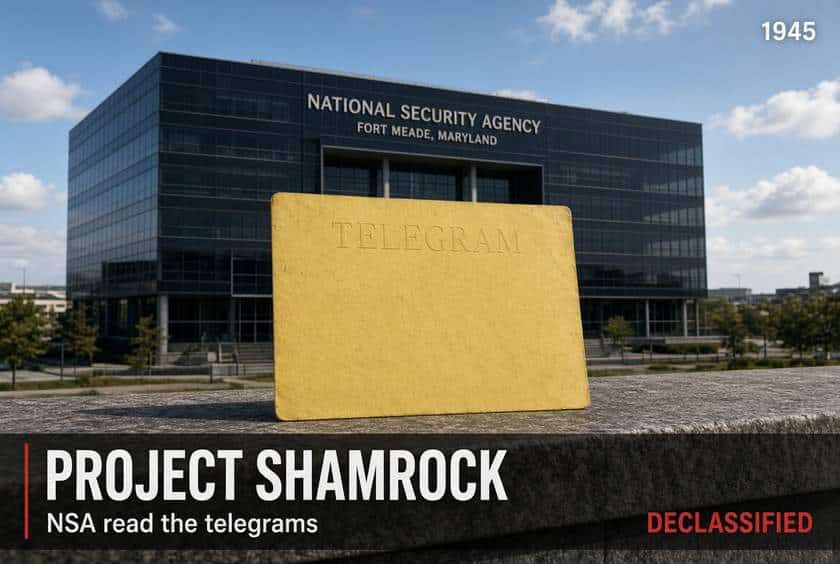
Project SHAMROCK was the arrangement under which the National Security Agency and its Army predecessors received copies of international telegrams from three American cable companies, RCA Global, ITT World Communications and Western Union International, from August 1945 to May 1975. The Senate’s Church Committee called it “probably the largest governmental interception program affecting Americans ever undertaken” (Church Committee, Book III, p. 765). No warrant was obtained for any telegram, and no written agreement with the companies was ever found (Book III, pp. 765, 771).
Two declassified accounts describe the program. The first is the Church Committee’s staff report, read into the public record in November 1975 and printed in Book III of the committee’s final report in April 1976. The second is the NSA’s own internal history, Thomas R. Johnson’s American Cryptology during the Cold War, 1945–1989, Book III: Retrenchment and Reform, written in 1998 and declassified through the Interagency Security Classification Appeals Panel in 2013. They agree on most of the mechanics. They disagree on whether the program was lawful and on who ended it.
Cable copies before 1945
According to the NSA history, the practice predates SHAMROCK by almost three decades. During World War I, federal censors sent a copy of every cable entering or leaving the United States to MI-8, the Army’s code-breaking section. Herbert Yardley’s postwar “Black Chamber” kept receiving copies from cooperative cable companies until the Radio Act of 1927 appeared to make the practice illegal, and the Communications Act of 1934 reinforced the bar. In 1938, the history states, the Army’s chief signal officer, Gen. Joseph Mauborgne, asked RCA president David Sarnoff on behalf of the secretary of war to resume sending copies, and Sarnoff agreed (Johnson, Book III, p. 83). During World War II, wartime censorship laws made all international message traffic available to military censors, who passed relevant foreign traffic to military intelligence (Book III, p. 767).
Three companies in three days, August 1945
With the war ending, the Army moved to keep its access. On August 18, 1945, two representatives of the Army Signal Security Agency went to New York to obtain the cable companies’ approval for “the interception of all Governmental traffic entering the United States, leaving the United States, or transiting the United States” (Book III, pp. 767–768, quoting an Army officer’s August 24, 1945 trip report).
The trip report records how each company responded. An ITT official first “very definitely and finally refused.” A Western Union vice president agreed, unless the attorney general ruled the intercepts illegal. On August 21 the Army representatives went back to ITT and suggested that the company “would not desire to be the only non-cooperative company on this project,” and ITT’s president agreed on the same condition. RCA’s president was willing but withheld final approval until he had heard from the attorney general (Book III, p. 768).
The companies’ lawyers uniformly advised against taking part. The Army representatives reported two fears among the executives. One was that the arrangement was illegal under federal communications rules, despite favorable opinions from the Army and Navy judge advocates general. The other was that the communications workers’ union, which had reported minor regulatory infractions before, would expose it (Book III, p. 768).
Here the two accounts part.
The NSA history says the companies received a promise from Attorney General Tom C. Clark that they would be protected from lawsuits while the Justice Department sought legislation (Johnson, Book III, p. 84). The Church Committee, working from documents the Defense Department produced in 1976, found no record that Clark ever gave the assurances the companies wanted. It did find that the program began anyway. ITT and Western Union were participating by September 1, 1945, and RCA by October 9 (Book III, p. 769).
By March 1946, an Army Signal Security Agency letter to the Army chief of staff said Western Union and RCA had “placed themselves in precarious positions since the legality of such operations has not been established,” and that only two or three people in each company knew of the operation (Book III, p. 769).
Forrestal’s assurances and the 1948 bill
In 1947 the companies asked for assurances again, this time from the president as well as the secretary of defense and the attorney general. At a December 16, 1947 meeting in Washington, Secretary of Defense James Forrestal, saying he spoke for President Truman, told ITT and RCA representatives that their participation was “in the highest interests of national security” and that they would not face criminal liability, but warned that he could not bind his successors (Book III, pp. 740, 769).
Forrestal’s office then tried to legalize the arrangement. In June 1948 it sought an amendment to Section 605 of the Communications Act that would have let agencies designated by the president obtain foreign governments’ wire and radio communications. The Senate Judiciary Committee approved the amendment in executive session on June 16, 1948, but left it to the chairman whether to release it to the floor. A Defense Department representative then told the chairman that “we did not desire an airing of the whole matter on the Floor of the Senate at this late date in the session.” The bill was apparently never reported out, and no further statutory attempt was made (Book III, pp. 769–770).
In 1949 the companies sought assurances from Forrestal’s successor, Louis Johnson, who told them the president and the attorney general had been consulted and approved. To the knowledge of the witnesses the Church Committee interviewed, that was the last time the companies asked. Control of the program passed from the Army Signal Security Agency to the Armed Forces Security Agency in 1949 and to the NSA at its creation in 1952 (Book III, p. 770).
Microfilm, paper tape and a 4 a.m. courier
Each company handled the copying differently, according to the committee’s interviews and Army documents (Book III, pp. 771–774):
- RCA Global refused an Army proposal to tap its overseas lines and agreed instead to provide paper tapes of all international traffic, which Army personnel in civilian clothes sorted in office space on the company’s premises in New York. A Recordak microfilm machine was installed there by 1950.
- ITT World Communications agreed in 1945 to give the Army access to all incoming, outgoing and transiting messages. By the early 1950s it was providing copies of its international traffic, which the NSA sorted and microfilmed.
- Western Union insisted that its own employees run the cameras. In New York, an NSA courier collected the microfilm cartridge from the transmission room floor at about 4:00 each morning. In San Antonio, an Army signal officer from Fort Sam Houston picked it up.
From 1952 to 1963, microfilm and paper tape went to NSA headquarters at Fort Meade, Maryland, several times a week. One former NSA official testified that the agency received “literally miles and miles and miles of punched tape” (Book III, p. 774).
Employees in RCA Global’s and ITT’s Washington offices believed they were handing telegrams to the FBI. The committee found the Washington messages went to the NSA (Book III, pp. 772–773). The companies never asked the NSA what it took from the material, and the NSA never told them (Book III, pp. 771, 776).
Magnetic tape and the watch list
The committee identified the switch to magnetic tape as the point where the program’s character changed. RCA Global began storing traffic on magnetic tape in the early 1960s, and by 1964 the NSA could sort RCA’s traffic electronically against its selection criteria. That meant the telegrams of Americans named on the agency’s watch lists, the program later known as MINARET, could be pulled out for analysts (Book III, pp. 765, 775). ITT followed around 1965. By 1966 RCA’s New York office supplied only magnetic tape, and ITT did the same by 1968 (Book III, pp. 772–773).
To avoid the daily round trips to Fort Meade, NSA Deputy Director Louis Tordella asked the CIA in 1966 for a place in New York to copy the tapes. The CIA rented office space in lower Manhattan under the cover of a television tape processing company and named the project LPMEDLEY. The cover ran from November 1966 to August 1973, when the CIA withdrew after its general counsel said, as Tordella recalled it, “get out of it.” The NSA moved the copying to other Manhattan office space, where it stayed until the program ended (Book III, p. 775).
The NSA history gives the scale in its own terms. The agency selected about 150,000 cables a month for further analysis and destroyed the rest (Johnson, Book III, p. 84). The Church Committee’s figure matches. About 150,000 telegrams a month were reviewed by NSA analysts in the program’s last two or three years, and the total number read over 30 years is not known (Book III, p. 765).
Western Union International’s participation ended differently. On February 2, 1968, a company vice president found the NSA’s Recordak machine in the transmission room. When a company official questioned the NSA courier on February 9, the courier said he was from the Defense Department and did not know the basis for the arrangement or what was done with the film. Western Union International’s participation ended by 1972, after another “discovery” by company officials (Book III, p. 774).
Who in government knew
Tordella, the NSA official with chief administrative responsibility for SHAMROCK, testified that to the best of his knowledge no president after Truman knew of it. He was “not sure” whether any attorney general after Clark had been told. He said he briefed Secretary of Defense James Schlesinger in the summer of 1973 (Book III, p. 770).
In 1970, during planning for the Huston Plan, the heads of the CIA, FBI, Defense Intelligence Agency and NSA discussed having the FBI take over SHAMROCK to gather information on domestic unrest. The FBI declined, and the idea was dropped (Book III, p. 776).
Two accounts of the legal question
The Church Committee concluded that copying Americans’ telegrams at the companies’ offices “appears to violate” the Fourth Amendment. It found the application of Section 605 to foreign intelligence interception unclear, but said that where telegrams were used for other purposes, such as the watch lists, Section 605 “would be violated.” It also found that the NSA’s own governing directive, issued in 1958, excluded “the intercept and processing of unencrypted written communications,” so the agency appeared to have exceeded its authority under internal executive rules (Book III, pp. 766–767).
The NSA history takes a different view. It describes the program as “not technically illegal” and records that Lt. Gen. Lew Allen, NSA director in the mid-1970s, said it did not pass the “smell test” very well (Johnson, Book III, p. 84).
May 15, 1975, and the record afterward
Documents from the Rockefeller Commission, which reached the Church Committee in May 1975, mentioned CIA “cover” for an NSA operation in New York where telegrams were copied. The NSA gave no confirmation when first asked in June and said in July that the subject could be disclosed only to Senators Frank Church and John Tower. Press reports in July and August 1975 described parts of the operation, and the NSA gave the committee its first detailed briefing in early September (Book III, pp. 766–767).
The two accounts also differ on how the program ended. The Church Committee states that SHAMROCK was terminated on May 15, 1975, “by order of Secretary of Defense James Schlesinger,” and cites a handwritten memorandum from Allen dated May 12 saying the secretary had decided to end it effective May 15. The NSA gave two reasons: the program was no longer a valuable source of foreign intelligence, and the risk of exposure had grown (Book III, p. 776). The NSA history credits Allen himself. It says he terminated the cable company portion on May 15, in the middle of the committee’s preliminary inquiry, “knowing the ramifications” (Johnson, Book III, p. 93).
On November 6, 1975, Church read the committee’s SHAMROCK report into the record at a public session. The executive branch declined to provide witnesses, so no other public record was made (Book III, p. 767). According to the NSA history, Allen had opposed public disclosure because of the embarrassment to the cable companies, and Senators Barry Goldwater, Tower and Howard Baker opposed it in closed session. Church argued that both SHAMROCK and MINARET were needed to support new legislation (Johnson, Book III, p. 94).
The record kept growing after the hearing. On March 25, 1976, the Defense Department told the committee that the NSA had “discovered” a file of SHAMROCK documents that a lower-level employee had held until about March 1. On April 26, 1976, while the final report was being printed, the department reported nine more documents found at the National Archives, including the papers on the 1948 Section 605 amendment (Book III, pp. 767, 769). The NSA history identifies the Foreign Intelligence Surveillance Act of 1978 as the closing act of this period for the agency (Johnson, Book III, p. 106).
A related program that the NSA history calls “New Shamrock,” wiretaps on foreign embassies in the United States that numbered sixty to seventy through the 1960s, is described only briefly in the declassified text (Johnson, Book III, p. 106). The watch-list program fed by SHAMROCK’s tapes is covered in this archive’s entry on Project MINARET.
Sources
- U.S. Senate, Select Committee to Study Governmental Operations with Respect to Intelligence Activities, Final Report, Book III: Supplementary Detailed Staff Reports on Intelligence Activities and the Rights of Americans, “National Security Agency Surveillance Affecting Americans,” pp. 733–783 (April 1976), PDF via the AARC Public Library. Used for: the program’s history, the 1945 negotiations, the Forrestal and Johnson assurances, the 1948 amendment, company mechanics, LPMEDLEY, the legal analysis, the investigation and termination.
- Thomas R. Johnson, American Cryptology during the Cold War, 1945–1989, Book III: Retrenchment and Reform, 1972–1980, National Security Agency, Center for Cryptologic History (1998; declassified by ISCAP, 2013), via the Internet Archive. Used for: the pre-1945 precedent, the Clark assurance, the 150,000-per-month selection figure, “not technically illegal,” Allen’s “smell test” remark, Allen’s termination of the program, the disclosure debate, “New Shamrock” and FISA.
- National Security Archive, Document 35: Thomas R. Johnson, American Cryptology during the Cold War, Book III (excerpt). Used for: the catalog record of the NSA history.
- DeClassified Now, “Project MINARET: The NSA’s Watch List of Americans”. Used for: the related watch-list program.