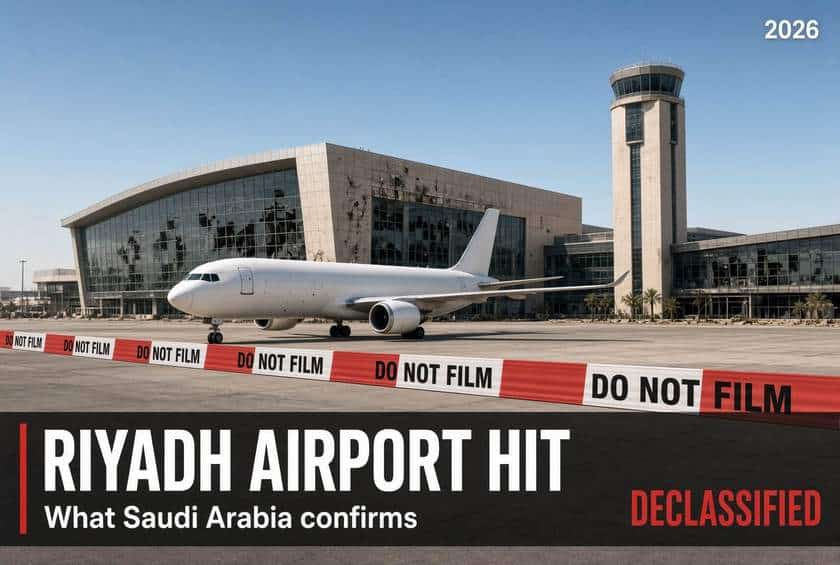
“I was on gate 403,” a witness at Riyadh’s King Khalid International Airport told AFP on Saturday afternoon. “I saw 401 hit, I saw injured in front of my eyes. Everyone was running.” A hospital source in the Saudi capital told the agency that dozens of people were injured, at least five of them treated in intensive care. One of two regional officials who spoke to the Associated Press said a missile had struck a passenger terminal.
As of Saturday evening, the Saudi government had not confirmed that anything happened. Saudi authorities did not confirm a new attack or an evacuation, AFP reported. The government-run Center for International Communication, which handles foreign media in the kingdom, did not immediately respond to the AP.
That gap is not new this week. Early in the week, hours after the Houthis claimed a new wave of strikes on the kingdom, the Interior Ministry warned the public that “filming, publishing or sharing information related to countering missiles and drones and their impact sites exposes you to legal liability.” The warning, reported by The National and the AP, applies to citizens and foreign residents alike and gives no penalty. Saudi Arabia has been tightly controlling public information about Houthi attacks on its soil in recent weeks, AFP reported, leaving media and residents unclear about the danger. France’s embassy went further on Friday and told French nationals not to record images of areas that had been hit, or to share any online.
Six days of strikes, and who has said so
We sorted this week’s reported attacks by who has vouched for them. The Houthis claim most of them. Saudi officials have confirmed some, sometimes through the civil aviation authority, sometimes through the military coalition, and have said nothing about others.
| When | Reported target | Houthi claim | Saudi official word |
|---|---|---|---|
| Oct. 5–6 | Riyadh airport; Aramco refinery at Rabigh | Yes | Interior Ministry filming warning hours later; no statement found on Rabigh |
| Oct. 6–7 | Abha and Riyadh airports | Yes | Civil aviation authority: 3 civilians killed, 36 injured at Abha and Riyadh |
| Oct. 8 | Riyadh airport, Najran airport, King Khalid Air Base | Yes, cruise and ballistic missiles | Civil aviation authority: 3 Saudis killed at Riyadh, including a pilot; 2 missiles intercepted; nothing on Najran or the air base |
| Oct. 10 | Riyadh airport passenger terminal | No statement yet | None |
Even the confirmed attacks arrive in pieces. In a statement on X on Friday, the General Authority of Civil Aviation said the Thursday attacks on the Riyadh airport killed an airline pilot and two other Saudi citizens and wounded several people of different nationalities. The flag carrier Saudia named the pilot as Captain Hamoud Ali Alkalthami citing an “incident” at the airport. On Thursday, Saudi authorities said two ballistic missiles fired toward Riyadh had been intercepted and that falling debris damaged a kindergarten and a medical clinic, CNN reported. The Houthis said their missile hit its target. Images verified by CNN showed smoke over the airport’s Terminal 4 and what appeared to be a damaged Saudi aircraft.
The aviation authority had earlier said that attacks on the Abha and Riyadh airports killed three civilians and injured 36, according to Al Jazeera. The AP reported that one of the dead in Wednesday’s attack was a Sudanese national. Al Jazeera also reported at least three people wounded in attacks on the Jazan and Najran airports near the Yemeni border.
Saturday’s events are the clearest case of the gap.
Two regional officials told the AP that the airport was attacked and evacuated and that air traffic stopped. A diplomatic source told AFP that a Houthi missile hit the airport at around 3 p.m. local time. Flightradar24 showed incoming flights diverted, Kuwait Airways said it was cancelling flights because the airport had closed, and the U.S., Canadian, German and Spanish embassies told their citizens to avoid it. Spain’s embassy called it a “new attack.” The official Saudi account so far is a terse airport alert telling passengers to check their flight status with their airlines.
What both sides claim in Yemen
The figures released about the fighting inside Yemen are larger and come with fewer caveats, but they come from the parties themselves. The Saudi-led coalition said it struck 82 Houthi military targets in Saada, Hodeidah, Al-Jawf and Marib provinces late Wednesday, and said on Friday that it had destroyed three Houthi rocket launch platforms. Yemen’s internationally recognized government said on Thursday that its forces had carried out 1,729 strikes during the offensive and killed 1,370 Houthi fighters. The Houthis said Saudi warplanes carried out 59 airstrikes and missile attacks in 24 hours, causing civilian casualties, CNN reported. None of those numbers has been independently verified.
The two sides also disagree on the ground. On Tuesday, The National reported that government forces had taken the Bab el-Mandeb strait, Dhubab and the port of Mokha. On Saturday, Yemeni military sources told AFP that their forces were advancing around the strait but had not yet secured control of the waterway, and that Mayun Island, in the middle of the strait, remained in Houthi hands. A Houthi official told AFP that the group still controls Bab el-Mandeb and the rest of the western coast.
A war that keeps widening
The Houthis, who have fought Yemen’s government and a Saudi-led coalition since 2015, renewed attacks on the kingdom after the U.S.-Iran ceasefire collapsed in July, according to CNN. Last month they seized Yemen’s western coastline, and the Saudi-backed government launched its counteroffensive last weekend. In a televised speech on Thursday, Houthi leader Abdul Malik al-Houthi said that “the Yemeni people today possess all the determination and elements of strength, regardless of how long the war lasts.” His group has warned airlines “for the last time,” in the AP’s words, against operating in Saudi airspace, and has told workers at Saudi oil facilities to stay away from possible targets.
The European Union Aviation Safety Agency expanded its guidance on Saudi airspace this week, warning that missile and drone attacks and interceptions “create an increased risk of misidentification of civil aircraft,” the AP reported. The U.S. Mission in Saudi Arabia now requires government employees to get special authorization to use the Riyadh airport.
Other governments are being pulled closer. Pakistan’s foreign ministry spokesman said on Friday that the country has a “substantial number of forces” in Riyadh under the mutual defense pact Saudi Arabia signed with Pakistan and Turkey this year, and that they would not cross into Yemen. Saudi Arabia and Yemen’s government asked the U.N. Security Council on Friday to act. U.S. officials have told the AP that American help includes intelligence sharing, target identification and planning for the offensive. Asked about the Riyadh attacks as he left the White House on Friday, President Donald Trump told reporters, “It’s not good” and “I’m not happy.” There has been no sign of direct U.S. military action in response.
This story is developing. The extent of Saturday’s damage and the number of people hurt have not been confirmed by any Saudi authority as of this writing. We covered the U.S. role in the offensive in U.S. Stays Out of Yemen’s Offensive, but Supplies the Targets, and the redacted finding on civilian harm from the last Saudi air war in The Saudi Arms Finding State Redacted, Even for Congress.
Sources
- Euronews, with AFP, “Evacuations and injuries reported at Riyadh airport after another alleged Houthi attack” (Oct. 10, 2026). Used for: the gate 403 witness, the hospital source, the lack of Saudi confirmation and the embassy warnings.
- The Associated Press via WSVN, “Missile strikes passenger terminal at Riyadh airport and many are wounded, official says” (Oct. 10, 2026). Used for: the regional officials, the Center for International Communication, Flightradar24 and Kuwait Airways, the Sudanese victim, the Interior Ministry warning, EASA, the airline warning, U.S. assistance and Trump’s remarks.
- CBS News live updates, with AFP and AP (Oct. 10, 2026). Used for: AFP’s report on Saudi information control, the French embassy warning, the 3 p.m. diplomatic source, Spain’s embassy, and the Bab el-Mandeb claims.
- The National, “Saudi Arabia warns against filming or sharing missile and drone interceptions” (Oct. 6, 2026). Used for: the Interior Ministry statement, the Rabigh and Riyadh claims, and the government’s claimed capture of Bab el-Mandeb and Mokha.
- Al Jazeera, “Houthi attack on Riyadh airport killed three Saudi nationals” (Oct. 9, 2026). Used for: the civil aviation authority statements, Saudia’s statement, Jazan and Najran, the rocket launch platforms, Pakistan’s deployment and the U.N. Security Council request.
- CNN, “Attack on Saudi airport kills 3 as Iran-backed Houthis warn of long conflict” (Oct. 8, 2026). Used for: the Houthi claims of Oct. 8, the intercepted missiles and debris damage, the verified images, al-Houthi’s speech, the coalition’s 82 targets and both sides’ casualty claims.
- Gulf News, “Americans in Saudi Arabia warned after Riyadh airport attacks” (Oct. 8, 2026). Used for: the U.S. Mission security alert.