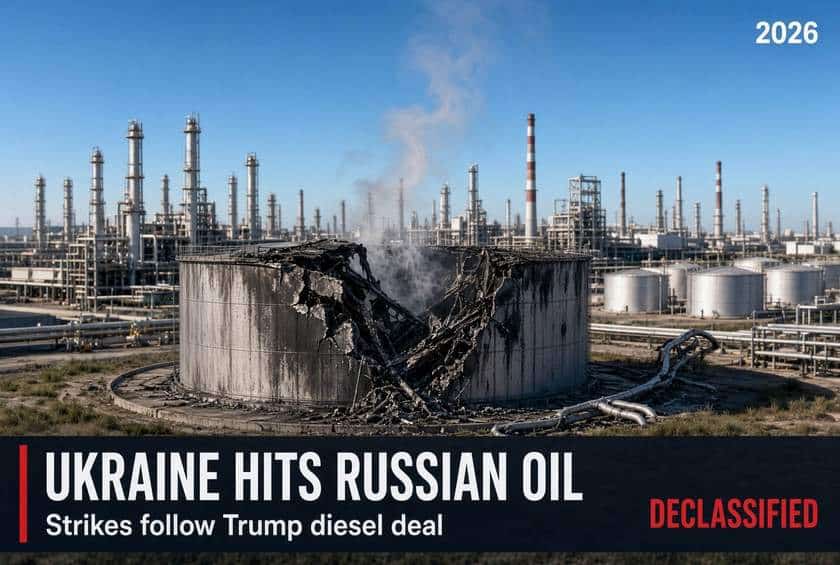
The Treasury Department’s license for Russian diesel was digitally signed at 2:43 p.m. Eastern on Friday, October 9. That morning, drones had struck a Lukoil refinery in Ukhta, in Russia’s far-northern Komi Republic, and President Volodymyr Zelensky confirmed the hit that afternoon. Overnight, after the license was signed, fires broke out at two more Russian oil sites, a fuel export terminal in Rostov-on-Don and a crude oil hub in Samara Oblast.
As of Saturday evening in Kyiv, no Russian refinery has been reported hit since President Donald Trump announced that Russia would supply diesel to U.S. and world markets. That is a matter of hours, not a pause. A senior Ukrainian official told the Financial Times on Friday, “We will burn [Russian] refineries,” according to Ukrainska Pravda’s account of the FT report.
Four oil sites in three days
We built this timeline from the time stamps on official statements and the first reports of each strike. Times are Kyiv time, which matches Moscow’s.
| When | Target | Relative to the deal | Who confirms it |
|---|---|---|---|
| Oct. 8, afternoon | Omsk refinery, Siberia, which Ukraine’s General Staff calls Russia’s largest | Before | Ukraine’s General Staff; drone maker Fire Point |
| Oct. 9, morning | Lukoil refinery, Ukhta, Komi Republic | Before, same day | Zelensky on X; reported by The Moscow Times and Ukrainska Pravda |
| Oct. 9, 9:43 p.m. | Treasury signs General License 135 | The deal | OFAC |
| Night of Oct. 9–10 | Yug Rusi oil-loading terminal, Rostov-on-Don | After | Regional governor confirmed a fire, not the target; Ukraine has not claimed it |
| Night of Oct. 9–10 | Samara crude oil station near Prosvet | After | Ukraine’s General Staff |
Neither post-deal target is a refinery. The Rostov site ships petroleum products for export, including fuel from the Novoshakhtinsk refinery, and the Kyiv Independent notes that it is separate from the refinery’s processing plant. Rostov Oblast Governor Yuri Slyusar confirmed a fire and said more than 50 drones had been shot down since the previous evening, according to Ukrainska Pravda. He did not confirm damage to the terminal, and the Kyiv Independent said it could not verify the footage. The Samara station, according to Ukraine’s General Staff, receives, stores and blends crude into Urals, Russia’s main export grade. The General Staff says it also struck the station earlier in the month.
Zelensky said the Ukhta refinery, about 1,900 kilometers from Ukraine’s border, was hit by An-196 drones. Damage there has not been independently established.
What the license allows
Trump’s Truth Social post put numbers on the deal. Russia would supply more than 300,000 tons of diesel immediately, another 500,000 tons in November and 1 million tons after that. A further 3 million tons would follow “based on the condition of their Diesel Refineries,” according to the post as quoted by the Kyiv Independent and Ukrainska Pravda. The Kremlin’s readout confirmed Russia’s readiness to supply oil and petroleum products to the U.S. and global markets, without figures.
The Treasury document has no figures either. General License 135, issued by the Office of Foreign Assets Control, authorizes transactions “related to the sale, delivery, offloading, or importation, including importation into the United States, of diesel fuel of Russian Federation origin.” It runs until 12:01 a.m. Eastern on April 7, 2027. It sets no tonnage, no list of approved sellers or buyers, and no link to the condition of Russian refineries. The only carve-out bars debits to U.S. bank accounts held by Russia’s central bank, its National Wealth Fund and its Finance Ministry.
The diesel also has to get past a Russian rule. On September 30 the Russian government extended its ban on diesel exports by fuel producers to October 31, citing harvest-season demand, The Moscow Times reported. A separate ban on diesel exports by non-producers runs through January. Neither Washington nor Moscow has said how an “immediate” 300,000 tons fits with that ban, which has three weeks left to run.
Russia imposed those curbs because of the drone campaign. The Moscow Times reported that Russian regions have reintroduced fuel rationing, and Ukraine’s military has claimed it knocked out more than 45% of Russia’s refining capacity. That figure is Ukraine’s own, and it has not been independently verified.
Axios: the deal followed Kyiv’s refusal
Axios reported on Saturday that Trump decided on the deal after Zelensky ignored about half a dozen U.S. requests to stop striking Russian refineries, citing a senior U.S. official. In the official’s account, Trump wanted Ukraine to stop on its own because the strikes were adding to high fuel prices in the United States, and he did not see them as equivalent to Russian strikes on Ukraine’s power grid. The official said Zelensky was “misreading the room.”
Zelensky’s position, according to the same report, was that Ukraine would stop hitting refineries if Russia stopped hitting Ukrainian power plants. Axios reported that during eight hours of talks in Miami, Trump envoys Steve Witkoff and Jared Kushner told the Ukrainian delegation that Trump would speak to Putin and lift sanctions on Russian diesel.
The two sides disagree on one point. A Ukrainian official told Axios that Witkoff and Kushner threatened to cut Ukraine off from U.S. intelligence if the strikes continued. The U.S. official denied any such threat. We were unable to read the Axios article directly, and these details come from Ukrainska Pravda’s account of it.
Kyiv’s answer
Zelensky responded on X late Friday. “Ukraine will not set Russian oil refineries on fire if Russia does not destroy our energy infrastructure,” he wrote, calling that the agreement Ukraine is proposing to the United States. He said allowing Russia to sell petroleum products was an investment in the war. In a phone interview with Axios, he called the decision “a happy birthday present for Putin,” whose birthday was October 7, according to Ukrainska Pravda.
In Washington, Democratic Senators Jeanne Shaheen, Chuck Schumer and Elizabeth Warren called the authorization “a total betrayal of Ukraine, our European allies and American national security” in a joint statement, the Kyiv Independent reported.
The Kremlin’s account of the call focused elsewhere. Kremlin aide Yury Ushakov said Putin told Trump that Ukraine’s drone attacks during Russia’s September elections had ruled out an immediate return to three-way peace talks, The Moscow Times reported.
Europe holds its line
Germany said on Saturday that it would keep its sanctions on Russia and that its support for Ukraine is unchanged, according to a statement from government spokesperson Stefan Kornelius reported by The Moscow Times. An Economy Ministry spokesperson said Germany has imported no Russian oil or petroleum products since EU sanctions took effect in 2023, according to Ukrainska Pravda’s report citing Welt. EU restrictions are not affected by the U.S. license.
Estonian Prime Minister Kristen Michal called the U.S. decision a major mistake in a Facebook post. He said Estonia and the upcoming European Council meeting should consider whether to rapidly increase support for Ukraine so that it “turns Russian oil refineries into ruins,” Ukrainska Pravda reported.
This story is developing. No diesel shipment under the deal has been reported, and the overnight Rostov fire has not been independently assessed. Our earlier breakdown of the deal’s volumes against global diesel demand covers what the promised tonnage would add to the market. The full text of General License 135 is on Treasury’s site.
Sources
- U.S. Treasury, OFAC, Russia-related General License No. 135, signed Oct. 9, 2026 (PDF) and OFAC recent action notice, Oct. 9, 2026. Used for: the license’s terms, expiry, carve-out and signing time.
- Ukrainska Pravda, “Omsk Oil Refinery strike” (Oct. 8, 2026). Used for: the Omsk strike, citing Ukraine’s General Staff and Fire Point.
- Ukrainska Pravda, “Drones attack Lukoil oil refinery in Russia” (Oct. 9, 2026). Used for: the Ukhta strike and its timing.
- The Moscow Times, “Ukraine Drones Hit Second Yandex Data Center in Two Days” (Oct. 9, 2026). Used for: Friday-morning reports of the Komi refinery attack.
- Ukrainska Pravda, Zelensky confirms Omsk and Ukhta strikes (Oct. 9, 2026). Used for: Zelensky’s confirmation, the 1,900 km distance and the An-196 drones.
- The Kyiv Independent, “Trump allows Russia to supply millions of tons of diesel to US, global markets” (Oct. 9, 2026) and Ukrainska Pravda, “Trump announces deal with Putin for millions of tonnes of Russian diesel” (Oct. 9, 2026). Used for: the tonnages in Trump’s post and the senators’ statement.
- Ukrainska Pravda, Kremlin readout of the Putin–Trump call (Oct. 9, 2026). Used for: Russia’s confirmation of readiness to supply.
- The Kyiv Independent, “Major fire reported at oil terminal linked to Russia’s Novoshakhtinsk refinery” (Oct. 10, 2026) and Ukrainska Pravda (Oct. 10, 2026). Used for: the Rostov terminal fire, its link to the refinery, and the governor’s statement.
- Ukrainska Pravda, Samara station strike (Oct. 10, 2026). Used for: the General Staff’s account of the Samara strike.
- The Moscow Times, “Government Extends Diesel Export Ban Until End of October” (Sept. 30, 2026). Used for: Russia’s export bans, fuel rationing and Ukraine’s 45% claim.
- Axios, “U.S. official: Trump cut deal with Putin after Zelensky ignored his requests” (Oct. 10, 2026), as reported by Ukrainska Pravda and Ukrainska Pravda. Used for: the U.S. official’s account, the Miami talks and the disputed intelligence threat.
- Ukrainska Pravda, citing the Financial Times (Oct. 10, 2026). Used for: the senior Ukrainian official’s quote.
- Ukrainska Pravda, Zelensky on X (Oct. 9, 2026) and Ukrainska Pravda, Zelensky’s Axios interview (Oct. 10, 2026). Used for: Zelensky’s quotes.
- The Moscow Times, Kremlin account of the call (Oct. 10, 2026). Used for: Ushakov’s remarks.
- The Moscow Times, “Germany Sticks to Russia Sanctions” (Oct. 10, 2026) and Ukrainska Pravda (Oct. 10, 2026). Used for: Germany’s statements.
- Ukrainska Pravda, Estonian PM Kristen Michal (Oct. 10, 2026). Used for: Michal’s comments.