OPINION
Every country has a story it tells about itself. For about a century, Canada’s has gone something like this: we are very good at digging things up, cutting things down and sending them somewhere else to be turned into something more expensive.
In 1979, a federal agency wrote that story down as a warning. The Science Council of Canada told Ottawa that unless the country built its own technological capability, Canadians would “return to their traditional role of ‘hewers of wood and drawers of water.'” It also noted, with some bureaucratic bluntness, that Canada’s industrial weakness was largely the result of policies Canada had chosen for itself.
That last part is the hopeful bit. An economy built by choices can be rebuilt by different ones. Half a century of government reports explains how leaning on one customer left Canada short of the factories, laboratories and high-end services that make a country rich and hard to push around. The last decade of trade data suggests what happens when it stops leaning.
A theory from the 1920s
The idea has a name, and it is older than most of the industries in question. In the 1920s, the economic historians Harold Innis and W. A. Mackintosh developed what became known as the staple thesis: Canada grew up exporting raw materials, from fur and fish to timber, grain and oil, and those exports shaped everything from where people settled to how the provinces fought with Ottawa.
The two men disagreed about where it led. Mackintosh expected the staple economy to mature into an industrial one. Innis worried Canada would be locked in for good as a resource hinterland for a bigger economy. The Canadian Encyclopedia notes that the thesis’s modern proponents think Innis had it right.
The branch-plant years
The bigger economy, after the Second World War, was the United States. American companies built plants in Canada to get behind the tariff wall, and by the 1960s the question of who owned Canadian industry had become a national argument.
In 1967, prodded by former finance minister Walter Gordon, Lester Pearson’s government appointed a task force of eight economists chaired by Mel Watkins. Its 1968 report documented the costs and benefits of foreign ownership and recommended a development corporation to help Canadians own more of their own economy. The government declined to endorse it, a 1974 McGill Law Journal review noted.
The next study had a stranger journey. The Gray Report, Foreign Direct Investment in Canada, was “leaked to the public through the back door,” appearing in abbreviated form in the Canadian Forum in December 1971, months before it was tabled in the House of Commons on May 2, 1972. Two days later, Herb Gray introduced a bill to screen foreign takeovers, and in 1973 Parliament established the Foreign Investment Review Agency on the report’s framework.
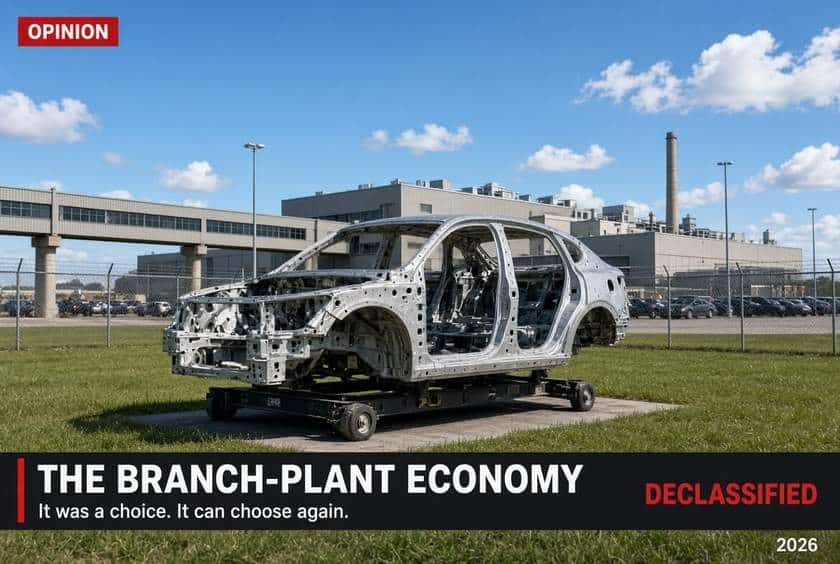
The Science Council gave the problem its most useful name: truncation. In Forging the Links (1979), it defined a truncated firm as a subsidiary missing the functions it would need to act on its own, from research and development to marketing, because those sit with a parent company abroad. Its conclusion is the heart of the matter. If enough firms in an economy are truncated, the council wrote, the whole economy takes on the same traits and becomes dependent and technologically backward.
The council described what that looked like on the ground. Most of Canada’s industrial capacity, it found, sat in low- and medium-technology assembly operations serving the home market, many of them branch plants. And foreign ownership and control were higher than in any other developed country.
Why services ride on factories
It is tempting to answer that none of this matters in a service economy. The Science Council anticipated that, too. A study it commissioned found that about a fifth of all service jobs in Canada were directly tied to manufacturing and resource extraction, and that every 100 manufacturing jobs generated 33 in services. Engineering, design, finance, consulting and software tend to cluster where things are invented and made. A country that assembles other people’s products tends to import their engineering along with the blueprints.
The bill, with interest
The pattern the reports described still shows up in the numbers. Canada spent 1.81 percent of GDP on research and development in 2022, Statistics Canada reports, against an OECD average of 2.73 percent. Innovation, Science and Economic Development Canada says the country has trailed the OECD average for two decades, “mainly driven by low business expenditure on R&D.”
Productivity tells the same story. Canada’s business-sector labour productivity fell from 83 percent of the U.S. level in 2002 to 73 percent in 2019, according to a Statistics Canada study published last December.
And the customer list is short. The U.S. still took 71.7 percent of Canadian merchandise exports in 2025, the Business Data Lab reports, even after a year in which that share fell more than four points.
What happens when Canada trades wider
Here is where the story gets better. When Canada has opened new markets, its exporters have used them.
Global Affairs Canada found that in the first five years of the Canada-EU trade agreement, Canadian merchandise exports to the EU rose 46.4 percent from their 2016 level. The products that got the biggest tariff cuts grew fastest. Those with cuts of more than 10 percentage points grew 54.5 percent. By March of this year, Canada and the EU said two-way goods trade had grown more than 75 percent since 2017, and trade in services had nearly doubled.
The shift has sped up under pressure. Exports to markets other than the U.S. rose 5.8 percent to a record in 2025, and exports of aircraft and other transportation equipment hit a record C$3.5 billion in December, according to the Business Data Lab. Ottawa’s stated goal is to double non-U.S. exports within a decade, which Global Affairs Canada puts at $300 billion more in trade.
None of this undoes a century of branch plants by itself. But it points the right way. A firm that sells to Germany, Japan and Vietnam needs its own designers, marketers and engineers in a way a subsidiary shipping to its parent in Michigan does not. Diversification and industrial depth are the same project.
The Auto Pact’s rebuttal
The strongest counterexample is the car. The 1965 Auto Pact tied Canada’s auto industry into a single continental market, and it worked. Canada’s share of the combined Canada-U.S. industry more than doubled from under 5 percent before 1965 by the 1970s, according to The Canadian Encyclopedia, and auto production overtook pulp and paper as Canada’s largest industry. Later, the economist Daniel Trefler found that the 1989 free trade agreement raised labour productivity by 14 percent at the plant level in the Canadian industries that got the biggest U.S. tariff cuts. Integration with the U.S. built real industry and made it better.
The details point somewhere else, though. The Auto Pact also moved decisions about design, sourcing and specification to the U.S. parent companies. Trefler’s gains came from competition. Both are arguments for more trade, with more partners, rather than less.
Building the second floor
The Science Council’s prescription in 1979 was something it called technological sovereignty, meaning the capacity to steer how technology is developed and used so that Canadians get the most out of the economic activity happening in Canada. It was not a call to close the border. It was a call to stop being the branch office.
Forty-seven years later, the customers are lining up in Europe and Asia, and the reports are still on the shelf. Canada has done the reading. It just has to do the homework.
Related: Canada Is Breaking From the U.S.: Why It Feels So Hard
Canada’s Branch-Plant Economy Was a Choice. It Can Choose Again.
Sources
- Science Council of Canada: Forging the Links: A Technology Policy for Canada, Report 29 (1979). Used for: “hewers of wood” warning, policies of Canada’s own making, definition of truncation, branch-plant assembly, services employment, technological sovereignty.
- The Canadian Encyclopedia: Staple Thesis, by Mel Watkins. Used for: Innis and Mackintosh, the 1920s origins, the hinterland debate.
- The Canadian Encyclopedia: Task Force on Foreign Ownership and the Structure of Canadian Investment. Used for: the 1967 task force, its eight economists and its recommendations.
- Wikipedia: Mel Watkins. Used for: Walter Gordon’s role as former finance minister.
- McGill Law Journal: After the Gray Report: The Tortuous Evolution of Foreign Investment Policy (1974). Used for: the Watkins Report’s reception, the Gray Report leak via the Canadian Forum, the May 2, 1972 tabling and Bill C-201.
- Wikipedia: Foreign Investment Review Agency. Used for: FIRA’s establishment in 1973 on the Gray Report’s framework.
- Statistics Canada: Gross domestic expenditures on research and development, 2022 (final). Used for: 1.81% R&D intensity vs. OECD 2.73%.
- Innovation, Science and Economic Development Canada: Growing business investment in research and development. Used for: two decades below the OECD average, driven by low business R&D.
- Statistics Canada: The role of firm size in the Canada–U.S. labour productivity gap since 2000 (Dec. 22, 2025). Used for: 83% of the U.S. level in 2002, 73% in 2019.
- Business Data Lab: Diversification Gains Traction as Exports Close the Year Stronger. Used for: 71.7% U.S. export share, record non-U.S. exports, record aircraft exports.
- Global Affairs Canada: CETA@5: Delivering trade benefits during unprecedented times. Used for: 46.4% export growth to the EU, faster growth for products with the deepest tariff cuts.
- Global Affairs Canada: Joint statement on boosting EU–Canada trade through CETA (March 5, 2026). Used for: goods trade up more than 75% and services up 97% since 2017.
- Global Affairs Canada: Diversifying Canada’s trade. Used for: the goal of doubling non-U.S. exports, $300 billion more in trade.
- The Canadian Encyclopedia: Automotive Industry. Used for: the Auto Pact and Canada’s share of the Canada-U.S. industry.
- Wikipedia: Canada–United States Automotive Products Agreement. Used for: autos overtaking pulp and paper; decisions shifting to U.S. parents.
- Daniel Trefler: The Long and Short of the Canada-U.S. Free Trade Agreement (NBER; American Economic Review, 2004). Used for: 14% plant-level productivity gain in industries with the largest U.S. tariff cuts.