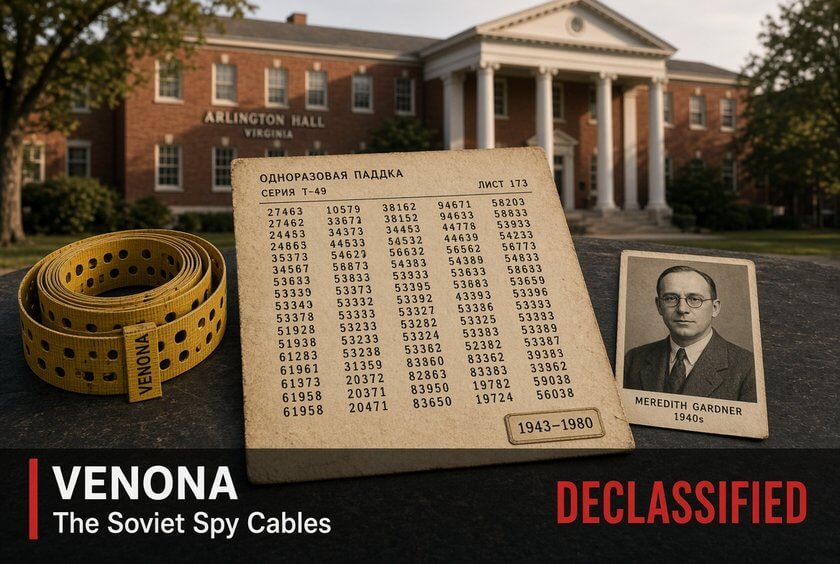
VENONA was the U.S. Army and later National Security Agency program to decrypt Soviet intelligence and diplomatic telegrams sent in the 1940s. Analysts read portions of more than 2,900 messages sent between 1940 and 1948, and the program was formally closed in 1980 (Benson and Warner, Venona: Soviet Espionage and the American Response, 1939–1957, NSA/CIA, 1996, preface).
The translations were declassified in a series of releases beginning in July 1995 and completed before an October 1996 NSA–CIA conference (ibid., foreword). This entry summarizes the program’s history as documented in that volume, which reprints the translations and the U.S. government records cited below.
Background
Under a June 1942 agreement with the Navy and the FBI, the Army held exclusive responsibility for analyzing foreign diplomatic and military ciphers. That work was based at the Signal Security Agency’s facility at Arlington Hall, in Northern Virginia (preface). Decrypted 1942 Japanese Army cables showed that Finnish cryptanalysts had made progress sorting Soviet traffic.
Benson and Warner describe this as “probably the immediate inspiration” for the Army’s examination of the Soviet telegrams (preface; Tokyo Circular 906, Oct. 6, 1942, Document 7).
On Feb. 1, 1943, the Signal Security Agency created a small program to examine the encrypted Soviet telegrams. It did so on orders from Col. Carter Clarke of the Military Intelligence Service’s Special Branch. Clarke was reportedly concerned that Moscow and Berlin might negotiate a separate peace (preface). Gene Grabeel, a former Virginia schoolteacher, began the work. She would remain on the project for 36 years (preface).
The cryptographic flaw
The Soviet messages were first encoded from a codebook and then enciphered with a one-time pad. Used correctly, that system is unbreakable. According to an inset by NSA’s Cecil James Phillips, the weakness lay in manufacture. For a few months in early 1942, the KGB’s cryptographic center printed duplicate copies of more than 35,000 pages of key and bound them into separate pad books (preface, “What Made Venona Possible?”).
The duplicate pages began appearing in messages in mid-1942. Most were used between 1942 and 1944, and one circuit still carried them as late as June 1948 (ibid.).
Lt. Richard Hallock found evidence of the duplicate pages in autumn 1943, in traffic of Soviet trade organizations. Analysts designated that traffic “Trade” (ibid.). In November 1944, Arlington Hall solved the messages’ starting-point indicator. Benson and Warner describe this as “the breakthrough that eventually made the cables readable” (preface).
The analysts identified five cryptographic systems. The other four, besides Trade, belonged to the KGB, the GRU, Naval GRU and the Foreign Ministry (preface).
Reading the messages, 1946–1948
Late in 1946, linguist Meredith Gardner broke the “spell table” that the KGB codebook used to encode English letters. This made names and English phrases readable. Soon afterward he was reading a 1944 message that listed prominent atomic scientists, including several at the Manhattan Project (preface; New York 1699 to Moscow, Dec. 2, 1944, Translation 74). By May 1947, Gardner had read a message implying that the Soviets had a source with access to War Department General Staff information (preface; Translation 77).
In the summer of 1947, Gardner drafted “Special Report #1” for senior Army Security Agency officials. It listed a covername tentatively read as “LIBERAL” and mentioned the source’s wife, “ETHEL” (Document 19; New York 1657 to Moscow, Nov. 27, 1944, Translation 73).
n late August or early September 1948, Clarke, by then deputy G-2, asked the FBI for a list of Soviet covernames. That exchange began the FBI’s cooperation with the codebreakers (preface). FBI Special Agent Robert Lamphere met Gardner in October 1948 and took over liaison with the project full-time (preface).
The program carried several names. The translations were first called the “Gardner material,” then “Bride” from 1950, and “Drug” from the late 1950s. The term “Venona” did not appear on translated messages until 1961 (preface, note on control terms).
Identifications, 1948–1951
The FBI used the translations as leads and did not introduce them in court. The volume records the following identifications (preface):
- December 1948 — Covername SIMA was identified as Justice Department analyst Judith Coplon. She was arrested in March 1949, the first arrest based on a VENONA lead. Both of her convictions were later overturned on appeal.
- September 1949 — Covernames REST and CHARLES were identified as Manhattan Project physicist Klaus Fuchs (Document 28). His interrogation by British authorities led the FBI to courier Harry Gold, arrested May 22, 1950.
- February–June 1950 — Covername CALIBRE led to David Greenglass, a wartime enlisted man at Los Alamos, who confessed June 15, 1950, and implicated his brother-in-law Julius Rosenberg. In late June 1950, the FBI matched covernames LIBERAL and ANTENNA to Julius Rosenberg. Two messages also implicated his wife, Ethel.
- 1949–1950 — Covername MLAD (“YOUNGSTER”) was matched to physicist Theodore Alvin Hall. Hall was questioned in 1951 but never prosecuted, “probably because a case could not have been made without revealing” the program.
- March–May 1951 — Covername HOMER (rendered “GOMER” in the Russian) was narrowed to British diplomat Donald Maclean. He and Guy Burgess then fled to the Soviet Union.
By June 1950, the FBI had determined that the covername ALES, in one KGB message, referred to former State Department official Alger Hiss (preface; Washington 1822 to Moscow, March 30, 1945, Translation 89). Around the same time, the covername JURIST was matched to former Treasury official Harry Dexter White (preface).
Compromise of the program
The Soviets had sources inside the effort. William Weisband, a Russian-speaking “linguist adviser” in Arlington Hall’s Russian Section, was named in 1950 by a former Soviet source as his wartime KGB handler.
Weisband was never prosecuted for espionage. He was convicted of contempt in November 1950 for skipping a grand jury hearing and sentenced to a year in prison (preface, “Who Was William Weisband?”). British liaison officer Kim Philby received translations regularly after arriving in Washington in autumn 1949. The volume states that “timely warnings from Philby” helped the KGB protect some of its agents (preface).
Benson and Warner note that by the late 1940s, when the Soviets could have acted on the flaw, most of the duplicate pages had already been used. The set of readable messages was therefore fixed (preface, inset). Some passages stayed unreadable “even after 37 years of effort” (ibid.).
Access and President Truman
VENONA was tightly held. The volume states that no definitive evidence has emerged that President Truman was briefed on the program. His public dismissal of the charges against Hiss, White and others suggests that he was not briefed, or did not grasp the program’s significance (preface).
The authors also record that the CIA’s early access was limited. Clarke apparently blocked further reports to an interagency counterintelligence center in early 1949 (preface).
Limits of the record
The translations cover only a small part of the traffic. The volume calls it “the tiny fraction of Soviet messages that were read.” It records that CIA and FBI officers concluded some wartime spies and agents of influence “remained unidentified” (preface). Many covernames in the published translations carry no identification, and others are marked as probable rather than certain.
Release
Director of Central Intelligence John Deutch released the first group of translations at CIA headquarters in July 1995. The last set was released before the 1996 conference, and about 2,900 messages were then made available online and in major archives (foreword). The NSA’s Center for Cryptologic History also published Robert Louis Benson’s history, The Venona Story, and five historical monographs on the program (foreword).
Sources
- Robert Louis Benson and Michael Warner, eds., Venona: Soviet Espionage and the American Response, 1939–1957 (Washington: National Security Agency and Central Intelligence Agency, 1996). Foreword; preface, including insets “What Made Venona Possible?” (Cecil James Phillips) and “Who Was William Weisband?”; Documents 7, 19, 28; Translations 73, 74, 77, 89.
- Robert Louis Benson, The Venona Story (Fort George G. Meade, Md.: Center for Cryptologic History, National Security Agency; 2019 reprint).
- National Security Agency, “VENONA: An Overview,” Cryptologic Almanac 50th Anniversary Series.
- National Security Agency, National Cryptologic Museum, “Cold War: VENONA”.
- Library of Congress, Venona Project records, 1940–1996.