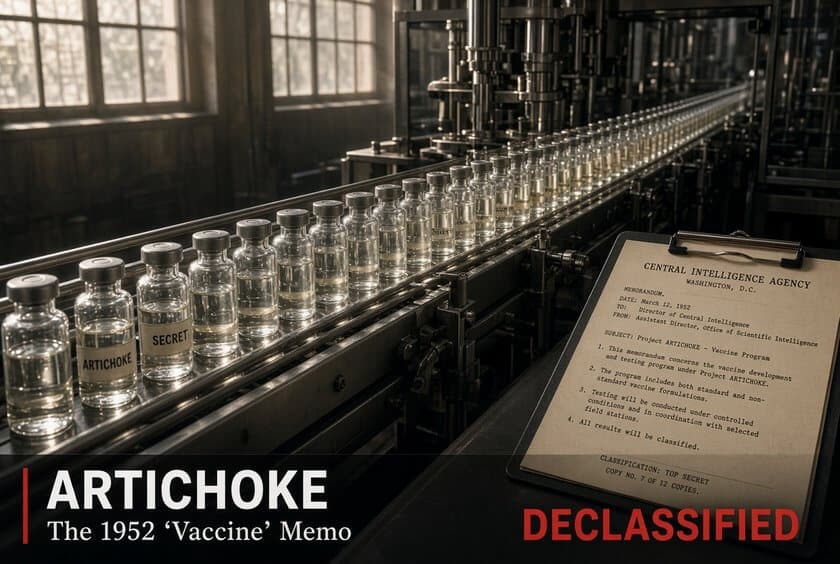
While the internet spent February 2026 sharing a headline that declassified CIA files revealed a “blueprint to manipulate Americans’ minds through covert drugging with vaccines,” the memo behind it sat in plain view. It’s seven typed pages from April 1952. The vaccine line is real. It’s one sentence. The other thirteen items on the same list are stranger than the headline, and a second memo two years later shows what a fake medical treatment actually looked like in practice.
We read both. Here’s what the record says, and what it doesn’t.
How one sentence became a hearing
The Daily Mail headline ran in late February 2026 and spread quickly. On Feb. 24, Rep. Anna Paulina Luna, who chairs the House Oversight Committee’s Task Force on the Declassification of Federal Secrets, cited it on X and wrote that the task force’s next hearing would be on MKUltra. That hearing, “Mind Control and Accountability: Uncovering the Truth of the CIA’s MKULTRA Project,” was held on June 30.
The day before, the National Security Archive published the memo alongside four related records, under the title “Declassification Task Force Should Focus on Real Secrets, Not Conspiracy Theories.” That compilation is where we started.
What the 1952 memo actually is
The memo is dated April 24, 1952 and titled “Special Research for Artichoke.” Artichoke was the CIA’s early-1950s interrogation research program, a precursor to MKUltra. The author’s name is redacted. He writes that on April 23 he had a long conversation with a consultant to the agency, also redacted, from the Technical Services Staff. The consultant offered research help and money and asked for an informal list of projects worth pursuing.
The memo is that list: “Suggested Fields for Special Research Relative Artichoke.” It has fourteen numbered sections. The author calls them suggestions “worthy of exploration.” He concedes that some are “controversial.” He proposes putting them to outside experts to see whether full-scale research would be warranted. It’s a brainstorm, not an operational order. Nothing in the memo says any item was approved.
The vaccine line, in context
The sentence sits in Section I, “Chemicals (Including Drugs).” The author wants research into drugs that could be given to “subjects” over a long period to make them anxious, tense or despondent. He lists hiding places: food, water, Coca-Cola, beer, liquor, cigarettes. Then comes the line that went viral. Such a drug, he writes, should also work in “standard medical treatments such as vaccinations, shots, etc.”
So the memo does float disguising drugs as a vaccination. That part of the headline holds up. What the memo doesn’t say is who the “subjects” would be, beyond the program’s own frame: Artichoke was about interrogation. Where the list names targets, it names “prisoners” and “individuals held in custody.” There is no mention of the American public, of mass vaccination, or of any population at all. The phrase “manipulate Americans’ minds” isn’t in it.
The rest of the list is stranger
The headline skipped most of the memo. Among the other thirteen sections:
- Diet. Removing sugar, vitamins or proteins from prisoners’ food to “condition” them, possibly with specially canned foods made for people in custody.
- A pen-sized injector. A “hypo-spray” built like a fountain pen, which the author calls “a very valuable weapon.”
- A German gas pistol. The author quotes a gun book on the wartime “scheintot” (“appearance of death”) pistol and says the device “should be run down.”
- Built environments. Moving or vibrating rooms, distorted rooms, soundproof rooms, the deliberate creation of panic and “the exploitation of established phobias.”
- Electro-sleep. A sleep-inducing machine reportedly in use at the University of Richmond Hospital, which “might be of extreme value” if it could be used for hypnotic control.
- Lobotomy. Here the author draws a line. He writes that the agency “under no circumstances” would consider brain surgery as an operative measure. He still recommends the medical staff study whether the Soviets could be using it as a weapon.
A separate paragraph records that electroshock and lobotomy were raised by the consultant, not the author.
When a “shot” was the cover
The second memo shows the medical-cover idea put into practice, on one man. It’s a March 1954 report to the CIA’s Director of Security from the chief of the Technical Branch, titled “ARTICHOKE Case #1.” The subject’s name and nationality are redacted. He is described as “an important covert operational asset” who was brought to a safe house so the agency could check whether he was reliable.
He came down with influenza on Feb. 18, 1954. According to the memo, a medical doctor working with the Artichoke team used the illness to build rapport, treating him with injections and medication. The doctor then recommended daily vitamin injections for his “poor, weakened condition.” On March 4, an intravenous drip of “fluids and vitamins” began. From 8 p.m. that night to midnight on March 5, the man was held under Artichoke techniques for about twelve hours, including roughly an hour and a half of direct questioning. Afterward he was told he had “suddenly been stricken with a virus” and had run a fever of 103.
The memo calls the operation “entirely successful” and says the subject spoke “unwittingly.” This is the documented version of the fear in the headline: a fake treatment used to drug someone who didn’t know it. But it was used on a single intelligence asset in a safe house, not on the public.
What the record doesn’t settle
None of this makes the CIA’s mind-control era harmless. The National Security Archive notes that Artichoke and MKUltra included experiments on federal prisoners, drug addicts and psychiatric patients. CIA officials also secretly drugged their own coworkers, in one case leading to the death of Army scientist Frank Olson in 1953. Sidney Gottlieb, who ran MKUltra, described the programs to the Church Committee in 1975; we covered his testimony here.
And the record has holes that can’t be closed. In 1973, on the orders of Director Richard Helms, the CIA destroyed much of the MKUltra paper trail. Much of what survives publicly traces to a 1977 FOIA request by John Marks, whose 16,000-page collection is now held by the National Security Archive. Both memos still carry redactions today. The Archive’s own reading is that nothing in the 1952 memo suggests the CIA ever used real vaccines on a population. We agree with that reading of the document. We can’t rule out what was in the files that no longer exist, and neither can anyone else.
The document behind the headline is real, and it’s worth reading. It shows a security officer in 1952 treating almost anything, from Coca-Cola and canned food to vibrating rooms and a pen-shaped syringe, as a possible tool for breaking a prisoner.
Primary source: CIA memo, “Special Research for Artichoke,” April 24, 1952 (PDF). Full context: National Security Archive, “MKUltra: Declassification Task Force Should Focus on Real Secrets, Not Conspiracy Theories”. Read it yourself.
Sources
- CIA — memo, “Special Research for Artichoke,” with attachment “Suggested Fields for Special Research Relative Artichoke,” April 24, 1952 (National Security Archive, Document 1)
- CIA FOIA Reading Room record 00184365, same memo (Internet Archive mirror)
- CIA — memo, Chief, Technical Branch, to Director of Security, “ARTICHOKE Case #1,” March 1954 (National Security Archive, Document 3)
- National Security Archive — Michael Evans, “MKUltra: Declassification Task Force Should Focus on Real Secrets, Not Conspiracy Theories,” June 29, 2026
- Daily Mail on X — “Declassified CIA files reveal chilling blueprint to manipulate Americans’ minds through covert drugging with vaccines,” Feb. 24, 2026
- House Committee on Oversight and Government Reform — hearing, “Mind Control and Accountability: Uncovering the Truth of the CIA’s MKULTRA Project,” June 30, 2026