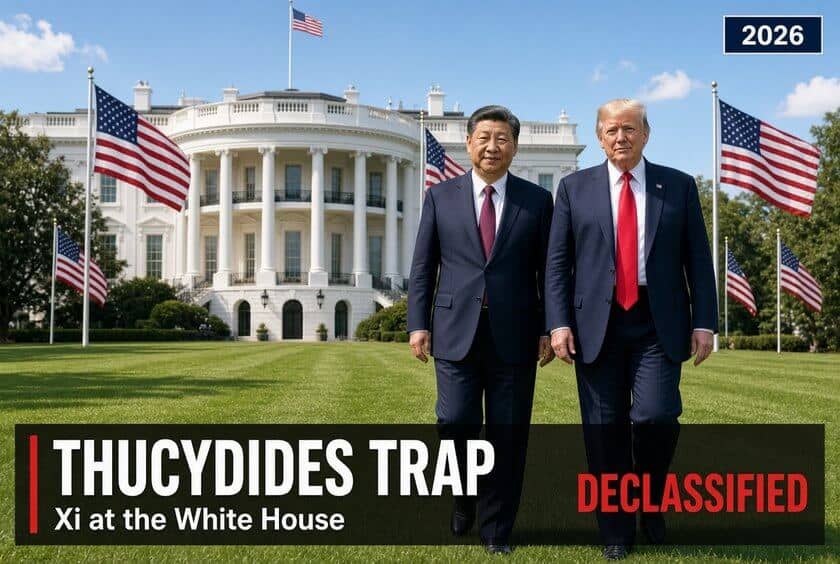
WASHINGTON — Chinese President Xi Jinping told President Trump at the White House on Sept. 24 that the “Thucydides Trap” between their countries “can be overcome.” He set out conditions for it, including regular dialogue between the two militaries. According to a readout from the Chinese Embassy, Xi said China and the United States “must hold the line of no conflict and no confrontation.”
The remarks opened a two-day state visit, the first by a Chinese leader to the White House since 2015. The visit comes as the two countries compete over artificial intelligence and trade and remain at odds over Taiwan. The U.S. restricts exports of advanced chips, chipmaking equipment and related software to China in an effort to slow its AI development.
Xi’s conditions
According to the Chinese Embassy readout, Xi called for “candid, in-depth and continued dialogue” between the two governments. He said the two countries “stand to gain from cooperation and will both lose in confrontation.” The Guardian reported that Xi also called for regular contact between the two militaries and better mechanisms for crisis communication and prevention.
Xi paired China’s national goal with Trump’s slogan. According to the readout, he said “the great rejuvenation of the Chinese nation and making America great again can go hand in hand.” He also announced that China will invite 100,000 young Americans to visit for exchanges and study over the next five years.
The term “Thucydides’s Trap” was popularized by Harvard political scientist Graham Allison. It describes the risk of war when a rising power threatens to displace a ruling one. A Harvard project led by Allison identified 16 such rivalries over the past 500 years, and found that 12 ended in war. The Guardian reported that Xi also raised the phrase when Trump visited Beijing in May.
Trump cites friendship and AI
Trump welcomed Xi and his wife, Peng Liyuan, at an arrival ceremony on the South Lawn. The White House said the ceremony included 479 military personnel. According to the Guardian, Trump said the two leaders had built “a truly great friendship.” He said talks would cover security, technology and AI, which he called “super intelligence.” He also said the two teams were working toward a more balanced trading relationship, including new market access for American farmers and ranchers.
The two leaders held bilateral talks after the ceremony. Trump hosted a state dinner that evening. According to the Guardian, guests included Nvidia CEO Jensen Huang, Meta CEO Mark Zuckerberg, Apple chair Tim Cook, SpaceX and Tesla CEO Elon Musk, and OpenAI CEO Sam Altman.
Trade truce extended to January
Treasury Secretary Scott Bessent said Sept. 24 that the two countries had extended their trade truce by two months, to Jan. 10. The truce was agreed in South Korea in October 2025 and had been due to expire in November. According to IBTimes, a spokesperson for China’s Commerce Ministry did not formally confirm the extension but said the two sides had discussed trade. Some reports gave a February end date; the Treasury secretary’s figure as reported by CNBC and IBTimes is Jan. 10.
The truce has not stopped China’s trade surplus from growing. China’s customs agency reported a record goods trade surplus of about $1.19 trillion for 2025, its first above $1 trillion. It also reported that exports to the U.S. fell 20% that year.
What’s next: The state visit runs through Sept. 25. The Guardian reported that the two leaders could meet again at the G20 summit in Miami in December. Under the extension, the trade truce now expires Jan. 10.
Filed under: The White House / Embassy of the People’s Republic of China / U.S. Department of the Treasury
Sources
- Embassy of the People’s Republic of China in the U.S. — “President Xi Jinping Attends the Arrival Ceremony at the White House Hosted by U.S. President Donald J. Trump,” Sept. 25, 2026
- The White House — “President Trump and the President of China Deliver Remarks” (video)
- The White House — First Lady releases details ahead of President Xi and Madame Peng Liyuan’s visit
- The Guardian — “At Trump meeting, Xi Jinping lays out terms to avoid US-China military conflict,” Robert Tait, Sept. 24, 2026
- CNBC — “U.S.-China trade truce extended for two months, Bessent says, as Xi begins state visit,” Sept. 24, 2026
- IBTimes — “Chinese President Xi Jinping Is Already in Washington. Bessent Says a Trade Truce Has Been Extended,” Sept. 24, 2026
- CNBC — “China’s annual trade surplus hits a record $1.2 trillion, even as exports to U.S. decline by 20%,” Jan. 14, 2026
- NPR — “Trump and Xi strike cordial tone at summit amid underlying tensions,” Sept. 24, 2026
- Belfer Center for Science and International Affairs, Harvard Kennedy School — Thucydides’s Trap Case File