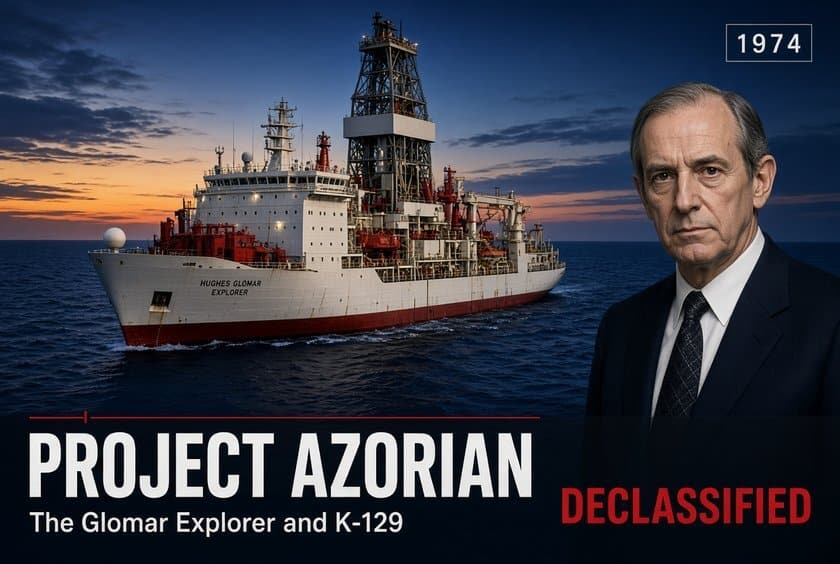
Project AZORIAN was a Central Intelligence Agency operation to recover a sunken Soviet ballistic missile submarine from the floor of the Pacific Ocean. It used a purpose-built ship, the Hughes Glomar Explorer, operated under the cover of a deep-ocean mining venture.
The recovery attempt took place in July and August 1974. The principal declassified account is an internal CIA history, “Project AZORIAN: The Story of the Hughes Glomar Explorer.” It was published in the agency’s classified journal Studies in Intelligence in fall 1985 and approved for release in excised form on Jan. 4, 2010.[1][2]
Background: the loss of submarine 722
According to the CIA history, a diesel-powered Soviet G-II-class ballistic missile submarine, pennant number 722, sailed from Petropavlovsk on about March 1, 1968. It was bound for a patrol station northeast of Hawaii.[1, p. 2–4]
The National Security Archive identifies the boat as K-129.[2] The submarine suffered an accident of unknown cause and sank with all hands roughly 1,560 miles northwest of Hawaii, at a depth of 16,500 feet.[1, p. 1, 4] The history records that the Soviet Navy conducted a two-month search that did not find the wreck.[1, p. 4]
The passage describing how the United States located it remains redacted.
Authorization, 1969–1971
On April 1, 1969, Deputy Secretary of Defense David Packard wrote to Director of Central Intelligence Richard Helms requesting a study of what could be done to recover components of the submarine.
Packard asked the CIA to take the lead.[1, p. 4] An agency task force was established on July 1, 1969, under John Parangosky, who had held senior posts in the CIA’s U-2 (IDEALIST) and A-12 (OXCART) aircraft programs.[1, p. 5]
On Aug. 8, 1969, an Executive Committee of Packard, Helms and presidential science adviser Lee DuBridge approved the organization. President Nixon was informed and approved it through a memorandum from Henry Kissinger.[1, p. 4] The program’s security compartment was named JENNIFER. The history notes that the press later used that name for the project itself.[1, p. 2, 5]
The history states that no country had previously raised an object of comparable size and weight from such a depth.[1, p. 5] Engineers considered direct mechanical lift, released ballast and gas generated at depth.
By late July 1970 a heavy-lift concept was favored. Formal authorization to concentrate on it followed on Sept. 11, 1970. A deep-ocean mining cover story was developed at the same time.[1, p. 5–9] At an Oct. 30, 1970 Executive Committee meeting, the plan was described as lifting an estimated 1,750-ton target from 16,500 feet using equipment mounted on a 565-by-106-foot surface ship.[1, p. 9]
The early estimate of the probability of success was about 10 percent. By the eve of the mission it had risen to about 90 percent.[1, p. 11–12]
The ship’s keel was laid on Nov. 16, 1971, at Sun Shipbuilding in Chester, Pennsylvania.[2] Publicly, the vessel belonged to Howard Hughes’s Summa Corporation. It was operated by Global Marine, Inc.[1, p. 1]
Final approval, 1974
After sea trials off California in early 1974, the U.S. Intelligence Board reaffirmed the target’s intelligence value on May 7, 1974. The board cited the expected acquisition of nuclear warheads, the SS-N-5 missile system and related documents.[1, p. 30–36]
The 40 Committee, the interagency body that reviewed covert operations, considered the mission on June 5. President Nixon approved it on June 7, on the condition that the actual recovery not begin until he had returned from a June 27–July 3 visit to the Soviet Union.[1, p. 36]
The recovery mission, July–August 1974
The Glomar Explorer moved from its Long Beach anchorage on June 20, 1974, for a ceremony marking Summa’s acceptance of the ship. It then set course for the recovery site and arrived on July 4.[1, p. 36–37] Operations were delayed by weather and by cracks found in the ship’s docking-leg guide structures.[1, p. 38]
Two Soviet vessels observed the operation. On July 18 the Missile Range Instrumentation Ship Chazhma approached within one mile. Its helicopter made repeated photographic passes. Queried by signal, the Glomar Explorer answered that it was conducting deep-ocean mining tests. Chazhma departed that evening.[1, p. 38–40]
From July 22, the Soviet salvage tug SB-10 kept the ship under surveillance, at times passing within 200 feet. That surveillance ended after 13 days and 16 hours.[1, p. 40–46] The CIA history records that crew members designated to defend the control room long enough to destroy classified material were alerted during the Chazhma approach.[1, p. 39]
According to the CIA history, the target was lifted from the bottom on Aug. 1. On Aug. 3 the ship sent an unclassified commercial message saying its “nodule collector vehicle” may have struck an outcrop, as the cover plan required.[1, p. 43]
The recovery phase ended on Aug. 9, reported in a prearranged commercial code as “Event 36-A.”[1, p. 46–47] The history records that inspectors found evidence of plutonium contamination. They attributed it primarily to one or more nuclear torpedoes whose high explosive had detonated without a nuclear yield.[1, p. 46]
The ship reached Lahaina Roads, off Maui, on Aug. 16, 1974. An exploitation team took over there.[1, p. 48]
What was recovered
The CIA history’s description of what was brought aboard, and of the intelligence obtained, remains redacted. The National Security Archive, drawing on the declassified record and published accounts, states that only a 38-foot forward section of the submarine was recovered, including its torpedo compartment.
According to the Archive, about 90 percent of the hull broke free and fell back to the ocean floor, including the conning tower, missile compartment and control room.[2] The Archive also cites estimates that the project cost as much as $500 million in 1974 dollars.[2] The CIA’s released text does not give a total cost.
Disclosure, 1975
According to the CIA history, the leak originated with a June 1974 break-in at Summa Corporation’s Los Angeles headquarters. Among the stolen documents may have been a memorandum describing the proposed CIA recovery effort.[1, p. 2] The Los Angeles Times published a partial account in February 1975. Columnist Jack Anderson broadcast the story in March 1975.[1, p. 2]
Declassified White House memoranda of conversation from Feb. 7 and March 19, 1975, record senior officials discussing the press exposure.[3][4] The CIA history states that the Soviet Union then assigned a ship to monitor the wreck site.[1, p. 49] The history refers to a broader “AZORIAN/MATADOR program” to be described in later articles.[1, p. 2]
According to the National Security Archive, the CIA decided not to make a second attempt to retrieve the remainder of the submarine.[2]
The “Glomar response”
A Freedom of Information Act request from journalist Harriet Ann Phillippi for records on the ship led to Phillippi v. CIA. The agency had refused to confirm or deny that responsive records existed. In a decision of Nov. 16, 1976, the U.S. Court of Appeals for the D.C. Circuit reversed and remanded a district court ruling for the agency.
The court did not reject the refusal itself. It directed the district court to build as complete a public record as possible on the agency’s justification before relying on classified affidavits reviewed in camera.[5]
The formulation became known as the “Glomar response,” a term later applied to similar replies by the CIA and other agencies.[2]
Sources
- [Author excised], “Project AZORIAN: The Story of the Hughes Glomar Explorer,” Studies in Intelligence, Fall 1985, Secret/Noforn, excised copy approved for release Jan. 4, 2010 (CIA document C05301269)
- National Security Archive, “Project Azorian: The CIA’s Declassified History of the Glomar Explorer,” Electronic Briefing Book No. 305, ed. Matthew Aid, William Burr and Thomas Blanton, Feb. 12, 2010
- White House, Memorandum of Conversation, Feb. 7, 1975
- White House, Memorandum of Conversation, March 19, 1975
- Phillippi v. Central Intelligence Agency, 546 F.2d 1009 (D.C. Cir. 1976), decided Nov. 16, 1976