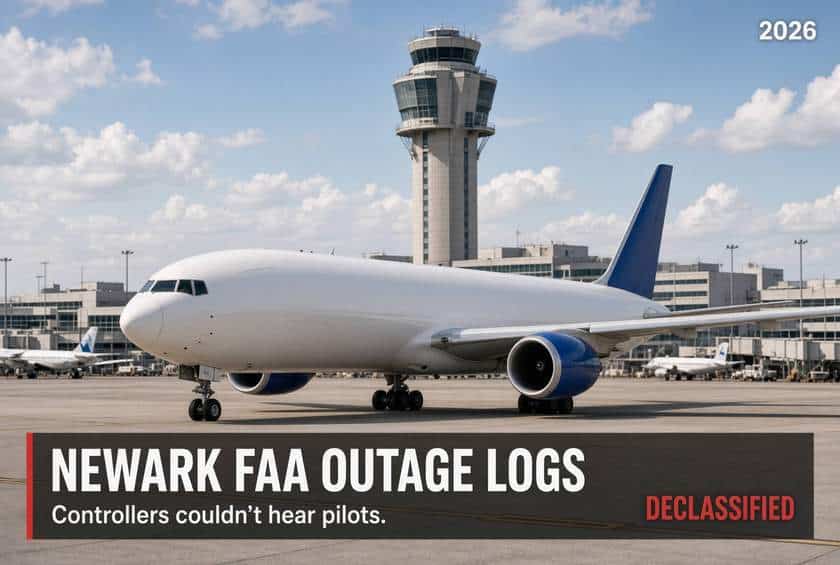
On Nov. 17, the Federal Aviation Administration released its records of the Sept. 21 outage that halted flights at Newark, Philadelphia, JFK, LaGuardia and Teterboro. The release answered a Freedom of Information Act request from John Greenewald of The Black Vault, who posted the 33-page file on Nov. 19. Greenewald asked for five kinds of records, including anything that established why the outage happened. The FAA sent two logs and a metrics report. On the cause, the equipment repairs and the restoration timeline, it said the Philadelphia facility holds no responsive records.
We read both logs line by line. They don’t say why the system failed. They do show what failed, minute by minute, and the first failure entry is timed 15 minutes before the moment NJ Transit gave for the cable cut that became the day’s explanation.
9:30 a.m., static on every frequency
The watch supervisor’s Daily Record of Facility Operation, FAA Form 7230-4, keeps time in UTC. Converted to Eastern time, its first outage entry is 9:30 a.m. Every radio position in Area C, the part of Philadelphia approach control that works Newark-area traffic, lit up at once and static came over all of its frequencies. Then the frequencies stopped receiving. Controllers could still transmit, but they couldn’t hear pilots read back their instructions, so they asked pilots to acknowledge with the transponder’s ident button instead. Shortly afterward, radar scopes shut off and came back on reading “SYSTEM DEGRATED,” in the log’s spelling.
The failure spread within minutes. At 9:31, Area A logged its own list of anomalies. Airport surface radar showed taxiing planes only as beacons, weather displays had to be updated by hand, and the recorded weather broadcast wouldn’t format. At 9:35, Area B reported static on all frequencies and could no longer hand aircraft off electronically. The traffic management log, the second record in the file, notes at 9:59 that all radars in Area C were lost. At 10:35, Area C went “ATC Zero,” unable to control traffic, and New York Center took over its airspace.
Fifteen minutes before the backup was cut
That afternoon, FAA Administrator Bryan Bedford told reporters that an old Verizon circuit serving the Philadelphia facility had failed, and that when the system tried to switch over, “the back-up fiber had a break,” NorthJersey.com reported. NJ Transit said a crew on its Delco Lead project between New Brunswick and North Brunswick severed a fiber-optic cable at approximately 9:45 a.m., working about 10 feet from the utility markings. The agency acknowledged it was the backup cable the FAA had described, NBC New York reported. Verizon said its facilities “were fully functional up to that point.”
Set those accounts beside the log and the primary circuit was already failing at 9:30, a quarter-hour before the backup was cut. That fits Bedford’s order of events, primary first. It leaves open what the backup was doing in those 15 minutes, if it was still intact. NJ Transit’s time was approximate by its own wording, and the FAA hasn’t published a timeline of its own.
The released records can’t settle it. None of them mentions the fiber, Verizon, NJ Transit or the construction site.
Sterilized airspace and 30 planes back at the gate
Philadelphia tried to keep moving. At 10:16 a.m. its tower began launching departures one at a time, 30 miles apart. Crews tried replacing the failed circuit that day, but the fix did not take, according to the FAA, as NBC New York reported. At 12:30 p.m. the traffic management log records that the operations manager in charge ordered the unit to “sterilize PHL airspace completely,” and at 12:31 every area stopped. A national advisory gave the reason as airspace sterilization for equipment maintenance. Bedford had told reporters that swapping the circuit meant suspending service to everything still running.
At Newark, the tower reported at 12:40 p.m. that 30 aircraft had returned to the gate, citing the Transportation Department’s three-hour tarmac limit or other time issues. They had waited an average of 110 minutes, the longest 165. One exchange in the log shows how unevenly the outage was felt. When Philadelphia called Newark’s tower at 12:38 to say it was sterilizing airspace and to stop radar services, the tower answered that it wasn’t affected and had its own radar. The Philadelphia specialist’s entry ends, “I advised them I am doing my due diligence.” By 1:35 p.m., the flight data terminals at Philadelphia were out of service too.
Testing began late in the afternoon. At 4:27 p.m., an advisory said Area C was taking one inbound plane to test its automation, and that the result would decide how the ground stop ended. Philadelphia came off “ATC Limited” at 5:07 p.m., and at 5:39 the log called radar and radio checks “trending in the right direction.” Transportation Secretary Sean Duffy posted just after 6 p.m. that the lines had been repaired. The facility’s last areas left alert status at 7:26 p.m., and at 8:24 p.m. the watch desk marked the morning’s three equipment entries returned to service. Teterboro’s tower logged at least 30 flights cancelled because of the delays.
Ghost targets at the midnight shift change
One entry has nothing explaining it anywhere in the file. In the block of items listed at the start of the day’s record, at the midnight shift change, the watch desk noted that Philadelphia’s Areas B and C, New York approach control and New York Center were all seeing ghost targets at different altitudes and speeds. Controllers didn’t know which were real airplanes, it says, and inbound and outbound traffic was “stepped,” probably a typo for stopped, until the issue was fixed. The entry gives no time for the problem. The same block lists a Newark radar out of service until further notice and a radar control panel and weather feed down, with FTI, the FAA’s telecommunications network, troubleshooting. Nothing in the record connects these to the morning’s failure, and nothing rules a connection out.
Five requests, two answered with nothing
Greenewald filed the day after the outage. He asked for final incident reports, Technical Operations trouble tickets and maintenance records, records on the cause including coordination with Verizon, NJ Transit and Amtrak, records of the operational impact, and records of when systems failed and came back. The search was done by the quality control office at Philadelphia’s tower and approach control, and it covered Air Traffic Services records. For trouble tickets and for the cause, the office found nothing. It also found nothing on the testing before equipment returned to service, or on restoration efforts and timing.
For incident reports, the watch log was the only record.
The letter doesn’t say whether Technical Operations, whose trouble tickets the request named, searched its own files. It was signed Nov. 17 for the Air Traffic Organization’s Mission Readiness Services, and it can be appealed within 90 days. We found no published FAA finding on the circuit failure. Eight weeks later, on Nov. 13, a separate communications failure set off a nationwide ground stop, which we covered here. No final cause has been published for that one either.
Primary source: FAA response to FOIA request 2026-06152, with the Form 7230-4 watch log, the National Traffic Management Log and the OPSNET metrics report (PDF). Full context: The Black Vault’s release page. Read the logs yourself. Times in them are UTC, four hours ahead of Eastern.
Sources
- FAA, Air Traffic Organization, response to FOIA request 2026-06152, signed Nov. 17, 2026, with enclosures. Used for: the records found and not found, every log entry and time, the gate returns and cancellations.
- The Black Vault, “FAA Releases Records on Major Northeast Air Traffic Control Outage, But Key Technical Details Remain Missing” (Nov. 19, 2026). Used for: the request and posting dates.
- NorthJersey.com, Colleen Wilson, “Flights halted at Newark, JFK and 4 other major East Coast airports” (Sept. 21, 2026). Used for: Bedford’s account, NJ Transit’s 9:45 a.m. time and the 10-foot distance.
- NBC New York, “Newark airport ground stop ordered over equipment issues” (Sept. 21, 2026). Used for: NJ Transit confirming the backup cable, Verizon’s statement, the failed circuit fix, Duffy’s evening post.
- FOX 29, “Ground stops lifted at Philadelphia International after fiber line severed in New Jersey” (Sept. 21, 2026). Used for: NJ Transit’s 9:45 a.m. time.