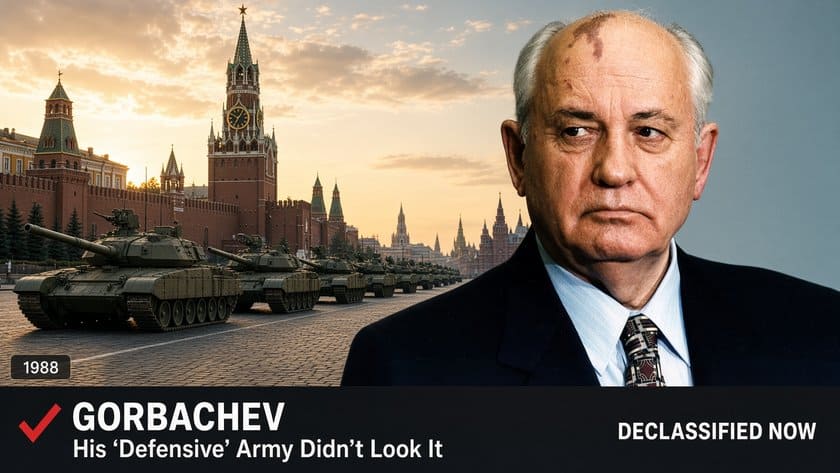
In the late 1980s, Washington kept asking one question about Mikhail Gorbachev’s new “defensive” military doctrine: was it real, or was it a show for Western audiences? The CIA leaned toward the show. The newly released record adds a twist. In private, Gorbachev himself was making the skeptics’ case to his own Politburo.
On Aug. 31 the National Security Archive published 12 documents from April 1987 to October 1989 on the Soviet military’s turn toward a defensive posture in Europe. Several are newly declassified. The Archive obtained them from the George H.W. Bush Presidential Library through a Freedom of Information Act request and a FOIA lawsuit. One is a Politburo diary transcript published in English for the first time. We read all 12. Here’s what they show, and where they leave room for doubt.
Gorbachev agreed with the doubters
The most striking item is a Nov. 3, 1988 Politburo conversation recorded in the diary of Gorbachev’s aide Anatoly Chernyaev. The Archive says it is appearing in print for the first time. In it, Gorbachev tells colleagues that no country spends as much per capita on weapons as the Soviet Union. Looking at the armored forces and river-crossing units stationed in East Germany, he asks how anyone could believe Soviet doctrine was defensive while “all this hangs over them.”
That is the heart of the story. Western skeptics said the Soviet force posture contradicted the peaceful rhetoric. By the Chernyaev record, the Soviet leader said the same thing behind closed doors, and treated the contradiction as a problem he had to fix, not a cover he meant to keep.
An earlier Chernyaev note, from April 1987, records Margaret Thatcher bluntly telling Gorbachev that the West did not believe him.
What U.S. intelligence expected
The American assessments in the set hold up in some ways and fall short in others. A CIA Directorate of Intelligence paper from October 1987 predicted large unilateral troop withdrawals from Europe. It also flagged resistance inside the Soviet military. A Defense Intelligence Agency study from the following month expected Moscow to keep its military power largely intact.
The sharpest example is Special National Intelligence Estimate 11-16-88, dated Nov. 17, 1988, of which only the key judgments are released. It read Soviet moves mainly as a diplomatic campaign to lower the West’s sense of threat. Less than three weeks later, on Dec. 7, 1988, Gorbachev told the U.N. General Assembly that the Soviet military would be cut by 500,000 people over two years, on a unilateral basis.
The estimate wasn’t necessarily wrong that Moscow wanted to shape Western perceptions. What the newer records complicate is the idea that perception management was all it was.
The Soviet marshals resisted
The documents also show the change was fought inside the Soviet system. A May 1988 State Department intelligence report describes military leaders pushing back against reform-minded intellectuals. Georgy Shakhnazarov, another Gorbachev adviser, left comments on a May 1988 report by Marshal Viktor Kulikov, commander of the Warsaw Pact forces. The Archive describes those comments as criticism of the ongoing militarization of Eastern Europe, and Kulikov as resisting Gorbachev’s demilitarization push.
Yazov at the Pentagon
The newly declassified Bush Library records come from the October 1989 U.S. visit of Soviet Defense Minister Dmitry Yazov. They include:
- An Oct. 2, 1989 memorandum of conversation between Yazov and Defense Secretary Dick Cheney. The Archive describes it as the first direct comparison of the two countries’ defense strategies. Gen. Colin Powell, just named Chairman of the Joint Chiefs, recalled serving about 115 km from a Soviet army in Germany.
- The text of Yazov’s Oct. 3 speech at the National Defense University. Yazov remarked that his appearance there would have been “seditious only a few years ago.”
- An Oct. 6 Pentagon public affairs Q&A with Yazov and Cheney.
The last document is an Oct. 16, 1989 status report for the House Armed Services Committee, written after a congressional delegation traveled to East Germany and the USSR. It assessed that Gorbachev’s actions would cut the offensive capability of Soviet forces in Eastern Europe by about 30 percent.
What the record doesn’t settle
Be careful with that 30 percent figure. It is one congressional delegation’s assessment in October 1989, not a final accounting, and the SNIE is released only in part. The documents show a real doctrinal shift that the Soviet leadership argued over, and that U.S. analysts were slow to credit. They don’t show that American skepticism was baseless. Gorbachev’s own words confirm that the skeptics were looking at real tanks.
Primary source: “Transforming the Mission: The Soviet Military’s Reorientation to a Defensive Posture in Europe,” National Security Archive. Full context: Gorbachev’s Dec. 7, 1988 U.N. address, Wilson Center Digital Archive. Read it yourself.
Sources
- National Security Archive — Transforming the Mission: The Soviet Military’s Reorientation to a Defensive Posture in Europe (Aug. 31, 2026), including the Chernyaev Politburo notes, CIA SNIE 11-16-88, the Yazov–Cheney memcon and the HASC delegation report
- Wilson Center Digital Archive — Address by Mikhail Gorbachev at the UN General Assembly Session, Dec. 7, 1988 (excerpts)
- The Washington Post — Gorbachev Announces Troop Cut of 500,000 (Dec. 8, 1988)