Paraguay’s new president, Pedro Alliana, said Tuesday that the government has repaid almost 95% of Ueno Bank’s savers, a week after regulators seized the digital lender. In a post on X, he put the total at about $330 million paid to 1.74 million depositors from the state’s Deposit Guarantee Fund, with the rest due by Wednesday under the law Congress passed last week. The fund’s director, José Maciel, put the figure at 93.1% of registered account holders, Infobae reported.
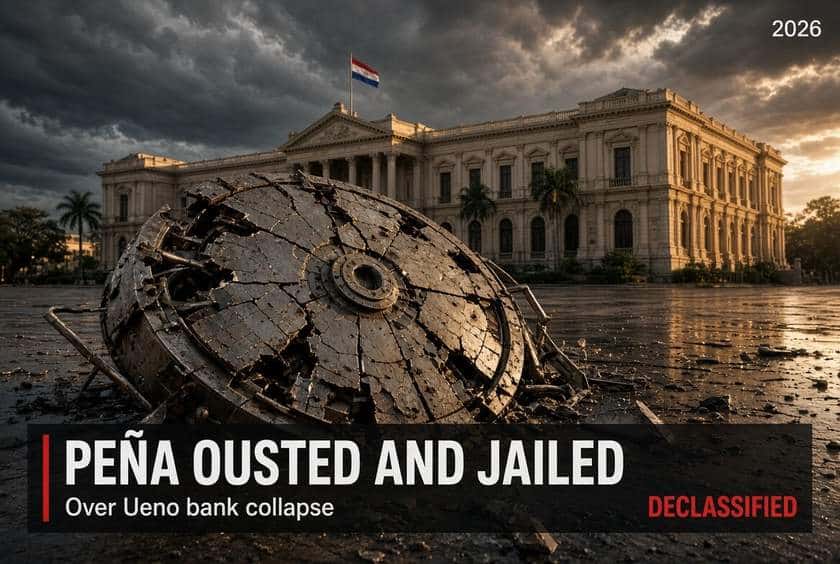
The man who led the country when Ueno failed is in custody. The Senate removed President Santiago Peña from office on Friday, Nov. 6, in a unanimous vote of the 44 senators present, the Associated Press and Infobae reported. By Saturday a judge had ordered him held in pretrial detention on charges tied to the bank, and he spent the weekend in a bedroom at the barracks of the presidential guard regiment in Asunción.
The story is still moving. Peña’s lawyers are contesting his detention, the biggest public depositors have not been made whole, and prosecutors are also investigating Alliana.
Removed, charged and held in two days
Peña announced his resignation in a video on X on Thursday, Nov. 5, and the lower house voted 78-0 to impeach him minutes later. Congress never accepted the resignation. On Friday senators turned down his request for 72 more hours to prepare a defense and voted to remove him for misconduct in office. His lawyers, Ricardo Preda and Adolfo Ferreiro, argued that lawmakers should have accepted his exit instead, the AP reported.
The order of those votes mattered. Paraguay’s Constitution gives elected former presidents a lifetime Senate seat, along with parliamentary immunity. Removal bars Peña from that seat, the AP reported, which is why opposition senators had pushed to convict him before any resignation took effect.
Prosecutors moved within hours. Late Friday a team led by prosecutors Elena Fiore and Christian Benítez served an order detaining Peña at his home until he could be brought before them, Infobae reported. Peña told Fiore, “I will submit to the process,” according to the outlet. Early reports, including the AP’s, described the measure as house arrest.
On Saturday Peña appeared for questioning and declined to answer, the Paraguayan newspaper ABC Color reported. Prosecutors charged him with breach of trust, as instigator, and self-serving administration, as perpetrator, and asked for pretrial detention. Judge Humberto Otazú granted it the same day, citing the risk that Peña would flee or obstruct evidence, Infobae reported. Benítez said the charges carry up to 10 years in prison.
Peña is held in an ordinary bedroom at the Regimiento Escolta Presidencial, with no bars, a phone and visitors allowed, Infobae reported. “It is just one more bedroom,” the unit’s commander, Col. José Dayub, told reporters. Preda has said Peña will cooperate with investigators while challenging the detention.
The case against him centers on the state pension and health fund, known as IPS. Prosecutors say Peña met with the fund’s president on Aug. 22 and Aug. 27, 2024, and that two days later IPS approved buying Ueno bonds worth 250 billion guaraníes, Infobae reported. Prosecutors put the damage at about $809 million, the total of state deposits at Ueno. That figure is the money at risk, not a proven loss, the outlet noted.
Carlos Carvallo, the central bank president Peña appointed and who resigned at his request on Nov. 3, faces breach of trust and related charges, and prosecutors have asked for his detention too, according to ABC Color. Carvallo once ran Financiera Ueno, the bank’s predecessor. The central bank has said he recused himself from decisions on Ueno, according to an analysis in The Conversation. Prosecutors have charged 27 people in the wider case, including Ueno’s controlling shareholder, Miguel Vázquez, the AP reported. A judge sent male executives to pretrial detention and placed female executives under house arrest with ankle monitors, ABC Color reported.
Alliana inherits the crisis
Alliana, 52, a former governor of Ñeembucú department, was sworn in on Nov. 6 and will serve out the term through August 2028. He survived his own impeachment attempt on Nov. 5, and prosecutors have named him in their investigation, the AP and Infobae reported. He has not been charged.
On Nov. 9 Alliana ordered cabinet ministers and senior officials to put their posts at his disposal, Latin Times reported, a step the outlet said is not a blanket firing. He has named Ariel Martínez interior minister, replacing Enrique Riera, who quit before the vote. Economy Minister Óscar Lovera and Defense Minister Óscar González are staying on.
How Ueno grew, and how it fell
Ueno was the bank most Paraguayans carried in their pockets. It counts about 2.94 million customers, Infobae reported, more than 60% of the country’s adults by the AP’s count. The AP calls it a rebranded version of a decades-old finance company. Al Jazeera reported that it won a full banking license in 2023, then grew on cashback offers, more than 70 branches and a sponsorship of the national football team.
Regulators say the growth hid a hole. A June 2026 supervisory report found about $146 million in loans to three companies linked to Grupo Vázquez, the family conglomerate that controls the bank, Al Jazeera and The Conversation reported. On a single day in September 2025, nearly $39 million went to three such companies, the AP reported. When central bank examiners corrected the books, Ueno’s solvency ratio fell to less than half the legal minimum. The bank was seized on Tuesday, Nov. 3, and its app, cards and transfers stopped working. The rush to open accounts elsewhere crashed other banks’ mobile apps, the AP reported.
Peña’s own ties to the bank are at the center of the political case. He held a stake in Ueno’s holding company until 2025, the AP and Al Jazeera reported. Al Jazeera and Infobae date the sale to March 2025; earlier reports said April. The Conversation reported that he held about 1.58% of Ueno Holding and that his brother Francisco also held shares through a Luxembourg company, with both exiting in 2025. The same analysis reported that IPS loosened its rules for bank deposits in 2023 and dropped a capital-based exposure limit in 2024. Peña has denied wrongdoing. As recently as October he dismissed concerns about Ueno as a smear campaign, the AP reported.
The public money still frozen
Small savers are being repaid because the guarantee fund covers each depositor up to roughly $36,000 to $38,000, depending on the exchange rate used. Government bodies are a different matter. Ueno held about $800 million in public deposits, roughly a quarter of its total, the AP reported. Al Jazeera and MercoPress put it at about $850 million.
The largest single exposure is the pension fund. The AP reported that IPS deposited $355 million at Ueno, beyond legal limits. Al Jazeera and Latin Times put IPS’s holdings at about $380 million, a figure that includes bonds. About 32,000 retirees’ accounts were frozen, according to Latin Times and the Spanish news agency EFE. The government has not said how much IPS and other public bodies will recover above the guarantee cap.
Anger has spilled into the streets. Police used tear gas, water cannons and rubber bullets on protesters last week, the AP and ABC Australia reported, and a teachers’ union with more than 40,000 members called an indefinite national strike starting Monday, Nov. 9.
Brazil’s dam money and Paraguay’s investor pitch
Some of the trapped money belongs to institutions Paraguay shares with its neighbors. Itaipú Binacional, which runs the giant hydroelectric dam Paraguay co-owns with Brazil, said it held about $183 million at Ueno when the bank was seized, EFE and ABC Color reported. Itaipú said it began banking with Ueno in January 2025 and that the money equals 7.6% of the funds it received in remittances from Brazil between 2024 and 2026. On Nov. 7 it filed a criminal complaint against Ueno’s directors, including Vázquez and the bank’s president, Juan Manuel Gustale, for fraud and breach of trust. It says the dam’s operations are unaffected. The AP has reported that the operators of Paraguay’s hydroelectric dams, plural, kept money at Ueno, but no figure has been reported for Yacyretá, the dam Paraguay shares with Argentina. We found no public comment from the Brazilian or Argentine governments.
The collapse also lands on the investment pitch Peña made abroad. Paraguay has marketed itself on low taxes and stability, and some promoters have called it a “Dubai of South America,” Colorado State University’s Joel E. Correia wrote in The Conversation. Moody’s granted Paraguay’s debt investment-grade status in 2024 and S&P followed in 2025. Rating agencies are now assessing whether the Ueno collapse puts that standing at risk, Latin Times reported. We found no change to Paraguay’s sovereign rating as of Tuesday. Ueno itself issued $350 million in international bonds earlier this year, Latin Times reported. Correia argues that Ueno grew through unusually close ties to political elites and public institutions.
Analysts outside Paraguay see a warning about digital banks across the region. Rhys Hicks, a banking analyst at the research firm GlobalData, said digital banks are becoming systemically important before their governance catches up. He argued that supervisors should judge them by customer numbers and payment activity, not assets alone. GlobalData’s survey of six Latin American markets found 86.7% of consumers use digital banking at least monthly.
Paraguay has been through this before, on a larger scale. From 1995 to 1998, 13 banks and 35 financial firms closed, with direct costs the International Monetary Fund estimated at 10% to 13% of GDP, The Conversation reported. The first domino in 1995 was Bancopar, closed over insider lending, according to Al Jazeera.
Washington is watching too. Alliana has been in contact with U.S. Secretary of State Marco Rubio, Latin Times reported, citing Infobae. Horacio Cartes, the Colorado Party leader who turned on his former protégé last week and publicly called for his ouster, was sanctioned by the U.S. Treasury in January 2023 over corruption allegations. No report has linked Cartes to Ueno. Our September coverage of State Department files on 1980s Paraguay covers Paraguay under Gen. Alfredo Stroessner, the Colorado Party strongman who ruled until 1989.
The next steps are the final guarantee payments, due Wednesday, Peña’s challenge to his detention, and the liquidation that will decide how much IPS, Itaipú and other public bodies recover. Alliana announced the repayment figures in a post on X. The U.S. Treasury’s 2023 designation of Cartes is on its website.
Sources
- Pedro Alliana on X, repayment announcement (Nov. 10, 2026)
- Infobae, “Tras el escándalo de Ueno Bank, el Gobierno de Paraguay completó el pago al 95% de los ahorristas” (Nov. 10, 2026)
- Última Hora, “Alliana afirma que se pagó a ‘casi’ el total de ahorristas” (Nov. 10, 2026)
- Associated Press via Anchorage Daily News, “Paraguay Senate removes President Santiago Peña from office following Ueno bank collapse” (Nov. 6, 2026)
- Infobae, “Santiago Peña fue detenido tras ser destituido por el escándalo del Ueno Bank” (Nov. 6, 2026)
- ABC Color, “Caso Ueno: Fiscalía imputa y pide prisión preventiva para Santiago Peña y el extitular del BCP” (Nov. 7, 2026)
- Infobae, “Cómo son las condiciones de detención de Santiago Peña” (Nov. 8, 2026)
- Latin Times, “Paraguay’s new president orders ministers to place their positions at his disposal” (Nov. 9, 2026)
- Associated Press via ABC News, “How one bank’s collapse is upending Paraguay, trapping savings and threatening its president” (Nov. 5, 2026)
- Al Jazeera, “How Paraguay’s Ueno collapse is only its latest banking crisis” (Nov. 6, 2026)
- The Conversation, Joel E. Correia, “Paraguay’s bank collapse brought down a president” (Nov. 9, 2026)
- ABC Australia, “Collapse of Paraguay’s Ueno Bank plunges country into political crisis” (Nov. 6, 2026)
- MercoPress, “Lost savings and broken trust: life for those hit by Ueno Bank’s closure” (Nov. 9, 2026)
- ABC Color, “Itaipú presenta denuncia penal contra Ueno Bank y sus directivos” (Nov. 7, 2026)
- EFE via Infobae, “Itaipú dice tener unos 183 millones de dólares en Ueno bank” (Nov. 8, 2026)
- GlobalData, “Ueno Bank collapse exposes oversight gaps in digital banking sector” (Nov. 5, 2026)
- U.S. Treasury, “Treasury Sanctions Paraguay’s Former President and Current Vice President for Corruption” (Jan. 26, 2023)