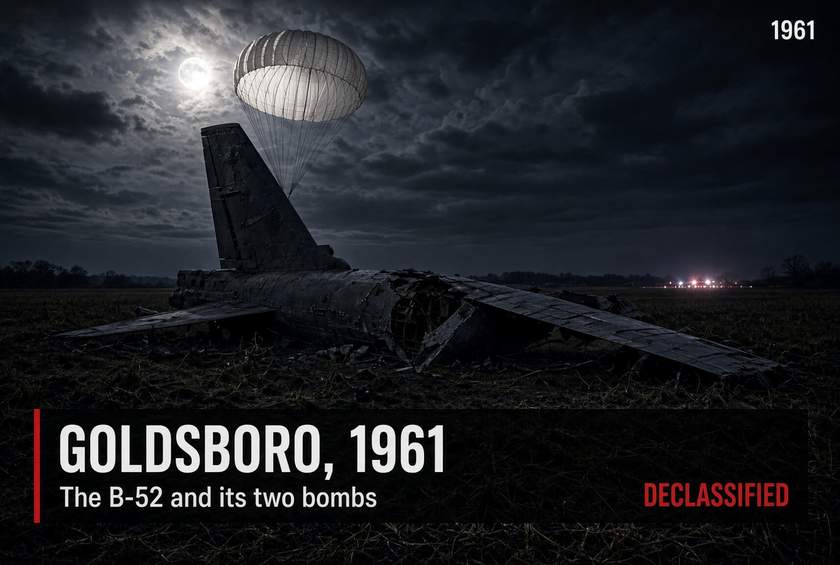
On Jan. 24, 1961, a B-52G bomber carrying two Mark 39 Mod 2 thermonuclear bombs broke up in the air and crashed near Seymour Johnson Air Force Base in Goldsboro, North Carolina. Neither bomb exploded.
In the three decades that followed, official records described the margin of safety in four different ways: a Sandia Corporation engineering analysis written within weeks, a remark by the secretary of defense in 1963, an internal Sandia memo in 1969 and a Pentagon summary entered into the Congressional Record in 1992.
A wing failure on airborne alert
The Sandia analysis, “Analysis of the Safety Aspects of the MK 39 Mod 2 Bombs Involved in B-52G Crash Near Greensboro, North Carolina” (SCDR 81-61, February 1961), gives the sequence. The report’s title names the wrong city; its text places the crash near Seymour-Johnson AFB. The bomber came apart in the air, and both weapons separated from it. The parachute of the weapon in the aft bomb bay, designated Weapon No. 1, deployed, and that bomb landed about a mile short of the main wreckage. The parachute of the forward weapon, Weapon No. 2, did not deploy, and it struck the ground in free fall about 1,500 feet beyond the impact point of the fuselage (SCDR 81-61, p. 5).
The Pentagon’s narrative summary of the accident, entered into the Congressional Record by Sen. J. Bennett Johnston of Louisiana on Aug. 3, 1992, attributes the breakup to structural failure of the right wing during an airborne alert mission. It states that the weapons separated at between 2,000 and 10,000 feet and that five of the eight crew members survived. A UNC Libraries account drawn from contemporary North Carolina newspapers reports the same toll: five men ejected and landed safely, one died after ejecting, and two died in the crash.
An Atomic Energy Commission team from the Albuquerque Operations Office, Los Alamos and Sandia went to the site. Components of Weapon No. 2 were later returned to Sandia for analysis (SCDR 81-61, p. 5).
Weapon No. 1: the parachute bomb
According to the Sandia report, observers said Weapon No. 1 separated from the aircraft at 7,000 to 9,000 feet. It came down fully retarded under its parachute, penetrated the earth about 18 inches, and remained upright with the parachute hanging in nearby trees. It was intact, with only minor damage (SCDR 81-61, p. 11).
The analysts found that the crash had performed steps that normally required a crew member. Safing pins had been pulled from the bomb’s Bisch generator, which powered the weapon, and lanyards attached to the pins had evidently pulled them as the aircraft broke apart. The fuzing sequence had begun. What stopped it was the aircraft-controlled Arm/Safe switch, which was in the safe position at release. “This in itself would have prevented a nuclear explosion,” the report says (SCDR 81-61, p. 5).
Weapon No. 2: the free-fall bomb
Weapon No. 2 probably separated at 2,000 to 5,000 feet, according to the same report. Its tail was buried about 12 feet below the surface, and the structure of the weapon was severely damaged. Its high explosive did not detonate (SCDR 81-61, p. 11).
When its MC-772 Arm/Safe switch was recovered, the indicator drum showed the ARM position. Post-mortem analysis at Sandia concluded that the impact shock had rotated the drum, and that the switch contacts had in all probability never closed in the ARM position. The same shock damaged the contacts so that there was no continuity through the switch in either position. The analysts concluded that the system was not armed at any point during the bomb’s fall and that “no nuclear explosion could have resulted” (SCDR 81-61, pp. 5, 20).
The report closed with three conclusions. Lanyard-controlled safing pins could not be relied on to prevent the fuzing sequence from starting in this type of accident. The Arm/Safe switch had “prevented a nuclear detonation in these weapons as it was designed to do.” A modification already under way, ALT 197, should be installed “as rapidly as possible” in all Mk 15/39 weapons used on airborne alert (SCDR 81-61, p. 20).
When the National Security Archive published the report in June 2014, its first summary described Weapon No. 2 as the closer call. The Archive revised the posting after hearing from the author Eric Schlosser. It now states that Weapon No. 1, the bomb that landed intact, came closest to detonation.
McNamara’s account, 1963
On Jan. 26, 1963, Secretary of Defense Robert McNamara met State Department officials to discuss delegating authority over nuclear use to NATO’s commander. The State Department memorandum of conversation records him arguing against such delegation by describing crashes of U.S. aircraft in North Carolina and Texas, “where, by the slightest margin of chance, literally the failure of two wires to cross, a nuclear explosion was averted.” The words are the note-taker’s summary of McNamara’s remarks, not a verbatim quotation. The memo says McNamara concluded that the possibility of an accidental nuclear explosion still existed despite the government’s best efforts.
Sandia’s second look, 1969
In 1969, Parker F. Jones, a supervisor in Sandia’s nuclear weapons safety organization, wrote a two-page internal memo titled “Goldsboro Revisited or: How I Learned to Mistrust the H-Bomb.” The Guardian published it in September 2013 after Schlosser obtained it under the Freedom of Information Act. As reported by the Guardian, Jones found that the Mk 39 Mod 2 “did not possess adequate safety for the airborne alert role in the B-52” and that “one simple, dynamo-technology, low voltage switch stood between the United States and a major catastrophe.”
The 1961 analysis and the 1969 memo describe the same switch. The earlier report presents it as a safeguard that worked as designed. The later memo presents it as the only safeguard left.
The missing component
The 1992 Pentagon narrative states that a portion of one weapon, containing uranium, could not be recovered despite excavation of the waterlogged farmland to a depth of 50 feet, and that the Air Force then bought an easement requiring permission for anyone to dig there. It states that there is no detectable radiation and no hazard in the area.
The nuclear weapons historian Chuck Hansen, in an account compiled in “The Full Story Behind the Goldsboro Incident,” identifies the missing component as Weapon No. 2’s secondary stage. By his account, the primary and secondary broke through the bomb’s nose and went deeper into the soil, a high water table defeated the excavation, and recovery work stopped on May 25, 1961, with the secondary calculated to lie at about 180 feet, plus or minus 10. Hansen puts the bomb’s tail about 22 feet below the surface, deeper than the 12 feet given in the Sandia report.
How the Sandia analysis became public
The National Security Archive obtained the Sandia analysis through a Freedom of Information Act request. Portions remain withheld under exemption (b)(3) on Department of Energy authority. The Archive published it on June 9, 2014, in Electronic Briefing Book No. 475, alongside a 1987 Sandia history of the nuclear weapons safety program, which reviews the Goldsboro accident among others. The McNamara memorandum is held at the National Archives and appears in the Archive’s collection on nuclear predelegation.
Sources
- J. M. de Montmollin and W. R. Hoagland, Sandia Corporation, “Analysis of the Safety Aspects of the MK 39 Mod 2 Bombs Involved in B-52G Crash Near Greensboro, North Carolina,” SCDR 81-61 (February 1961). Used for: the breakup sequence, both weapons’ trajectories and condition, the safing pins and lanyards, the Arm/Safe switch findings, the conclusions and ALT 197.
- National Security Archive, “New Details on the 1961 Goldsboro Nuclear Accident,” Electronic Briefing Book No. 475 (June 9, 2014; updated June 11, 2014). Used for: the release history, the Weapon No. 1 correction and the 1987 Sandia safety history.
- U.S. Department of State, memorandum of conversation, “State-Defense Meeting on Group I, II and IV Papers” (Jan. 26, 1963), via the National Security Archive. Used for: McNamara’s remarks.
- The Guardian, “US nearly detonated atomic bomb over North Carolina – secret document” (Sept. 20, 2013). Used for: the Parker F. Jones memo, its title and quoted findings.
- “The Full Story Behind the Goldsboro Incident,” reproducing the Pentagon narrative entered into the Congressional Record (Aug. 3, 1992) and its page of information supplied by Chuck Hansen. Used for: the right-wing failure, separation altitudes, crew survival, the unrecovered portion, the easement and the secondary.
- UNC Libraries, North Carolina Collection, “January 1961: Bombs Over Goldsboro”. Used for: the crew toll as reported in 1961 newspapers and the Congressional Record citation.