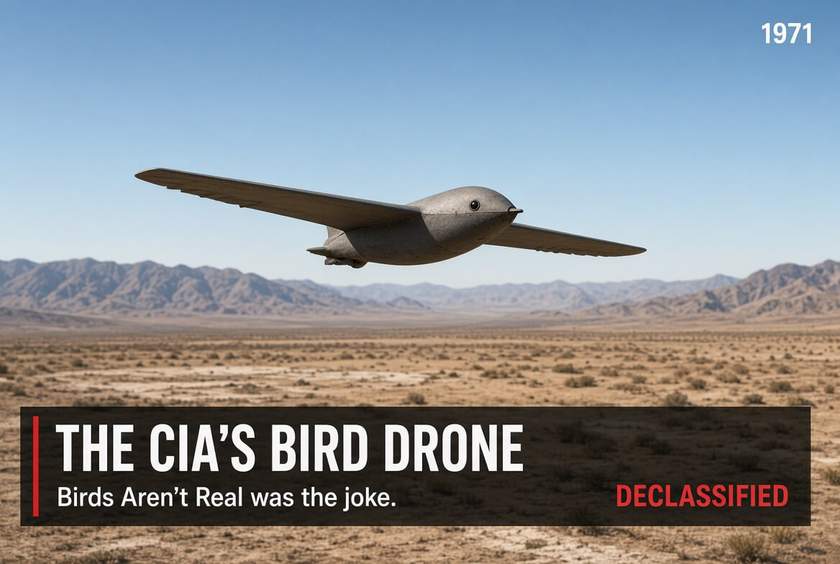
In August 1967, CIA engineers wrote that they needed bird-watching data. The agency’s Office of Research and Development was building a small, unmanned spy plane, and a study it prepared that month for the Bureau of the Budget explained why wildlife mattered. Population maps would show how likely the aircraft was to be seen. Studies of local birdlife would show how likely it was to be mistaken for a bird.
The project was called AQUILINE, from the Latin for eagle-like. Its security brochure listed what had to stay secret above all: that the CIA was building “a small, bird-like surreptitious vehicle” quiet and small enough “to operate in the natural physical signal environment of living birds.”
Fifty years later, a college student in Memphis started telling crowds that birds were government drones. He was joking. The CIA’s own files show it had already tried to build one.
A joke about the CIA, and the CIA’s paperwork
Peter McIndoe made the first “Birds Aren’t Real” sign in January 2017, the day after President Trump’s inauguration, and improvised a conspiracy theory for protesters in the street, he told 60 Minutes in 2022. By then the movement had more than a million followers. His friend Connor Gaydos wrote its backstory, in which the CIA tired of birds fouling its windshields, killed them and replaced them with surveillance robots. “So, it’s, it’s, it’s a joke,” Gaydos told the program. McIndoe described the whole project as a place to laugh at misinformation rather than be scared by it.
No record supports the bird-killing part. The drone part has a paper trail.
The CIA posted 40 AQUILINE documents, 289 pages, to its online reading room in 2020, most of them approved for release in November 2019 and February 2020. We read 19 of them, along with the CIA History Staff’s account of the program in its declassified history of the U-2 and OXCART.
Painted orange so its own chase planes could find it
Work began in mid-1965, according to the CIA history. The idea was simple: Soviet missiles had made the U-2 vulnerable, and satellites could not be pointed at a target on short notice. A small, slow aircraft might slip in under radar and never be noticed at all.
The 1967 study lays out how ambitious the plan was. The first version would carry a five-pound payload at up to 10,000 feet. Later versions would drop “black box” sensors near Soviet and Chinese weapons sites, and the study names three of them as targets for one-way missions: Lop Nor, Shuang-ch’eng-tzu and Sary Shagan. Its stated long-term goal was “land and sea launch capabilities against any target in the USSR and China.”
A February 1968 briefing paper made the political pitch. The aircraft “flies low and slow,” it said, and could “outfox defenses rather than overpower them.” Its “inoffensive and unassuming characteristics” would make it “more politically palatable” than spy planes or large drones. A later planning paper made the same case more bluntly: losing one over denied territory would be a low risk, because the aircraft was “very small” and had “no armament.”
The hardware was humbler than the pitch. The CIA history says Douglas Aircraft’s first prototypes were tested in 1968 at Randsburg Wash, on the Navy’s test station at China Lake, California. Chase pilots kept losing sight of the plane, so its upper surface was painted bright orange. It still landed by flying into a net close to the ground, which almost always damaged a wing or the propeller.
The nuclear bird that stayed on paper
Headlines in 2020 called AQUILINE a nuclear-powered drone. The files show a plan, not an aircraft. The 1967 study listed radioisotope propulsion among the options, with “unlimited range” on a 30-day flight of 36,000 miles. The 1968 briefing scheduled the first flight tests of a radioisotope version for fiscal year 1973, with an endurance of 50 days. It added that the radiation hazard “will be so low as to permit consideration of its use for over-land missions.” The program was canceled before fiscal 1973 began, and no document we read says a radioisotope engine was ever built or flown.
The crashes, on the other hand, are documented. Vehicle No. 2 went down on its first flight in January 1968, and a review traced it to a wiring error, according to an April 1968 memo from Carl Duckett, the CIA’s deputy director for science and technology. The same memo recommended skipping ahead to “a small bird configured aircraft” because an interim design “would not have produced a bird-like vehicle.” By 1970 the program had moved to Area 51, where its security plan gave it a new operational name, RECHARTER, and an unclassified nickname, Project 274.
SALT, Ping-Pong and the last flight
On June 16, 1971, Duckett and the agency’s executive director-comptroller, L. K. White, briefed the director of central intelligence and his deputy, Gen. Robert Cushman. White’s memo of the meeting, written two days later, says Duckett “reported on the last test flight, during which the plane crashed.”
Money was one problem. There was enough to keep going on “a bare-bones approach” for about 90 days, and fiscal 1973 would be the peak budget year. The other problem was the world outside. “In the light of SALT negotiations, Ping-Pong diplomacy, and the like,” White wrote, “we need to satisfy ourselves to the extent possible that, assuming we produce a viable operational asset, we shall be permitted to use it over denied areas.”
China had invited the U.S. table-tennis team to play there in April 1971, a public face for the quieter talks that led to Nixon’s 1972 visit, according to the State Department’s historians. The SALT talks with Moscow had opened in Helsinki in November 1969. A drone built to fly over Lop Nor and Sary Shagan was arriving at an awkward moment. The director gave the program 90 days to wring out its testing and told the staff to put the question to the 40 Committee. That panel, chaired by the president’s national security adviser, gave policy approval for politically sensitive covert operations and for certain reconnaissance missions. A decision was due by Sept. 30.
The CIA history gives the outcome. In operational testing, AQUILINE flew 130 miles and brought back very-high-resolution photographs, meeting the 1967 standard. Turning it into a practical long-range system would cost another $35 million and take two to three years. On Duckett’s recommendation, the program was canceled on Nov. 1, 1971. The history credits that decision to cost and time and does not mention the 40 Committee. We found no record of what, if anything, that committee was told.
“Not admit or imply any association”
A phase-out security annex dated Nov. 17, 1971, covered what came next. The remaining vehicles, three by its count, would be stored at Area 51. (The CIA history says three of five prototypes were destroyed in testing, so the two records count differently.) Contractor staff at McDonnell Douglas in Huntington Beach, California, were to be debriefed and told not to “admit or imply” any link to the program, even if “future press coverage might surface information” about it.
The annex went further. Former employees were not to mention a reconnaissance program on a résumé, and employers were to describe their work as an in-house research project. Anyone briefed on the program was to give notice for about a year before traveling to “certain risk areas.”
The secrecy faded faster than that suggests. By June 1973, two CIA memos show, AQUILINE material had been downgraded to Confidential and shared with U.S. military services, and the agency’s Office of Training was using the files to write a case study for a management course.
Primary source: the CIA’s AQUILINE collection, 40 documents. Full context: Appendix E of the CIA’s history of the U-2 and OXCART programs, via the National Security Archive.
Sources
- CIA, “Project AQUILINE Research and Development Study” (Aug. 23, 1967), C03055186. Used for: the birdlife and population studies, payload and altitude goals, named targets, the radioisotope range figure, the China Lake range.
- CIA, “Project AQUILINE,” briefing paper (Feb. 15, 1968), C03050666. Used for: “low and slow,” “politically palatable,” the fiscal 1973 radioisotope tests and the radiation remark.
- CIA, AQUILINE briefing statement, security brochure and RECHARTER security plan, C06774185. Used for: “bird-like surreptitious vehicle,” “living birds,” Area 51, RECHARTER and Project 274.
- CIA, Carl Duckett, “Revised AQUILINE Program” (April 1968), C02777858. Used for: the January 1968 crash and wiring error, the move to a bird-configured design.
- CIA, L. K. White, memo on Project AQUILINE (June 18, 1971), C05646579. Used for: the June 16 meeting, the crash, the 90-day budget, the SALT and Ping-Pong passage, the 40 Committee and the Sept. 30 deadline.
- CIA, “AQUILINE Phaseout Security Annex” (Nov. 17, 1971), C02379871. Used for: storage of the remaining vehicles, debriefing rules, the résumé and travel instructions.
- CIA, AQUILINE program call, C05646611. Used for: the “very small” and “no armament” risk passage.
- CIA, “Project AQUILINE (Classification of Materials)” (June 11, 1973), C02378346 and “Project AQUILINE (Reclassification Request)” (June 1973), C02378347. Used for: the downgrade to Confidential and the training case study.
- Gregory W. Pedlow and Donald E. Welzenbach, CIA History Staff, “The Central Intelligence Agency and Overhead Reconnaissance: The U-2 and OXCART Programs, 1954–1974,” Appendix E (approved for release June 25, 2013), via the National Security Archive. Used for: the program’s start, the orange paint and net landings, three of five prototypes lost, the 130-mile test, the $35 million estimate and the Nov. 1, 1971 cancellation.
- National Security Decision Memorandum 40 (Feb. 17, 1970), Foreign Relations of the United States, 1969–1976, Vol. II, Doc. 203. Used for: the 40 Committee’s membership and approval role.
- Office of the Historian, “Rapprochement with China, 1972” and “Strategic Arms Limitations Talks/Treaty (SALT) I and II”. Used for: the April 1971 table-tennis invitation and the November 1969 start of SALT.
- CBS News, 60 Minutes, “The origins of ‘Birds Aren’t Real'” (May 1, 2022). Used for: the movement’s origin, its following, Gaydos’s backstory and McIndoe’s description.