OPINION
Ever notice that the weather forecast and the Fed forecast have a lot in common? Both are produced by serious people with expensive equipment, and both can change completely before you’ve finished your coffee.
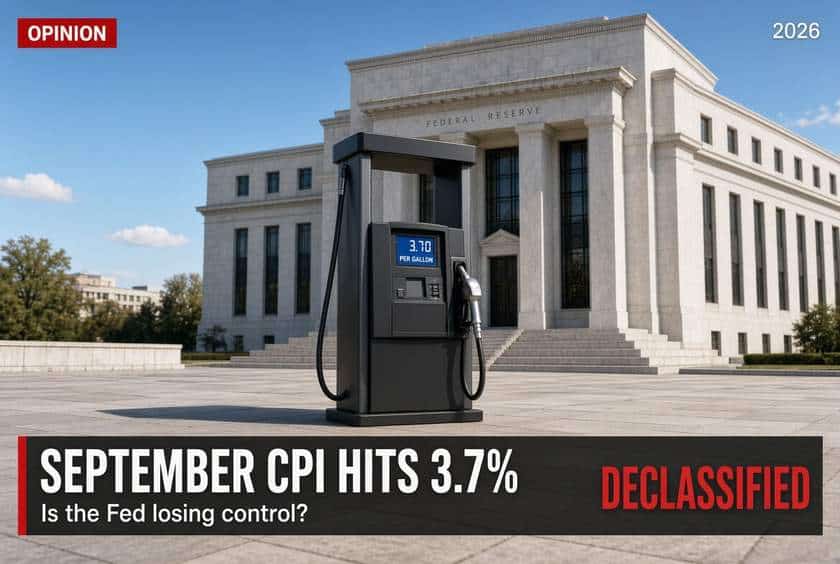
On Wednesday the Bureau of Labor Statistics reported that consumer prices rose 0.6% in September, after 0.4% in August. The annual rate climbed to 3.7% from 3.4%. By lunchtime, the question making the rounds was whether the Federal Reserve is losing control of inflation. It’s a fair question to ask. It’s worth seeing what the numbers say before answering it.
The report was not quiet. Gasoline rose 9.1% and accounted for more than half the monthly increase. Core prices, which leave out food and energy, rose 0.3% for a second straight month and are up 2.6% from a year ago, compared with 2.4% the month before. Shelter rose 0.4%, used cars 0.7%, and airfares 1.2%, as airlines passed along the cost of jet fuel.
Now consider what economists expected: a 0.6% monthly rise and a 3.6% annual rate. The headline came in one-tenth of a point above that. Core missed by about the same margin. If your contractor quotes you $3,600 for a job and bills you $3,700, you might grumble. You probably wouldn’t conclude he has lost control of carpentry.
Then there’s the rate-hike betting. At one point Wednesday, traders put a 47% chance on a quarter-point hike at the Fed’s October 27–28 meeting, up from 22.1% the day before. Depending on when you checked, you could also have seen 54% or 35%. By late in the day, CME FedWatch had October at 31.6% and December at 89.7%. In other words, traders didn’t so much become convinced of a hike as move it to a later date, the way you move a dentist appointment. Most analysts still expect the Fed to sit tight a week before the midterms.
Gas, the main culprit, has at least stopped climbing. The Energy Information Administration’s weekly average for all grades peaked at about $4.61 a gallon in late September and was down to about $4.50 by the first week of October. That’s 11 cents. On a 15-gallon fill-up it’s a little under two dollars, which won’t change anyone’s life, though it’s a start on next month’s report.
Now, the strongest case for worry, because it deserves one. Real average hourly earnings fell 0.5% in September and are down 0.7% from a year ago. On a $1,000 paycheck, that’s $7 of buying power gone, and it’s gone whether or not the report beat consensus by a tenth. The “supercore” measure, which strips out housing and energy services, has been running at nearly a 4.6% annualized pace over three months.
That points to something beyond the gas pump. Cleveland Fed President Beth Hammack has warned that inflation is broad-based rather than concentrated in one category, citing tariffs, the AI investment boom and rising service prices. That isn’t partisan noise; it’s a sitting Fed president. And the Fed already raised rates in September for the first time since July 2023, so another hike is a live option. Even gas, for all its recent easing, was still about where it averaged across September. Anyone who looks at their grocery bill and feels squeezed is reading the data correctly.
So the disagreement isn’t really about the numbers. It’s about how loudly to read them. September was a bad month with a known cause, a small miss against forecasts, and a gas price that has stopped rising, at least for now. Whether it marks the start of something worse is a reasonable question. It just isn’t one the data have answered yet.
The next CPI report comes out November 10. Until then, the Fed will keep watching the numbers, and everyone else will keep watching the Fed. Only one of them has a 2% target.
Sources: