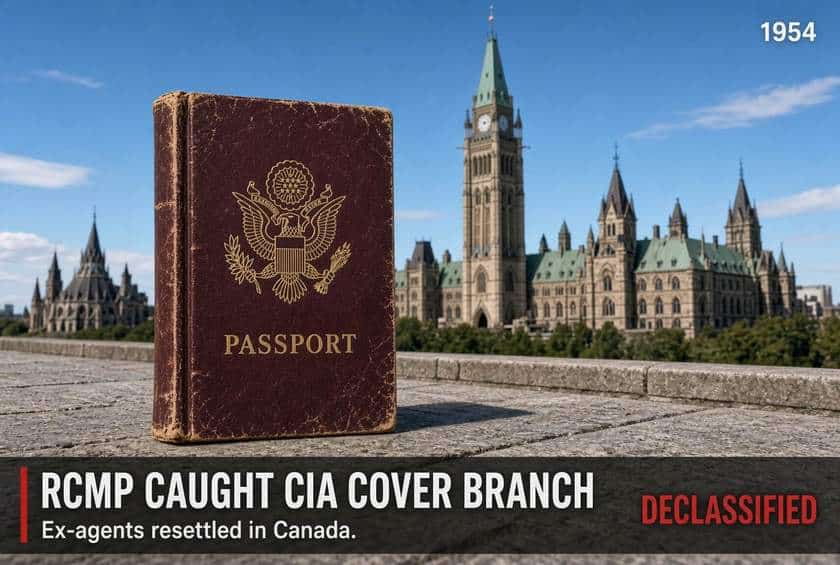
In 1954, an American intelligence official told a senior Royal Canadian Mounted Police officer, identified in court records as former Deputy Commissioner Kelly, what he thought of a U.S. immigration law. He said it in confidence, and Kelly put it in a memo. Seventy-two years later, after a federal judge ordered almost everything around it released, that opinion is the only passage of the report Canadians still can’t read. Ottawa says that is because Washington never agreed to let it out.
The rest came out on Thursday, when Ottawa released a nearly complete version of historian Alti Rodal’s 618-page study, “Nazi War Criminals in Canada: The Historical and Policy Setting from the 1940s to the Present,” written in 1986 for the Deschênes Commission, Canada’s inquiry into whether the country had become a refuge for Nazi war criminals. The release follows a Sept. 1 Federal Court ruling in a suit brought by B’nai Brith Canada, and the government chose not to appeal. We read the ruling, which quotes the disputed chapter at length, alongside the newly public passages as reported by The Globe and Mail and The Canadian Press.
A refuge, or a destination someone else chose
Most Canadians who know this history know it through one afternoon. In September 2023, during Volodymyr Zelensky’s visit to Parliament, the House of Commons gave a standing ovation to Yaroslav Hunka, a 98-year-old who had served in a Waffen-SS division. The Speaker resigned days later, and the episode put new pressure on Ottawa to open its files on war criminals. The story told since has mostly been about Canadian officials. Bernie Farber, a former head of the Canadian Jewish Congress, said this week that Rodal’s report exposed “grave failures of judgment by Canadian officials.”
Rodal’s report, much of it public since 1987, already supports part of that. As the court summarized it, Canadian screening after the war was built to catch Communist infiltrators and spies rather than Nazis and their collaborators. But the chapter Ottawa fought to keep sealed, titled “Irregularities in resettlement of defectors and former agents by American intelligence agencies,” describes something more deliberate.
Some of the people arriving were sent by an ally.
What the RCMP found in 1953 and 1954
According to the report, the Research and Resettlement Branch of the U.S. Army in Europe, known as USAREUR, was a “cover organization” for the CIA and other American intelligence agencies. Its job was resettling defectors from Communism and former agents who had worked for the Americans. The USAREUR representative told the RCMP that some of those people had criminal records, a number of them involving “moral turpitude,” the category in which Nazi collaborators were included. That admission is in the 2026 ruling’s own summary of the report.
The newly unredacted pages put numbers on it. In 1954 the RCMP reported to Ottawa that “some forty persons” had been presented for admission to Canada in 1953 by USAREUR, The Globe reports. A memo that year from the RCMP commissioner counted 35 people already in Canada with USAREUR’s help and 52 more applicants the Mounties had turned down, mainly on security grounds. According to The Canadian Press, later RCMP checks concluded that nearly all of the 35 would have been “rejectable.” Some Canadian immigration offices in Europe had accepted USAREUR’s applicants without background checks, the court noted.
The RCMP suspected the count was low. In 1954, Rodal wrote, it was convinced that “larger numbers than those actually detected” had been pushed through Canadian immigration with false documentation arranged by USAREUR. Her own assessment, quoted in the ruling, is that large numbers of former agents were being resettled by the Americans, “and it was perhaps the less desirable ones” they wanted placed in another country, such as Canada.
The report is careful about what it can prove. It says U.S. intelligence personnel “could well have assisted persons with war criminal background” and were in a position to supply false papers and tell Canadian visa officers there was nothing adverse on file. It does not, in the passages made public, name a war criminal who came in this way, and “security grounds” in the RCMP memo is not further explained in the coverage. Jared McBride, a UCLA historian who testified in the case, told The Globe the material shows U.S. intelligence set out to deceive an ally with invented biographies, which he called far less known than the resettlement itself.
The sentence about the 100 Persons Act
The one line still withheld is narrow. Per the ruling, it is the U.S. official’s view of an American statute the court calls the “100 Persons Act,” quoted inside Deputy Commissioner Kelly’s 1954 memo. The ruling doesn’t cite the statute by section, but the name matches the provision of the Central Intelligence Agency Act of 1949 that is still on the books. It lets the CIA director, the attorney general and the immigration commissioner admit a foreigner for permanent residence “without regard to their inadmissibility” under immigration law, capped at 100 people in any fiscal year. So the legal back door into the United States was real, and small. The Globe’s reporting on the ruling says Rodal’s report links that cap to the American preference for sending some people elsewhere.
Justice Simon Fothergill let that one line stay redacted under a mandatory exemption for information received in confidence from a foreign government. He wrote that it “appears to be innocuous” and that Canada should consider asking the United States again. The evidence that Washington objected was thin. The record includes an August 2024 email from Canada’s embassy in Washington, relayed secondhand: “Nothing on Rodal, no.” The embassy official added that, in practice, this meant the Americans would not agree to more releases.
Everything else, the judge ordered out.
The government had argued that disclosure would damage relations with the United States, writing that “tensions exist between these nations.” Fothergill called that “a bald statement” and said it was no basis for withholding “very specific information related to efforts by the United States to resettle suspected Nazis and Nazi collaborators in Canada.” He also noted that the names of U.S. officers in comparable roles had already been released by the U.S. government and by historians.
Washington’s own account of a different route
The U.S. government has described this kind of operation in its own words, in a different country. In 1983 the Justice Department published Allan Ryan’s report on Klaus Barbie, the Gestapo chief in Lyon whom U.S. Army counterintelligence employed after the war and then helped escape to South America. Ryan laid out a “rat line” run by the Army’s 430th Counter Intelligence Corps detachment in Austria, which passed defectors and informants to a Croatian priest in Rome who secured papers and South American visas.
Ryan’s verdict on that route reads close to what the RCMP suspected about USAREUR. “False documentation was obtained surreptitiously,” he wrote, and information was withheld from the U.S. agencies that controlled travel. He also found no evidence that the 430th had used the rat line for other suspected Nazi war criminals. Barbie, put on it by a different CIC detachment in Germany, was the case that prompted the report. The Barbie report and the Rodal chapter describe different units and different destinations. They do describe the same postwar habit of moving useful people out of Europe on paperwork nobody was meant to check closely, and Rodal’s conclusion, quoted in the ruling, names the use of former Nazis and collaborators “by American, British and French intelligence agencies and by the Vatican” as a determining factor.
Still sealed
Part II of the Deschênes Commission’s final report, which is believed to list the names of suspected war criminals, has been withheld in full since 1986. B’nai Brith says it is still pursuing it. In a statement to The Globe on Thursday, Rodal said she hopes the saga around her report leads to greater transparency, particularly for records relating to the Holocaust.
Primary source: B’nai Brith Canada v. Canada (Heritage), 2026 FC 1119, which quotes the disputed chapter and the government’s arguments. The 2024 public version of the report is at Library and Archives Canada. Full context: the Justice Department’s 1983 Barbie report, rat line section starting at page 135.
Sources
- Federal Court of Canada, B’nai Brith Canada v. Canada (Heritage), 2026 FC 1119 (Sept. 1, 2026). Used for: the chapter title, USAREUR as a “cover organization,” “moral turpitude,” the screening focus on Communists, applications accepted without checks, “less desirable ones,” the 100 Persons Act redaction, “innocuous,” the embassy email, the “tensions” argument and “bald statement,” prior release history and the OIC finding.
- The Globe and Mail, “Ottawa declassifies new details about CIA’s role in resettling Nazi war criminals in Canada” (Oct. 8, 2026). Used for: the Thursday release, “some forty persons,” Farber’s comment, the 35 and 52 figures, “larger numbers,” “could well have assisted,” McBride’s comments, Rodal’s statement, the Hunka context.
- The Globe and Mail, “Court orders Ottawa to release details about resettlement of Nazi war criminals in Canada” (Sept. 3, 2026). Used for: the report’s link between the 100-a-year policy and resettlement elsewhere.
- The Canadian Press, “Covert U.S. effort led to Canada’s acceptance of dubious postwar immigrants: study” (October 2026). Used for: the 35 people and the “rejectable” finding, the false-documentation passage.
- The Canadian Press via CP24, “Federal Court orders release of some secret material in Nazi war crimes study” (Sept. 3, 2026). Used for: the 1987 censored release.
- B’nai Brith Canada, “Federal Government Releases Unredacted Rodal Report Following B’nai Brith Legal Victory” (October 2026). Used for: the decision not to appeal, the 52 rejections, “larger numbers,” Part II.
- 50 U.S.C. § 3508, Central Intelligence Agency Act of 1949, § 7 (formerly § 8). Used for: the 100-person annual cap and its wording.
- U.S. Department of Justice, Allan A. Ryan Jr., “Klaus Barbie and the United States Government” (August 1983). Used for: the 430th CIC rat line, Dragonovic, “false documentation was obtained surreptitiously,” no evidence of use for other suspected war criminals.
- CBC News, “Anthony Rota resigns as Speaker after honouring Ukrainian veteran who fought with Nazi unit” (Sept. 26, 2023) and Al Jazeera (Sept. 26, 2023). Used for: the Hunka ovation and the Speaker’s resignation.