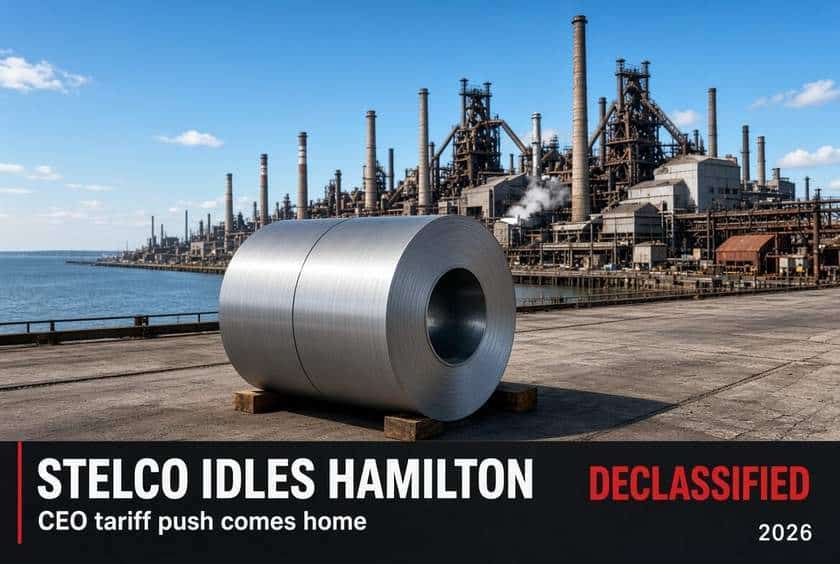
Stelco, the Hamilton steelmaker owned by Ohio-based Cleveland-Cliffs, will idle the finishing operations at its Hamilton Works plant starting October 9, 2026, cutting hundreds of jobs. The company blames U.S. tariffs. The CEO behind the decision, Lourenco Goncalves, has spent years lobbying for those same tariffs.
United Steelworkers Local 1005 confirmed on Monday, September 28, that about 350 employees at the Hamilton plant will be laid off. A company memo seen by The Canadian Press put the number at up to 500 employees across its Hamilton and Lake Erie facilities. The cold-rolled and coated steel lines are the ones being shut.
The same Monday, President Donald Trump announced a new $15-billion steel plant in Iowa, which the White House says will be the largest in U.S. history. That plant is being built by Mesabi Metallics, a company owned by India’s Essar Group. It has no connection to Cleveland-Cliffs or Stelco, but the timing sharpened the contrast for Hamilton workers.
A policy ally, not a known friend
The decision to idle Hamilton was made by Cleveland-Cliffs. Some online posts have claimed Trump asked a friend to cut the jobs, but no reporting supports that, and nothing on the public record shows a personal friendship between Trump and Goncalves.
What the record does show is a CEO who openly backs Trump’s trade agenda. In an October 2025 Politico profile, Goncalves said he believes what Trump is trying to do is “for the betterment of the country.”
“I influenced that”
Goncalves has praised the steel tariffs at each step, and has claimed a hand in them. On the company’s February 2025 earnings call, he thanked the Trump administration for having “the courage” to impose 25% tariffs on steel imports from all countries.
On that same call he predicted the tariffs would also benefit Stelco, noting that Stelco’s best year of the previous decade was 2018, when 25% tariffs on Canadian steel were in place. After Trump doubled the rate to 50% in June 2025, Goncalves told Politico he had “influenced that 50 percent,” without giving details, in the same Politico profile.
By July 2026 his tone on Hamilton had shifted. He said then that without further trade protections, “the future competitiveness of our galvanizing lines in Hamilton is at risk,” according to BNN Bloomberg.
The 2024 promises
When Cleveland-Cliffs bought Stelco for C$3.4 billion in 2024, Goncalves made commitments to workers and to Ottawa that are now at the centre of the dispute.
In July 2024, days after the deal was announced, he met the executives of USW Locals 1005 and 8782. According to the union’s own account, he told them there would be no layoffs at either location, that he wanted to add workers, and that he would honour their collective agreements.
Ottawa approved the takeover in October 2024 under the Investment Canada Act. Its conditions were legally binding five-year employment commitments, including keeping at least the same number of unionized workers and the vast majority of non-union staff.
Hamilton has been here before. Ottawa took U.S. Steel to court after its 2007 Stelco takeover, alleging it broke job and production undertakings. A Federal Court ruled in 2010 that such undertakings are binding commitments.
The company’s case
Goncalves says the trade war broke the deal’s premise. He told CBC News that selling Hamilton steel freely to U.S. buyers was “an underlying condition” of buying Stelco. “I would not have acquired the Stelco if I knew that Canada and the United States would become what they became — enemies in trade,” he said.
He also blames imports into Canada. He said the Canadian market cannot absorb the output of Stelco and ArcelorMittal Dofasco plus imported steel. He rejected Ottawa’s offer of aid: “The problem is not lack of money,” he told CBC, adding that Stelco is not running out of cash.
The company says overall steel tonnage will not change. Production is shifting to hot-rolled steel at Lake Erie Works in Nanticoke, and Stelco expects a significant number of affected Hamilton workers to be absorbed there. Goncalves says the company has every legal right to idle the plant. Asked about Ottawa’s threat, he told Bloomberg, “We’ll resolve this in court,” as reported by HRD Canada.
What Trump has said about Canada
Trump has not commented on Stelco specifically. He has, however, said repeatedly that his tariffs are meant to pressure Canada.
The trade war escalated in late August after Canada-U.S. talks broke down. Trump imposed 50% tariffs on $20 billion of Canadian imports, and Canada matched them dollar-for-dollar. On August 26 he told radio host Glenn Beck it was “time to teach Canada you can’t do this anymore”, according to Reuters.
On Monday, September 28, the day the layoffs were announced, Trump told reporters at the White House he expected a deal within weeks. “They’re gonna come in and they’re gonna say, ‘Sir, we are sorry,'” he said. Asked about Trump’s comments the next day, Carney laughed and said he would take note but not respond.
Two days later, on September 30, he spoke at an East Room event marking Hispanic Heritage Month. Talking about automakers moving plants to Canada, he said Canadians “act like they’re totally innocent. They’re not. They were very bad. But now they’re being taught a little lesson,” CTV/CP24 reported.
The fight ahead
The legal question is whether the tariffs count as something outside the company’s control. Under the Investment Canada Act, investors are not held accountable when non-compliance is clearly caused by factors beyond their control. The union argues that exception cannot apply to a CEO who says he helped set the tariff rate.
On Tuesday, September 29, Carney said workers and families had been “betrayed by the company” and that Ottawa would pursue Cleveland-Cliffs “to the fullest extent of the law,” Quartz reported. He singled out Goncalves for applauding the tariffs, and said the federal government had put money on the table to preserve jobs.
On October 1, USW Locals 1005 and 8782 called the company’s rationale “disingenuous and contradictory.” Local presidents Ron Wells and John McElroy said Cleveland-Cliffs is “obscuring their own role in manufacturing this crisis,” pointing to Goncalves’ claim that his fingerprints are on the 50% rate. Wells also disputed the company’s job-transfer promise, saying only about 40 of the laid-off Hamilton workers have been offered positions in Nanticoke.
The Hamilton lines are set to begin winding down October 9. Whether the dispute ends in a settlement, a court ruling or a Canada-U.S. trade deal is still open.
Sources
- CTV News: Union calls Stelco layoff rationale ‘disingenuous and contradictory’ (Oct 1, 2026). Used for: Union statement; about 40 workers offered Nanticoke jobs
- Yahoo Finance Canada (Canadian Press): same story (Oct 1, 2026). Used for: Wells and McElroy quotes
- CP24 (Canadian Press): same story (Oct 1, 2026). Used for: Investment Canada Act “beyond their control” exception
- CP24: Trump says Canada being ‘taught a little lesson’ (Sept 30, 2026). Used for: “Little lesson” quote and context; Carney reaction
- News Beep (Canadian Press): same story (Sept 30, 2026). Used for: Hispanic Heritage Month event; Monday “Sir, we are sorry” quote
- CBC News: Stelco’s U.S. owner defends right to idle operations (Sept 30–Oct 1, 2026). Used for: Goncalves: “underlying condition,” “enemies in trade”
- Ontario Construction News: Stelco owner defends Hamilton shutdown (Oct 1, 2026). Used for: Goncalves: “The problem is not lack of money”; Canadian market and Dofasco
- HRD Canada: Cleveland-Cliffs CEO defends idling Hamilton plant (Oct 1, 2026). Used for: “We’ll resolve this in court” (via Bloomberg)
- Quartz: Canada threatens to sue Cleveland-Cliffs (Sept 30, 2026). Used for: Carney: “betrayed,” “fullest extent of the law”
- Yahoo News (AP): Carney accuses US steelmaker of betraying Canadian workers (Sept 29, 2026). Used for: Five-year employment conditions on the 2024 approval
- BNN Bloomberg: Stelco to lay off 350 steelworkers (Sept 28, 2026). Used for: 350 jobs; Goncalves’ July 2026 warning
- Narcity (Canadian Press): Stelco to lay off up to 500 (Sept 28, 2026). Used for: Up to 500 across both sites; Lake Erie absorption claim
- CBS News: Trump to announce Iowa steel plant (Sept 28, 2026). Used for: Iowa plant; Mesabi Metallics
- Kitco (Reuters): Trump: time to teach Canada you can’t do this anymore (Aug 26, 2026). Used for: Glenn Beck interview; August tariff escalation
- Motley Fool: Cleveland-Cliffs Q4 2024 earnings call transcript (Feb 25, 2025). Used for: Goncalves thanks Trump for tariffs; predicts benefit to Stelco
- Politico: ‘I influenced that’: A steel CEO takes a bow for Trump’s tariffs, confirmed via this summary (Oct 12, 2025). Used for: “Influenced that 50 percent”; “betterment of the country”
- USW Local 1005: Information update on Cleveland-Cliffs (July 23, 2024). Used for: Goncalves’ no-layoffs commitment to the union
- AIST: Court upholds Canadian law in U.S. Steel case (June 15, 2010). Used for: U.S. Steel precedent; undertakings are binding