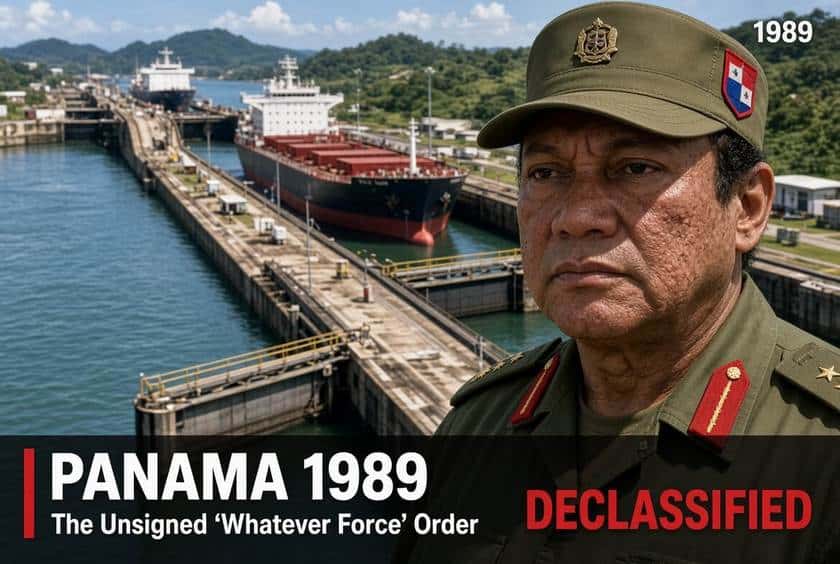
The draft is two pages long, typed on National Security Council letterhead and dated November 19, 1989. It carries George Bush’s typed name at the bottom and a blank line where the date of signing would go. Its last sentence says the order “shall supersede any conflicting Executive Branch regulation not required by law.”
A month later, on December 20, U.S. forces invaded Panama. That night Bush told the country the operation had four aims: protecting American lives, defending Panamanian democracy, fighting drug trafficking and protecting the Panama Canal treaties. The draft directive, found among White House Counsel C. Boyden Gray’s files at the George H. W. Bush Presidential Library, frames the same moment in different terms. It is one of 20 records the National Security Archive published in January in a briefing book on the legal groundwork for the invasion. We read the draft, and two of the planning records filed with it, against the Archive’s account of what they mean.
What the November draft says, and what it leaves out
The directive opens with two things the President says he has been told. Individuals in Panama are planning terrorist or criminal acts against the United States, and people believed to have broken U.S. law are or may be in Panama. It then authorizes all U.S. military, intelligence and law enforcement personnel to use “whatever force” is needed in and around Panama, including preemptive action. Where the action is law enforcement, it authorizes them to arrest anyone believed to have violated U.S. law and to seize evidence. The Secretary of Defense is put in charge.
The final sentence is the one the Archive focuses on. Its research fellow Arturo Jimenez-Bacardi reads the supersession clause as the President making clear that Defense Department and CIA rules implementing the assassination ban in Executive Order 12333 would not apply. The draft itself names no regulation, and it does not mention the executive order or assassination. The Archive’s reading is an inference from context. It may be right, but the page does not say it.
Two other things the document cannot tell us. It is a draft, and the copy published is unsigned and undated in the signature block. The Archive’s posting does not say whether a final version was signed. It is also listed as carrying a handwritten note to Gray on its first page, which we could not read in the scan.
A “snatch” was on the options list in April
The planning goes back much further than November. On April 25, 1989, the State Department’s executive secretary, J. Stapleton Roy, sent National Security Adviser Brent Scowcroft addenda to a policy paper on Panama that is still classified. The addenda weigh a range of options against Gen. Manuel Noriega. One is a “snatch operation” to seize him, carried out by U.S. forces with Panamanian forces loyal to President Eric Arturo Delvalle, at his request.
The paper is blunt about the costs. It calls the operation risky and complex and assumes the possibility of U.S. casualties. It predicts Latin American and international criticism that would be very costly if the operation failed. If it succeeded, the paper judges the criticism “likely to abate quickly.” Another section, on the drug indictments against Noriega, says prosecuting him would mean going after him with a snatch or a Panamanian military operation, and accepting casualties.
“Some other thing happening”
Two weeks later, on May 8, 1989, the day after Panama’s elections, the National Security Council met in the Cabinet Room. The minutes record Defense Secretary Richard Cheney warning that the planned measures made it look as if the United States were preparing for military action, and asking whether it really was. Bush said he was frustrated with the status quo. The minutes paraphrase him as seeing no option but more U.S. actions and the hope of “some other thing happening to get this man out.”
Near the end, Office of Management and Budget Director Richard Darman observed that the package could be read as a prelude to invasion. He added that the administration did not want people asking in a couple of months where the invasion was.
From 1989 to the Maduro operation
The Archive’s briefing book argues that these records, together with a set of opinions from the Justice Department’s Office of Legal Counsel, form what it calls the “Barr Doctrine,” after William P. Barr, who led that office in 1989. The best known of those opinions, dated June 21, 1989 and later published by the Justice Department, concluded that the President could authorize the FBI to arrest people abroad even where that conflicted with customary international law. According to the Archive, a December 23, 2025 opinion by the current head of the office, T. Elliot Gaiser, cited two of Barr’s 1989 opinions in approving the January 3, 2026 operation that captured Venezuelan President Nicolás Maduro. The Gaiser opinion is heavily redacted, and the Archive’s account of what else it relies on is partly inference.
The same caution applies to one more link in the Archive’s chain. A 1996 article by CIA lawyer Jonathan Fredman, now available unredacted on his website, describes a classified Justice Department opinion. That opinion found the assassination ban would not necessarily bar U.S. support for a coup in which the foreign leader was likely to be killed. Fredman’s text attributes the opinion to the Justice Department. The Archive attributes it to Barr, who ran the office that would have written it. The opinion itself remains classified.
The documents do support the core of the Archive’s case. By April 1989 a seizure of Noriega was a formal option with its diplomatic costs priced in. By May the minutes record a President hoping events would force the issue. By November a draft order to use force and set aside conflicting regulations was on the Counsel’s desk. How far that order reached is the part the record has not yet shown.
Primary source: Draft Presidential Directive, November 19, 1989 (Document 16). Full context: National Security Archive, “Imperial Prerogative,” January 16, 2026.
Sources
- National Security Archive, Draft Presidential Directive, “Directing United States Military, Intelligence and Law Enforcement Personnel to Take Whatever Steps are Necessary to Protect the Interests of the United States in and Around Panama,” November 19, 1989 (George H. W. Bush Presidential Library, Office of Counsel to the President, C. Boyden Gray files)
- National Security Archive, J. Stapleton Roy, Memorandum for Brent Scowcroft, “Panama Policy,” with addenda to a still-classified policy paper, April 25, 1989 (Document 8)
- National Security Archive, White House, “Minutes of the NSC Meeting on Panama,” May 8, 1989 (Document 9)
- National Security Archive, William P. Barr, OLC Memorandum Opinion, “Authority of the Federal Bureau of Investigation to Override International Law in Extraterritorial Law Enforcement Activities,” June 21, 1989 (Document 11)
- National Security Archive, Jonathan Fredman, “Covert Action, Loss of Life, and the Prohibition on Assassination, 1976–1996,” Studies in Intelligence (Document 20); unredacted edition
- National Security Archive, Arturo Jimenez-Bacardi, “Imperial Prerogative: How the Panama Invasion and the ‘Barr Doctrine’ Set the Stage for the Maduro ‘Snatch’ Operation,” January 16, 2026
- Miller Center, University of Virginia, George H. W. Bush, “Address to the Nation on Panama,” December 20, 1989