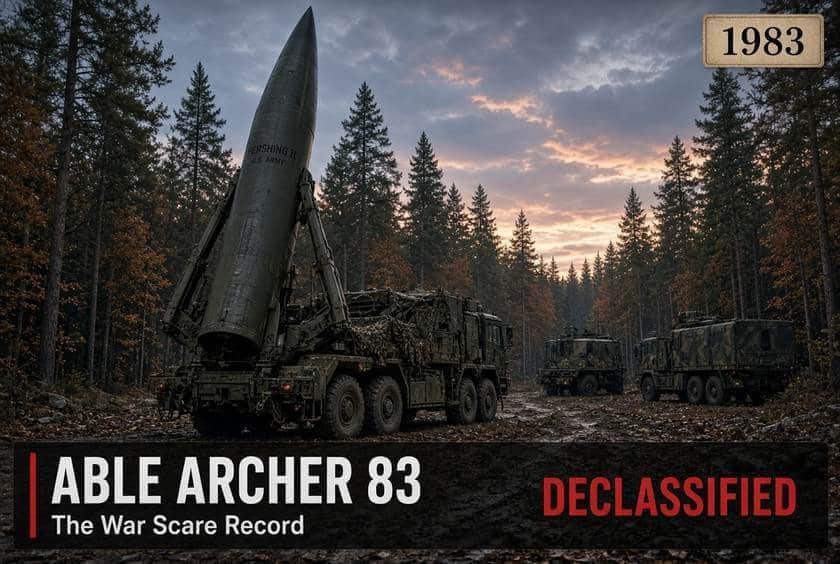
Able Archer 83 was NATO’s annual command post exercise for practicing nuclear release procedures, held in November 1983 (PFIAB report, “Able Archer 83”). Soviet and Warsaw Pact forces reacted to it with military and intelligence measures that, in the words of a later review, “previously were seen only during actual crises,” including heightened alert of Soviet air forces in East Germany and Poland (PFIAB report, executive summary). The two principal U.S. government records of that reaction are the President’s Foreign Intelligence Advisory Board study The Soviet “War Scare”, dated Feb. 15, 1990, and declassified in 2015, and the “End of Tour Report Addendum” written in January 1989 by Lt. Gen. Leonard H. Perroots of the U.S. Air Force. This entry summarizes the episode as documented in those records and traces how each came to be released.
The exercise and its setting
Perroots was the deputy chief of staff for intelligence at U.S. Air Forces Europe, Ramstein Air Base, in November 1983 (Perroots addendum, para. 1). He described the exercise’s scenario as “purposely chosen to be non-controversial” and the exercise as “a routine annual event.” It followed the bombing of air defense sites in Lebanon and directly followed the U.S. invasion of Grenada. By his recollection there was “no particular feeling of tension” in Europe beyond the normal (para. 1).
The one irregularity he recorded beforehand was that Soviet signals intercept units had not returned to garrison after covering NATO’s AUTUMN FORGE exercise series (para. 2). Soviet collection against practice Emergency Action Messages for nuclear release was known to be routine (para. 2). According to the addendum, Able Archer began on the morning of Nov. 3 and moved at once, in the scenario, to NATO State ORANGE (para. 3). A later NSA report dated the Soviet reaction to the exercise period of Nov. 2–11 (para. 6).
The Soviet side was operating under a KGB and GRU collection program known as RYaN (or VRYaN), from a Russian acronym for sudden nuclear missile attack. The PFIAB report describes the program and its associated computer model, which was intended to measure the correlation of forces and warn when Soviet relative strength had fallen far enough to justify preemption (PFIAB report, executive summary). According to KGB officer Oleg Gordievsky, as recounted by Perroots, Moscow Center had concluded by March 1983 that Able Archer 83 would serve as cover for a planned Western attack and directed residencies to look for evidence of it (Perroots addendum, para. 9).
The Soviet air alert, November 1983
At 2100Z on Nov. 4, 1983, the National Security Agency issued report G/00/3083-83, “Soviet Air Forces GSFG Placed on Heightened Readiness 2 November 1983” (Perroots addendum, para. 3). It stated that as of 1900Z on Nov. 2 the fighter-bomber divisions of the air force of the Group of Soviet Forces in Germany had been placed on heightened alert, with command posts manned around the clock by augmented teams (para. 3).
The fighter-bomber divisions were also ordered to load out one squadron in each regiment. Perroots calculated that, if the order applied across the group, at least 108 fighter-bombers were on alert, armed and at 30-minute readiness to strike first-line targets (para. 4). A squadron at Neuruppin, East Germany, asked and apparently received permission to fly without its jamming pod because of an unexpected weight-and-balance problem. Perroots’s analysts took this to mean that the squadron was loading a configuration it had never loaded before, a warload (para. 4).
Perroots read the NSA report on the morning of Nov. 5 and informed the commander in chief of U.S. Air Forces Europe, Gen. Billy Minter, that the activity was probably a reaction to Able Archer. Asked whether real force generation should be increased, he advised that the situation be watched and that the evidence did not justify raising the real alert posture (para. 5). At that point U.S. forces were in a simulated posture of State ORANGE, with simulated generation of combat aircraft under way at Ramstein and other bases (para. 5).
An NSA message dated Dec. 2, 1983, filled in the rest. Titled “Soviet 4th Air Army at Heightened Readiness in Reaction to NATO Exercise ABLE ARCHER 2–11 November 1983,” it reported that the alert had been ordered by the chief of the Soviet Air Forces, Marshal Pavel Kutakhov, and involved all units of the 4th Air Army. The alert “included preparations for immediate use of nuclear weapons” (para. 6).
The 4th Air Army was based in Poland. Owing to its source, that reporting had not been available in near real time (para. 6).
Perroots also recorded what U.S. warning systems missed. The alert was never reflected in the indications and warning system, and a stand-down of Soviet aircraft facing NATO’s Central Region went undetected (para. 7). Because the alert began on a Wednesday evening, followed by two days without flying, a weekend, and the Nov. 7 revolution holiday, the absence of flights had ready explanations. A warning condition was raised only around Nov. 9, when overhead photography showed fully armed FLOGGER aircraft on air defense alert in East Germany, by which time the stand-down had lasted a week (para. 7).
The Perroots addendum, January 1989
Perroots, by then retiring as director of the Defense Intelligence Agency, circulated the addendum in January 1989. He wrote that he had spent the six months after the exercise raising it at every appropriate level and had proposed moving the annual exercise away from the November holiday (para. 8). He noted that Gordievsky, whose reporting became available for U.S. analysis in the fall of 1985, “knew nothing of a military alert” during Able Archer (paras. 8–9).
He was critical of the intelligence community’s treatment of the episode. The repeated position that a real alert would have been detected more fully “may be whistling through the graveyard,” he wrote (para. 10). He closed by asking what might have happened if U.S. forces had begun a precautionary generation of forces “rather than waiting for further information” (para. 10). A CIA response prepared for the chairman of the National Intelligence Council described the episode as one in which Soviet air forces in Central Europe “assumed an abnormally high alert posture” in response to a routine NATO exercise, and judged Perroots’s concerns legitimate as they related to warning support for theater commanders (CIA response memorandum, 1989, as quoted by the National Security Archive).
The PFIAB report, February 1990
The President’s Foreign Intelligence Advisory Board reviewed the intelligence community’s handling of the war scare and reported on Feb. 15, 1990. It found that, although Soviet intelligence had monitored earlier Able Archer exercises, “the reaction by Warsaw Pact military forces and intelligence services to the 1983 exercise was unprecedented” (PFIAB report, “Able Archer 83”).
The Board’s principal criticism concerned two Special National Intelligence Estimates issued in May and August 1984. Those estimates stated, “We believe strongly that Soviet actions are not inspired by, and Soviet leaders do not perceive, a genuine danger of imminent conflict or confrontation with the United States.” The Board found that the evidence “did not and certainly does not now support such categoric conclusions” and described the estimates as overconfident, particularly on Soviet leadership intentions, given how little intelligence existed to support them (PFIAB report, key judgments; “Analysis”).
On the conduct of the exercise itself, the Board wrote that the military officers in charge “minimized this risk by doing nothing” in the face of evidence of an unusual Soviet alert. They “acted correctly out of instinct, not informed guidance,” having received no guidance on the possible significance of such changes (PFIAB report, “Analysis”). The Board recommended that intelligence estimates on questions of national survival be cast as alternative scenarios subjected to comparative risk assessment (PFIAB report, key judgments).
Its summary judgment was that “in 1983 we may have inadvertently placed our relations with the Soviet Union on a hair trigger” (PFIAB report, executive summary).
Release history of the records
The PFIAB report was declassified in October 2015 in response to a request by the National Security Archive, which had sought it for roughly twelve years (National Security Archive, “The 1983 War Scare Declassified and For Real,” 2015).
Substantial portions of the Able Archer section remain redacted.
The Perroots addendum was first published in February 2021 as part of a 15-page appendix to Foreign Relations of the United States, 1981–1988, Volume IV, Soviet Union, January 1983–March 1985, pp. 1420–1434, together with the CIA response and a 1988 memorandum for the record on National Security Advisor Robert McFarlane’s account of briefing President Reagan on Gordievsky’s reporting (National Security Archive, 2021 and 2025). The appendix’s sources are CIA National Intelligence Council files (FRUS appendix, source note).
In 2021 the National Security Archive requested the original Perroots document under the Freedom of Information Act. The CIA denied the request. U.S. District Judge James Boasberg upheld the denial, finding that the CIA “was not properly involved” in the document’s earlier disclosure, and the D.C. Circuit affirmed in 2024 (National Security Archive, 2025).
The State Department then republished the FRUS volume in January 2025 without the appendix’s contents. A department official told the Washington Post that the department “was not required to provide public notice” (Washington Post, Nov. 13, 2025). In the current online edition, the volume’s appendix lists “A. Editorial Note” with no accessible text (Office of the Historian, FRUS 1981–88, vol. IV, Appendix). The National Security Archive published copies of the removed pages on Nov. 14, 2025 (National Security Archive, “The Censored History of Able Archer 83”).
Sources
- President’s Foreign Intelligence Advisory Board, The Soviet “War Scare”, Feb. 15, 1990, Top Secret, declassified October 2015 (National Security Archive copy, MDR 2012-0238). Executive summary; key judgments; “Able Archer 83”; “Analysis.”
- Lt. Gen. Leonard H. Perroots, U.S. Air Force, “End of Tour Report Addendum,” January 1989, as published in FRUS 1981–1988, vol. IV, Appendix, pp. 1426–1429. Paragraphs 1–10.
- National Security Archive, Document 1, “The Censored FRUS Appendix” (FRUS 1981–1988, vol. IV, Appendix A, pp. 1420–1434, including the 1989 CIA response and the 1988 McFarlane memorandum for the record).
- National Security Archive, “The Censored History of Able Archer 83,” Briefing Book, Nov. 14, 2025.
- National Security Archive, “Able Archer War Scare ‘Potentially Disastrous,'” Briefing Book, Feb. 17, 2021.
- National Security Archive, The Able Archer 83 Sourcebook.
- U.S. Department of State, Office of the Historian, Foreign Relations of the United States, 1981–1988, Volume IV, Soviet Union, January 1983–March 1985, Appendix (current online edition).
- Washington Post, report on the State Department’s removal of Able Archer records from FRUS, Nov. 13, 2025.