This is a fast-moving story. Details below are current as of Saturday afternoon, Sept. 26, 2026, Eastern time, and positions on both sides have been shifting by the hour.
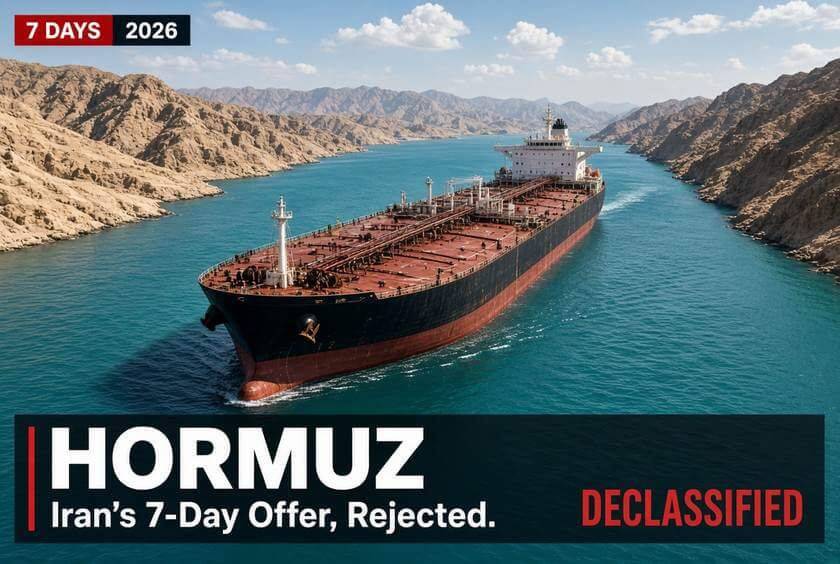
For a few days this week, a reopening of the Strait of Hormuz looked possible. Iran put a written, time-stamped plan on the table: seven days to a reopened strait, if Washington met its terms. On Saturday, President Donald Trump said no.
“I rejected their deal,” Trump told reporters as he boarded Marine One at the White House on Saturday, according to NBC News. Hours earlier he had posted an image to Truth Social relabeling the waterway the “Trump Strait,” NBC and Fox News reported.
What follows is what each side has put forward, what is confirmed, and what is still only reported.
How we got here
The war has run about seven months, Al Jazeera notes, and CBS News reports that global oil supplies have been constrained since late February. In June, Washington and Tehran signed a memorandum of understanding meant to end the fighting and restore shipping.
- Al Jazeera dates it June 17 and says it included a 60-day ceasefire, U.S. waivers on Iranian oil exports, restored maritime traffic and a deferred nuclear discussion. Reports differ on how it fell apart.
- France 24 says it broke down when Iran fired on commercial ships in the strait.
- Al Jazeera says it collapsed the following month over disputes about shipping routes.
- NBC News describes it as collapsing within days. We have not been able to reconcile those accounts.
Since then, the United States has maintained a naval blockade of Iranian ports. We have covered what the disruption has meant for fuel prices in our analysis of record diesel prices.
The week, day by day
- Sept. 19–20: Mohsen Rezaei, secretary of Iran’s Supreme National Security Council, said Tehran had sent Washington “seven conditions” for resuming talks through Qatari mediators, according to Iran’s state news agency IRNA, as republished by GlobalSecurity.org, and Israel’s Ynet. He publicly named only some of them: an end to the war on all fronts, release of frozen funds and an end to the naval blockade. The full list has not been published.
- Sept. 22: Araghchi met U.S. envoys Steve Witkoff and Jared Kushner on the sidelines of the U.N. General Assembly in New York, according to Al Jazeera and France 24. Oil fell about 3% early that day on reports that Iran would reopen the strait within a week if Washington eased pressure. Brent briefly dropped below $100 a barrel, OilPrice.com reported.
- Sept. 24–25: Araghchi described the seven-day plan publicly at the United Nations. Reuters dates his remarks to Thursday; Euronews and Al Jazeera, to Friday. “The choice now rests with the United States,” he said, according to NBC News and France 24.
- Sept. 26: The Wall Street Journal reported that Trump had rejected the plan. Trump then confirmed it himself.
What Iran is offering, and asking
Across Al Jazeera, Euronews, France 24 and the Associated Press, the core of the proposal is consistent. Within seven days of U.S. acceptance, hostilities would stop on all fronts, including Lebanon. The United States would lift its naval blockade and waive sanctions on Iranian oil sales. Iran would reopen the strait at the end of the seventh day, and talks on its nuclear program would then resume.
“The moment they accept this plan, from the next day, this timetable can start, and after seven days, the strait will be open,” Araghchi said, according to Al Jazeera.
Some details vary by outlet:
- Frozen assets: Al Jazeera, France 24 and a Reuters account of Araghchi’s remarks include the release of frozen Iranian assets. France 24 and state-media reports carried by Arab News put the figure at $12 billion or more. Euronews’s summary does not mention assets.
- Yemen: France 24 says the ceasefire would also cover Yemen. Other outlets mention only Lebanon.
- The shipping route: NBC News reports the plan refers to a transit route through the strait agreed between Iran and Oman.
Iranian leaders have also signaled limits. A senior Iranian official, speaking to Reuters on condition of anonymity, said Friday that Iran would make no nuclear concessions even if Washington accepted the Hormuz plan, and that the strait would stay closed until “all of Iran’s conditions are met.” Rezaei said Iran’s nuclear doctrine was unchanged but warned that more sanctions or pressure could affect its future position.
President Masoud Pezeshkian told CBS News Iran would allow U.N. nuclear inspectors and wants a deal before the U.S. midterm elections. Iranian state media reported Saturday that he said the plan was coordinated with Supreme Leader Mojtaba Khamenei. In a separate interview with Al Jazeera, Pezeshkian said the Hormuz issue could be solved “through negotiations, not the use of force,” but that Iran does not trust talks with Washington, NBC News reported.
What Washington says it wants
On the record, Trump’s objections center on leverage. Aboard Marine One on Saturday, he said Iran wants to open the strait immediately “because they’re losing so badly.” He added that Iran has “no money coming in” and that the United States had mounted “the greatest blockade ever in military history,” NBC News reported. According to CBS News, he also disputed Iran’s reading of the June agreement and said the United States has “total control” of the strait.
At the General Assembly earlier in the week, Trump said he was weighing whether to “annihilate” Iran or negotiate, and he repeated that Iran “will never have a nuclear weapon,” according to NBC News and Al Jazeera.
A U.S. official told NBC News the administration was having “positive and constructive” discussions through mediators but was “not in any hurry” to reach an agreement. Secretary of State Marco Rubio said it would be wrong to describe the New York meeting as a major breakthrough, Al Jazeera reported. Al Jazeera also reports that the administration wants Iran’s nuclear program negotiated now, as part of a single deal, rather than deferred until after the strait reopens, as Iran proposes. We have not found that position stated on the record by a named U.S. official.
What is reported but not confirmed
The most widely repeated claim this weekend rests on anonymous sourcing. The Wall Street Journal, citing U.S. officials, reported that Trump told aides he expects a renewed U.S. bombing campaign after the November midterm elections, according to accounts of the Journal’s story by Newsmax, France 24 and others. The White House has not confirmed that detail publicly, and Trump’s own remarks Saturday did not address it. We have not been able to read the Journal’s report directly.
Also unconfirmed: the complete list of Iran’s seven conditions, the exact dollar figure for frozen assets, and whether Yemen is covered.
Both sides, in their own words
Iran’s case is that it has offered a concrete, short timeline, and that the next move belongs to Washington. The United States’ case, as Trump put it Saturday, is that the blockade is working, that Iran is under economic strain, and that there is no reason to ease pressure before the nuclear question is addressed. Analysts quoted by Al Jazeera suggested each side may be overestimating its leverage. Urban Coningham of the Royal United Services Institute and Burcu Ozcelik, a Middle East security fellow, made that point.
Markets and shipping
Brent crude fell to about $98 a barrel early on Sept. 22, OilPrice.com reported. By late in the week it was back around $104 to $105, according to CBS News and Euronews. CBS News reported that 29 vessels had been guided out of the strait under military supervision. NBC News reported that nearly 40 million barrels transited the strait in the 48 hours before the New York talks. We could not independently verify either shipping figure.
For the fuel-price picture behind these numbers, see our executive brief on diesel prices.
What happens next
As of Saturday afternoon, Iran’s offer has been publicly rejected by the president, Qatar remains the channel between the two sides, and Iran says the strait stays closed until its conditions are met. Pezeshkian met Qatar’s prime minister on Saturday to discuss de-escalation, Euronews reported. Whether talks continue in some other form, and whether the reported post-midterm timeline for renewed strikes holds, are open questions. This story is changing quickly, and some of what is reported today may be revised.
Sources: NBC News; CBS News; Al Jazeera; France 24; Euronews; Associated Press (via U.S. News & World Report); Reuters (via U.S. News & World Report); The Wall Street Journal (as reported by Newsmax via Yahoo News and France 24); Fox News; Arab News (AFP/state media); OilPrice.com; IRNA (via GlobalSecurity.org); Ynet.
Sources
- NBC News — “Trump says he has rejected Iranian proposal to reopen Strait of Hormuz,” Sept. 26, 2026
- CBS News — “Iran War Updates: Trump rejects 7-day plan to reopen Strait of Hormuz,” Sept. 25–26, 2026
- Al Jazeera — “What’s in Iran’s seven-day plan to reopen the Strait of Hormuz?” Sept. 25, 2026
- France 24 — “Trump rejects Iran’s seven-day plan to reopen Strait of Hormuz,” Sept. 26, 2026
- Euronews — “Iran proposes plan to US to reopen Hormuz in seven days and end the war,” Sept. 25, 2026
- Associated Press (via U.S. News) — “Iran Proposes a Deal to Reopen the Strait of Hormuz in 7 Days if the US Meets Its Conditions,” Sept. 25, 2026
- Reuters (via U.S. News) — “Iran Will Make No Nuclear Concessions, Iranian Official Says,” Sept. 25, 2026
- Newsmax (via Yahoo News) — “Trump Rejects Iran Ceasefire, Expects Bombing to Resume After Midterms,” citing The Wall Street Journal, Sept. 26, 2026
- Fox News — Live updates, Sept. 26, 2026
- Arab News — “Iran president says supreme leader backs new plan to reopen Hormuz,” Sept. 26, 2026
- IRNA (via GlobalSecurity.org) — “Major General Rezaei: Iran has announced seven conditions to US for resuming talks,” Sept. 20, 2026
- OilPrice.com — “Oil Tumbles 3% as Iran Floats Hormuz Reopening Within a Week,” Sept. 22, 2026
- Ynet — “Iran sends US ‘seven conditions’ for talks, warns nuclear doctrine could change,” Sept. 19, 2026