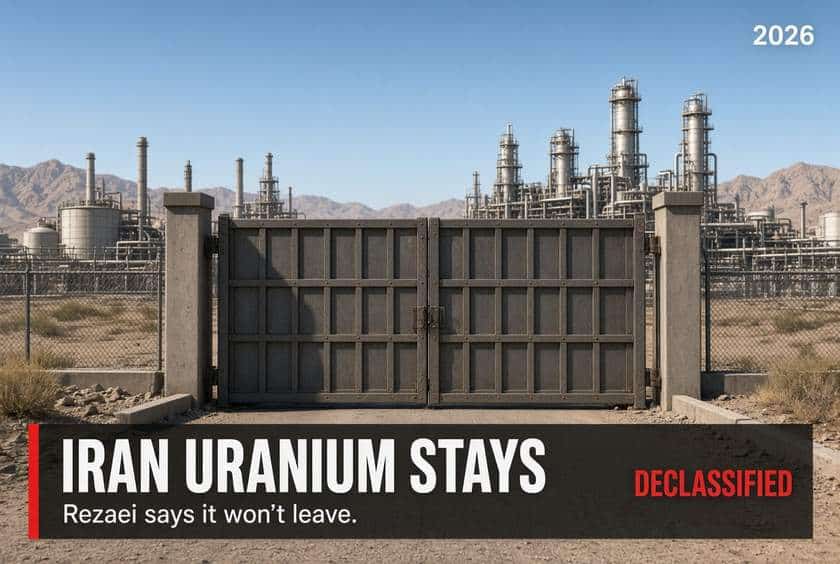
Iran will not send its enriched uranium abroad under any deal with the United States, the secretary of its Supreme National Security Council, Mohsen Rezaei, said in an interview with Lebanon’s Al Mayadeen TV that aired Wednesday, Nov. 11. Tehran has told Russia, the country most often floated as a destination for the stockpile, that the material is staying put, he said.
Reuters, Iran’s semi-official Mehr News Agency and Radio Free Europe/Radio Liberty all carried the remarks. The translations differ slightly. Reuters and Mehr have Rezaei saying Iran won’t let “even a single particle” of enriched nuclear material leave the country. RFE/RL renders it as not “a single atom.” Al Jazeera reported that he was rejecting a U.S. proposal to move Iran’s stockpile of 60% enriched uranium to a third country, and that Russia had offered to receive and store it.
Iran has made this move once before. In December 2015, a ship carried Iran’s low-enriched uranium to Russia under the nuclear deal Tehran had signed with six world powers that July. That shipment is the template a transfer deal would follow, and it’s the one Rezaei is now ruling out.
What Rezaei said, and where
Clips of the interview were released Wednesday ahead of the full broadcast, according to RFE/RL. In Mehr’s account, Rezaei said Iran had “informed our Russian friends that the enriched materials will remain in Iran and that we will use them ourselves.” He gave a reason, as Mehr quoted him: Iran needs enriched material “to design nuclear-powered ships and submarines.” Mehr is the only outlet we found carrying that line, and Iran has given no other public detail on any such program.
Rezaei also warned that any new U.S. strikes would be answered with attacks on U.S. bases, including distant ones, Reuters reported. And he denied that Iran and the United States are negotiating. RFE/RL said Al Mayadeen quoted him calling reports of a recent meeting in Qatar “pure lies” meant to push down oil prices.
Rezaei was appointed to the security council post in August and serves as Supreme Leader Mojtaba Khamenei’s representative on it, RFE/RL reported. He met Russian President Vladimir Putin in Moscow on Nov. 5.
The position isn’t new. Two senior Iranian sources told Reuters in May that the supreme leader had issued a directive barring Iran’s near-weapons-grade uranium from being sent abroad. Iran hasn’t published that directive, and we haven’t seen it confirmed elsewhere.
How much uranium, and where it is
Nobody outside Iran can say for certain. The International Atomic Energy Agency estimated that Iran held 440.9 kilograms of uranium enriched to 60% when Israel and the United States struck its nuclear facilities in June 2025, according to Reuters and RFE/RL. Reuters describes that level as far higher than needed for civilian use. Inspectors couldn’t verify how much survived those strikes or where it’s stored. Strikes hit Iran’s facilities again after the current war began on Feb. 28, RFE/RL noted.
Iran denies seeking nuclear weapons. Washington has said nuclear issues must be part of any initial talks to end the war, Reuters reported.
The 2015 shipment Iran did send
On Dec. 28, 2015, Iran shipped a large share of its enriched uranium stockpile to Russia, a step required by the Joint Comprehensive Plan of Action. Secretary of State John Kerry called it “one of the most significant steps” toward Iran meeting its commitments, NPR reported. The material was low-enriched, not bomb grade.
The figures for that shipment don’t match. Kerry’s statement put it at more than 25,000 pounds of low-enriched uranium materials, according to NPR. State Department spokesman Mark Toner described a 12.5-tonne cargo, Al Jazeera reported, citing AFP. Iran’s ISNA news agency reported 8.5 tonnes sent, with about 140 tonnes of natural uranium coming back from Russia in exchange. The deal required Iran to cut its low-enriched stockpile below 300 kilograms, and Kerry said the shipment more than tripled the U.S. estimate of how long Iran would need to produce enough weapons-grade uranium for one bomb, from two to three months.
The 2015 shipment was low-enriched uranium sent under a signed agreement whose terms the IAEA was charged with verifying, NPR noted. The stockpile now at issue is enriched to 60%, its location isn’t verified, and there’s no agreement. Russia’s role is the same in both cases: the country that takes the material.
The standoff around it
The large-scale fighting has mostly stopped, but the key disputes are unresolved, including Iran’s nuclear program, the U.S. naval blockade of Iranian ports and shipping through the Strait of Hormuz, according to RFE/RL. President Trump said on Nov. 9 that the war was “effectively over” militarily, RFE/RL reported. Secretary of State Marco Rubio said after a G7 meeting in Paris on Nov. 10 that economic pressure on Iran was “so devastating that right now there is no need for major combat operations.”
Oil rose about 1% after Rezaei’s comments on Wednesday, Reuters reported. Crude had touched two-month lows the day before, according to Investing.com.
Al Mayadeen was due to broadcast the full interview later on Wednesday, according to RFE/RL. We found no public U.S. response to Rezaei’s remarks as of Wednesday afternoon. Our Hormuz tanker attack tracker follows the shipping side of the standoff.
Sources
- Reuters, “Iran will not allow enriched nuclear material to leave the country, security chief says” (Nov. 11, 2026), via Business Recorder
- Mehr News Agency, “Iran’s top security official: Not a particle of enriched nuclear material to be exited” (Nov. 11, 2026)
- Radio Free Europe/Radio Liberty, “Iranian Security Chief Insists Enriched Uranium Won’t Leave Country” (Nov. 11, 2026)
- Al Jazeera, “Iran war live: Iran’s Rezaei rejects moving nuclear material out of country” (Nov. 11, 2026)
- Investing.com, “Iran security chief rejects transfer of nuclear materials out of the country” (Nov. 11, 2026)
- NPR, “Iran Ships Over 25K Pounds Of Uranium To Russia As Part Of Nuke Deal” (Dec. 28, 2015)
- Al Jazeera, “Nuclear deal: Iran’s uranium ship reaches Russia” (Dec. 28, 2015)