OPINION
You ever notice how “a little more” depends entirely on who’s paying? The waiter says the truffle is just a little extra. The contractor says the new cabinets add just a little more. And then the bill comes, and you find out that “a little” was measured from the other side of the counter.
Last Wednesday in North Carolina, President Trump said higher gas prices are “a very inexpensive price to pay for what we’ve done” in the war with Iran. He added that it was only a little more — and that even a lot more would be worth it. So let’s measure it from this side of the counter.
The little more
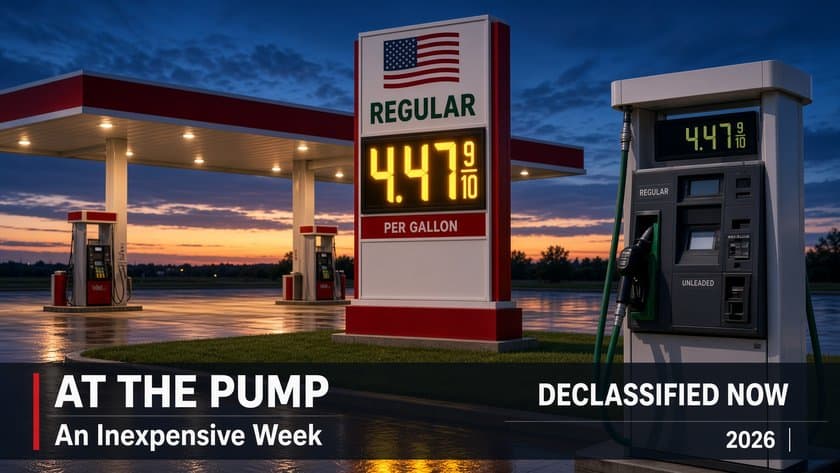
When the president gave his State of the Union address in late February, the national average for a gallon of regular was $2.92, down from when he took office. Days later, the United States and Israel went to war with Iran. On Wednesday, AAA had regular at $4.47 — about 53 percent higher than on the night of that speech, and $1.30 more than a year ago.
Take an ordinary 15-gallon tank. At $2.92 it cost $43.80 to fill. At $4.47 it costs $67.05. That’s $23.25 more every time you fill up. Do that once a week and it comes to about $1,200 a year, which is inexpensive in the sense that a used transmission is inexpensive, if you happen to be the one selling it.
Diesel is worse. AAA put the national average at a record $6.52 a gallon on Wednesday, nearly $3 more than a year ago, and in California it has passed $8.40. Diesel is what moves the trucks, the trains and the combines, which is how a fuel most people never buy ends up in the price of everything they do.
The diesel week
Which brings us to this week. Over the weekend, Iowa’s Republican Sen. Chuck Grassley urged the White House to embargo diesel exports to help farmers. On Tuesday, at the United Nations, the president said he had been telling his own people, “let’s not send out the diesel.” Treasury Secretary Scott Bessent said the administration was examining whether a full or partial ban would work, and the president said a decision would come quickly, one way or another.
It came quickly. Energy Secretary Chris Wright — who ran an oilfield services company before taking the job — had already warned the week before that an export ban would mean more expensive gasoline right away, because refineries would cut production as their tanks filled up. The oil industry’s main lobby said restricting exports would only compound the problem. On Wednesday, after Politico reported a 90-day ban was being prepared, a White House official denied it, and Wright said nobody was considering a flat ban at all — only ways to get more diesel into the country. Democratic leaders, for their part, called the whole idea a gimmick.
So in the space of about a week, the price went from inexpensive to an emergency to a thing we are definitely not doing. The pump, meanwhile, stayed where it was.
What the voters think
Voters have not been confused about where the price came from. In an I&I/TIPP poll in late April and early May, 67 percent said the rise in gas prices was mainly due to the war with Iran, including 74 percent of Democrats, 61 percent of independents — and 68 percent of Republicans. Every one of the 36 demographic groups the pollster tracked put the war above 50 percent.
Whether that becomes blame is another matter. In Quinnipiac’s poll in late July, 54 percent of registered voters said they blame President Trump “a lot” for the rise in gas prices and 19 percent said “some.” Among Republicans, though, only 11 percent blamed him a lot, and 36 percent not at all. Those are two different polls, months apart, so you shouldn’t lay one on top of the other too neatly. But taken together they suggest a lot of Republican voters have concluded that the war raised the price of gas and that this has very little to do with the man who started the war. That is a generous way to read a gas pump, and a generous electorate is a fine thing to have seven weeks before a midterm.
The Associated Press found both kinds of voter at the pump this week: a 28-year-old delivery driver in South Texas choosing between groceries and a full tank, who didn’t think it was a good trade at all, and a 63-year-old carpenter in Arizona who voted for Trump, paid $4.39 a gallon, said the president hurt himself stepping into this — and in the same breath said the Democratic Party had lost its way, too.
The other side
In fairness, a good deal of this isn’t made in Washington. Diesel is expensive worldwide partly because Russia banned its own diesel exports after Ukrainian attacks on its refineries, taking the world’s second-largest source off the market, and because Iran and its Houthi allies have attacked refineries and threatened tankers moving through the Strait of Hormuz.
The president argues the war is what stands between Iran and a nuclear weapon, and if you accept that premise, then asking the public to absorb higher fuel costs is exactly the kind of trade leaders have always asked for in wartime.
It is also worth saying plainly that the administration looked at a popular, bad idea — one pushed by its own party’s farm-state senators in an election year — listened to its energy secretary and the people who actually run refineries, and dropped it within a day. That is not nothing. It is, in fact, how it’s supposed to work. And “end the war” is a position, not an energy policy; the price of a barrel doesn’t fall on the day a politician says so.
Still, the words stick. The president said the decision on diesel would be fast, one way or another. It was fast, and it was the other. The price at the pump, meanwhile, didn’t need anybody’s decision at all.
Sources:
- PBS News / Associated Press, “Rising gas prices frustrate voters. Trump says it’s an ‘inexpensive price to pay’ for the Iran war,” Steve Peoples and Jonathan J. Cooper, Sept. 2026 (link) — Trump’s North Carolina remarks, his rationale for the war, voter interviews
- PolitiFact, “Ask PolitiFact: What does the Iran war mean for US gasoline prices?,” March 4, 2026 (link) — $2.92 national average at the State of the Union
- CNBC, “Trump administration is examining whether a diesel export ban is feasible, Treasury secretary says,” Sept. 22, 2026 (link) — Bessent’s statement, Trump on timing, California diesel, Russian export ban and refinery attacks
- CNBC, “Oil industry warns a diesel export ban will raise fuel prices as Trump weighs restrictions,” Sept. 23, 2026 (link) — Trump’s “let’s not send out the diesel,” Grassley, Wright’s warnings, API, AAA prices of $6.52 diesel and $4.47 gasoline
- Reuters via KFGO, “White House denies report US is considering a diesel export ban,” Sept. 23, 2026 (link)
- The Washington Times, “Democrats call diesel export ban a ‘gimmick’ that won’t solve sky-high fuel prices,” Sept. 23, 2026 (link)
- I&I/TIPP Poll, 1,464 voters, April 28–May 1, 2026, via Issues & Insights (link)
- Quinnipiac University national poll, 963 registered voters, July 23–27, 2026, released July 29 — question 23 (release, full results)