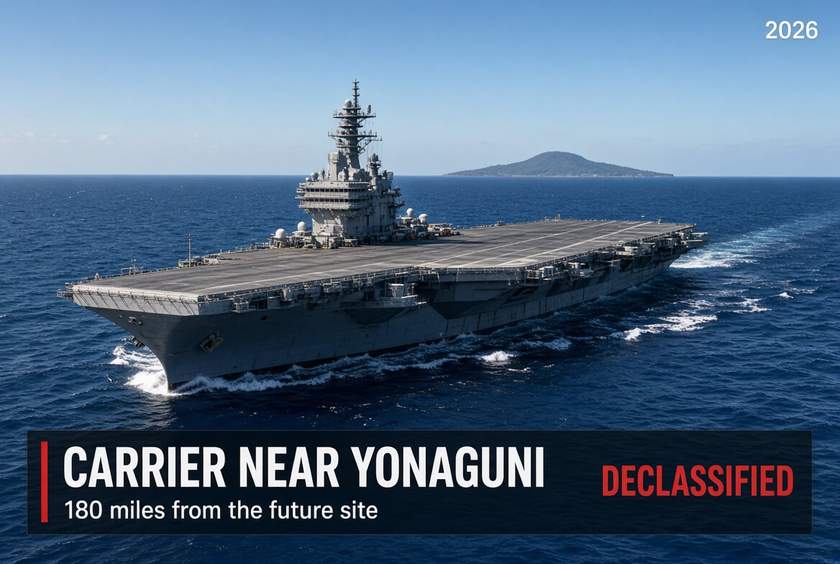
On October 14, Chinese fighter jets and helicopters took off from and landed on the aircraft carrier Liaoning about 10 times, roughly 250 kilometers south of Japan’s Ishigaki Island, according to Japan’s Joint Staff. By our calculation, that put the carrier about 290 kilometers, or 180 miles, from Yonaguni, the island where U.S. Marines plan to set up anti-ship missiles for the first time when the U.S.-Japan exercise Keen Sword begins on October 19.
The next day, Japan reported that the carrier and its three escorts had turned toward the South China Sea. Beijing describes the voyage as routine annual training that is not directed at any country.
Three days in Japan’s records
Japan’s Self-Defense Forces first spotted the group at about 11 a.m. on Tuesday, October 13, heading south roughly 390 kilometers southwest of the Danjo Islands in Nagasaki prefecture, the Joint Staff said. With the Liaoning were two Renhai-class guided-missile destroyers, hull numbers 103 and 104, and a Luyang III-class destroyer, hull number 123. Global Times identified them as the Anshan, the Wuxi and the Huainan.
On Wednesday, the four ships sailed southeast between Okinawa’s main island and Miyako Island into the Pacific. The carrier then began flight operations south of Ishigaki, and Japan scrambled Air Self-Defense Force fighters in response, according to the Joint Staff, Stars and Stripes and the Jiji news agency. The Joint Staff’s follow-up release counted about 10 launches and landings by carrier-based fighters and helicopters. Stars and Stripes reported that the operations took place inside Japan’s exclusive economic zone. The destroyer Yugiri, based at Yokosuka, tracked the group, along with P-1 and P-3C patrol planes.
The carrier was not the only Chinese military activity in the area that day. A suspected Chinese drone flew from the East China Sea between Yonaguni and Taiwan into the Pacific, and a Y-9 intelligence plane and a WZ-7 reconnaissance drone flew over the East China Sea, the Joint Staff said. Japan scrambled fighters again. On the same day, four U.S. Air Force F-22s trained with two Japanese F-15s and an E-767 early warning plane in the airspace northwest of Okinawa’s main island, according to a separate Joint Staff release. Japan did not link the drill to the carrier.
On Thursday, October 15, the Joint Staff said the Liaoning and its three escorts had sailed toward the South China Sea. It did not say which route they took. Another Y-9 flew over the East China Sea that afternoon.
How close the carrier came to U.S. and allied sites
Japan gave only an approximate position for the flight operations, about 250 kilometers south of Ishigaki. We measured from that point, so the distances below are estimates and could be off by tens of kilometers.
| Site | Link to U.S. forces | Approximate distance |
|---|---|---|
| Yonaguni, Japan | U.S. Marines bring NMESIS anti-ship missiles for Keen Sword | 290 km (180 mi) |
| Southern tip of Taiwan | Not a U.S. site | 340 km (215 mi) |
| Naval Base Camilo Osias, Cagayan, Philippines | Open to U.S. forces under the Enhanced Defense Cooperation Agreement | 450 km (280 mi) |
| Lal-lo Airport, Cagayan, Philippines | Open to U.S. forces under the same agreement | 510 km (315 mi) |
| Kadena Air Base, Okinawa | U.S. Air Force base; the group passed Okinawa’s main island on its way out | 600 km (370 mi) |
| Andersen Air Force Base, Guam | U.S. Air Force base | 2,390 km (1,485 mi) |
The missiles headed for Yonaguni
Keen Sword 27 runs from October 19 to 29. Japan will commit about 45,000 personnel, 6,100 vehicles, 40 ships and 260 aircraft, according to the Joint Staff’s September 29 announcement. The exercise is co-directed by the head of Japan’s Joint Operations Command and the commander of the U.S. Pacific Fleet. Its training list includes air and missile defense and joint anti-ship combat. Australia, Canada, France, Germany, the Netherlands, New Zealand and the Philippines are listed as participants.
For the first time, U.S. Marines will bring the Navy-Marine Expeditionary Ship Interdiction System, known as NMESIS, to Yonaguni, Army Recognition and SSBCrack reported. The system pairs an unmanned launcher with Naval Strike Missiles, which have a publicly reported range of more than 185 kilometers. The Marines will also bring a short-range air defense system called MADIS. Yonaguni sits about 110 kilometers from Taiwan. Japan’s Okinawa Defense Bureau said on October 2 that U.S. and Japanese forces would set up a joint coordination center at the Ground Self-Defense Force camp on the island, Army Recognition reported. The deployment is for the exercise, not a permanent basing.
The Philippine sites to the south
Japan has not said how the Liaoning group is traveling to the South China Sea. From where the carrier was operating, the most direct way in is through the waters between Taiwan and Luzon.
Northern Luzon is where the United States gained access to new military sites in 2023. That April, Manila and Washington named Naval Base Camilo Osias in Santa Ana and Lal-lo Airport, both in Cagayan province, and Camp Melchor Dela Cruz in Isabela among four new locations open to U.S. forces under the Enhanced Defense Cooperation Agreement, CNN and BusinessWorld reported. The agreement does not allow a permanent U.S. presence. The Philippines is also a participant in Keen Sword this year.
Beijing’s account, and December’s radar lock
China’s navy said the group sailed to the western Pacific on October 14 under its annual training plan, to test and improve its combat readiness, Xinhua and CGTN reported. It said the training complies with international law and is “not directed at any specific country or target.” Zhang Junshe, a Chinese military commentator, told Global Times that Japan frequently hypes such exercises. Jiji Press wrote that the drills were apparently aimed at keeping the United States and Japan in check, since a U.S. carrier would be expected in the western Pacific in a Taiwan contingency. Beijing has not said how long the deployment will last. The Liaoning’s previous deployment, to the South China Sea and Philippine Sea, ended in June, USNI News reported.
The carrier’s last pass near Okinawa ended in a dispute. On December 6, 2025, J-15 fighters from the Liaoning twice pointed their radar at Japanese F-15s southeast of Okinawa, Japan’s defense ministry said. Defense Minister Shinjiro Koizumi called it a dangerous act, and Japan said it was the first time it had formally disclosed such an incident, Naval News reported. China rejected Japan’s protest and lodged counter-protests, accusing the Japanese jets of harassing its training, according to Naval News and Stars and Stripes.
Japan has not reported any comparable incident this week. The U.S. 7th Fleet did not respond to a request for comment from Stars and Stripes. This story is developing, and we will update it if Japan reports where the group goes next.
Sources
- Japan Joint Staff, “Movements of Chinese Navy vessels” (Oct. 14, 2026, in Japanese). Used for: the Oct. 13 sighting, the ships, the Okinawa–Miyako passage, the flight operations position and Japan’s surveillance.
- Japan Joint Staff, “Movements of Chinese Navy vessels” (Oct. 15, 2026, in Japanese). Used for: the count of about 10 launches and landings and the turn toward the South China Sea.
- Japan Joint Staff, “Movements of Chinese military aircraft” (Oct. 14, 2026, in Japanese) and (Oct. 15, 2026). Used for: the drone between Yonaguni and Taiwan and the Y-9 and WZ-7 flights.
- Japan Joint Staff, “Japan-U.S. bilateral training” (Oct. 15, 2026, in Japanese). Used for: the Oct. 14 F-22 training.
- Japan Joint Staff, “Keen Sword 27” (Sept. 29, 2026, in Japanese). Used for: the exercise dates, size, commanders, training list and participants.
- Stars and Stripes, “Chinese carrier operations near Okinawa draw Japanese fighter response” (Oct. 15, 2026). Used for: the EEZ location, the scramble, China’s statement and the 7th Fleet request.
- Jiji Press via Nippon.com, “China Flattop Conducts Apparent Drill after Passing Okinawa” (Oct. 14, 2026) and “Chinese Flattop Liaoning Heads for Western Pacific for Drills” (Oct. 14, 2026). Used for: the flight operations, the scramble and Jiji’s assessment.
- Xinhua (Oct. 14, 2026) and CGTN (Oct. 14, 2026). Used for: the PLA Navy’s statement.
- Global Times (Oct. 14, 2026). Used for: the escorts’ names and Zhang Junshe’s comments.
- Army Recognition (Oct. 2026) and SSBCrack News (Oct. 2026). Used for: NMESIS and MADIS on Yonaguni, the Okinawa Defense Bureau announcement and the missile’s range.
- CNN (April 4, 2023) and BusinessWorld (April 3, 2023). Used for: the northern Luzon EDCA sites.
- Naval News (Dec. 2025) and Stars and Stripes (Dec. 8, 2025). Used for: the December radar incidents and China’s counter-protest.
- USNI News (June 22, 2026). Used for: the previous deployment.
- Distances are DeClassified Now calculations from the Joint Staff’s reported position, using great-circle distance to each site.