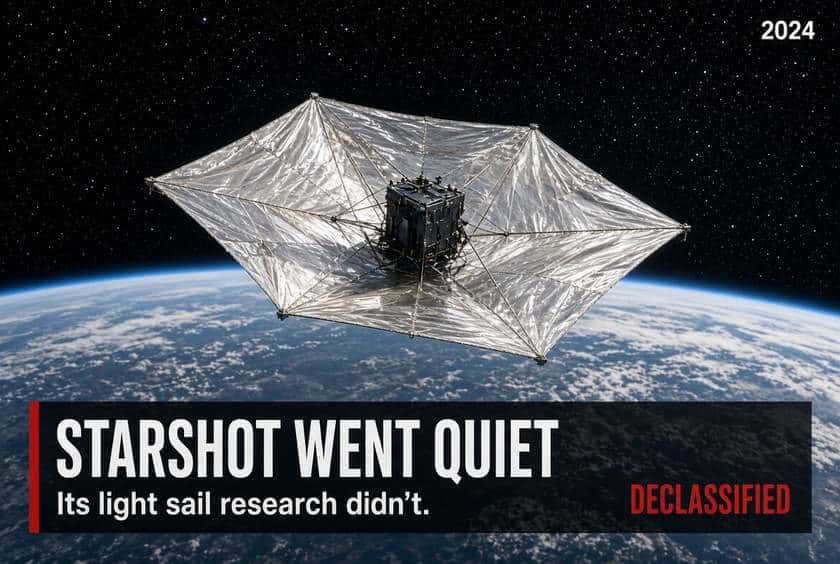
On May 26, Nature Communications published a paper from engineers at Penn, Caltech and UCLA describing a new kind of light sail. It’s a crinkled, three-layer film of molybdenum disulfide between two skins of alumina, built to be pushed by a laser to a fifth of the speed of light. Near the end, in the funding note, the authors say the work was “primarily supported by the Breakthrough Initiatives.”
That is the organization behind Breakthrough Starshot, the $100 million plan to send tiny probes to Alpha Centauri. In 2025 its executive director said the program had been put on hold. A year on, the people who worked on it still disagree about whether it failed, what it cost and whether it’s coming back. The final report on its first phase was finished in September 2023, according to one of its senior researchers. It has never been published.
A $100 million pledge and a 20-year trip
Yuri Milner, the tech investor, announced Starshot on April 12, 2016, at One World Observatory in New York, with Stephen Hawking beside him. The foundation’s release described a $100 million research and engineering program to prove that light-propelled “nanocraft” could work. Each probe would be a gram-scale chip on a sail a few hundred atoms thick. A laser array on the ground, scaled up to 100 gigawatts, would push the sails to 20 percent of light speed, fast enough to reach Alpha Centauri, 4.37 light-years away, about 20 years after launch. With the fastest spacecraft of the day, the release said, the trip would take about 30,000 years.
Pete Worden, a former director of NASA’s Ames Research Center, was named to lead it. Hawking, Milner and Mark Zuckerberg made up the board.
Worden’s email to Scientific American
The first detailed public account of the stall came in September 2025, when Scientific American ran a long piece by Sarah Scoles. Worden declined an interview. In an email he wrote that the program was “on hold” and that the foundation was working to hand portions of it “to others.” He didn’t say who, and the article doesn’t name anyone.
Several scientists Scoles spoke to were unsure where things stood. Mason Peck, a Cornell engineering professor and former NASA chief technologist, said it looked paused to him and unlikely to resume soon. Martijn de Sterke, a physicist in a University of Sydney group that worked on sail stability, said his team hadn’t heard from Breakthrough in about two years.
The article also took on the money. Philip Lubin, the UC Santa Barbara physicist whose laser-propulsion roadmap shaped the program, told Scoles the full $100 million never materialized. He estimated that Breakthrough spent roughly $4.5 million across about 30 contracts, and that his own group got less than $200,000 over eight years. Scientific American noted that the grants were never made public.
In late January 2025, after Scoles contacted Worden and the Harvard astrophysicist Avi Loeb, a foundation spokesperson told her a report on the project would be finished around spring 2025 and made available to the magazine. It hadn’t appeared when the October issue went to print.
Benford’s rebuttal and a $20 million gap
The pushback came in March 2026, in a two-part essay on Centauri Dreams, the interstellar-flight site run by Paul Gilster. Its author, James Benford, was with Starshot from the start and led its sail team for several of his eight years there.
Benford argues the program did what Phase I was meant to do. It looked for show-stoppers in laser-driven sailing and asked whether credible fixes exist, and he says the answer was yes. In his telling, the project was paused in 2024 to restructure and seek broader support. It was not canceled. He calls Lubin’s $4.5 million figure “absurd” for eight years of contracts, standing advisers, subcommittees and invitation-only meetings, and puts Phase I at about $25 million. He counts roughly 50 Starshot-related papers, some published after the pause. He also faults the magazine for not hearing from Worden or Loeb, though Scientific American says both declined to be interviewed.
He also lays out the next step. In a Phase II, a coalition led by Caltech would run lab demonstrations and the first experiments in orbit, and the research phases together are projected at $120 million. He doesn’t say who would pay for it.
Both cost figures are estimates from people who worked on or around the program. Neither comes from the foundation, which has not published what it spent. Benford is also making the case for work he helped lead. By his own rating, the solutions sit at technology readiness level 2, which means they are worked out on paper and still need experiments to prove them.
The report nobody outside has read
Benford’s references list the “Breakthrough Starshot Summary Report, September 2023” with the note “not published.” In his second essay he repeats the point.
“There is a final report, but it has yet to be published,” he wrote.
The fullest public overview is a chapter Worden co-wrote for Laser Propulsion in Space, a 2024 Elsevier volume edited by Claude Phipps, alongside system models by Kevin Parkin and work by Lubin. Benford says the foundation publicized little during most of the project and has kept media contact to a minimum. The program’s own web page, still online, describes Starshot’s “commitment to full transparency and open access.” Beyond Worden’s email, we could find no public statement from Breakthrough on Starshot’s status.
Five problems between here and Proxima
Every account agrees the remaining work is enormous. The figures below come from Benford’s essays and from the researchers Scientific American interviewed.
| Problem | What Starshot needs | Where it stands |
|---|---|---|
| Laser array | About 100 gigawatts from roughly 100 million small lasers locked in phase | About five orders of magnitude beyond today’s state of the art, Benford writes. Labs have phase-locked tens of lasers, Carnegie Mellon’s Zachary Manchester told Scientific American. |
| Laser cost | Cents per watt | About $100 per watt today, per physicist Kelvin Long. Benford says a system of about $10 billion needs a 100- to 1,000-fold price cut. |
| The atmosphere | Real-time correction of turbulence that makes the beam twinkle | The 2024 book chapter called it potentially the program’s largest technical hurdle, Scientific American reported. |
| The sail | About 0.1 gram per square meter, meters wide, almost no absorbed light | Assembled only at millimeter scale so far, Scientific American reported. The best new film, from the Penn-led team, weighs about 0.7 grams per square meter. |
| Data home | About 100 kilobytes back from 4.37 light-years | Optical links can do it at a limited rate, Benford says. Long and Manchester said communications got less early attention than the other problems. |
The sail labs Breakthrough still funds
The lab work has kept coming out. In January 2025, a Caltech team led by Harry Atwater, who ran Starshot’s sail-materials effort, reported in Nature Photonics what Caltech called the first experimental measurements of laser-driven motion in miniature lightsails. Their test sail was a square of silicon nitride 50 nanometers thick and 40 micrometers on a side, tethered at its corners like a tiny trampoline. A beam of 110 watts per square centimeter pushed it with a force of about 70 femtonewtons. The paper credits the Air Force Office of Scientific Research and the Breakthrough Starshot Initiative. The sail never flew free. The team’s stated next step is a surface that pulls a drifting sail back onto the beam by itself.
The Penn-led paper goes after the weight and reflectivity problem. Its corrugated, honeycomb-patterned films reflect more than half the light across a broad band and absorb less than 4 percent. At about 0.7 grams per square meter, they are within a factor of ten of Starshot’s target. The prototypes are up to about 3 millimeters across. In the authors’ comparison, theirs is the only design that could reach the 20 percent goal using reflectivity actually measured in the lab rather than calculated. They estimate about seven minutes of laser time from an array 26 kilometers wide. Penn’s July 30 news release on the work doesn’t mention Starshot, but the paper names it throughout, and the team posted its code in a public repository named “starshot.”
Neither paper’s funding note says when the money was awarded. The Penn paper was submitted in February 2026, well after the 2024 pause. That fits Worden’s line about moving portions of the program to others, but it can’t show whether Breakthrough is still writing new grants or paid for this work before 2024.
Read the Penn paper, “Experimental demonstration of corrugated nanolaminate films as reflective light sails,” and Benford’s case that Starshot succeeded.
Breakthrough Starshot Went Quiet. Its Light Sail Research Didn’t.
Sources
- Sarah Scoles, Scientific American, “How a Billionaire’s Plan to Reach Another Star Fell Apart” (Sept. 16, 2025; print title “Voyage to Nowhere,” October 2025). Used for: Worden’s email, Peck and de Sterke on the program’s status, Lubin’s spending estimate and grants, the spokesperson’s promised report, Long, Manchester and the 2024 book chapter on technical hurdles.
- James Benford, Centauri Dreams, “Starshot Is a Success: Part I” (March 3, 2026). Used for: Phase I goals, the 2024 pause, the $25 million estimate and “absurd,” roughly 50 papers, Phase II and the $120 million projection, TRL 2, the unpublished September 2023 summary report.
- James Benford, Centauri Dreams, “Starshot Is a Success (Part II)” (March 10, 2026). Used for: the final report quote, the foundation’s publicity, the Phipps volume, the laser array and cost figures, the sail mass target, data return.
- Breakthrough Initiatives, Starshot announcement (April 12, 2016). Used for: the $100 million program, the mission design, Worden’s role, the board, the 30,000-year comparison.
- Breakthrough Initiatives, Starshot program page. Used for: the transparency pledge.
- Michaeli, Gao et al., Nature Photonics, “Direct radiation pressure measurements for lightsail membranes” (Jan. 30, 2025) and Caltech’s release via ScienceDaily (Jan. 31, 2025). Used for: the measurement, sail dimensions, funding, next steps.
- Campbell, Kumar et al., Nature Communications, “Experimental demonstration of corrugated nanolaminate films as reflective light sails” (May 26, 2026). Used for: the sail design, performance figures, prototype size, the Breakthrough funding note, submission date, the code repository.
- Penn Engineering, “A New Kind of Light Sail Brings Interstellar Travel One Step Closer” (July 30, 2026). Used for: the research team and the release’s framing.