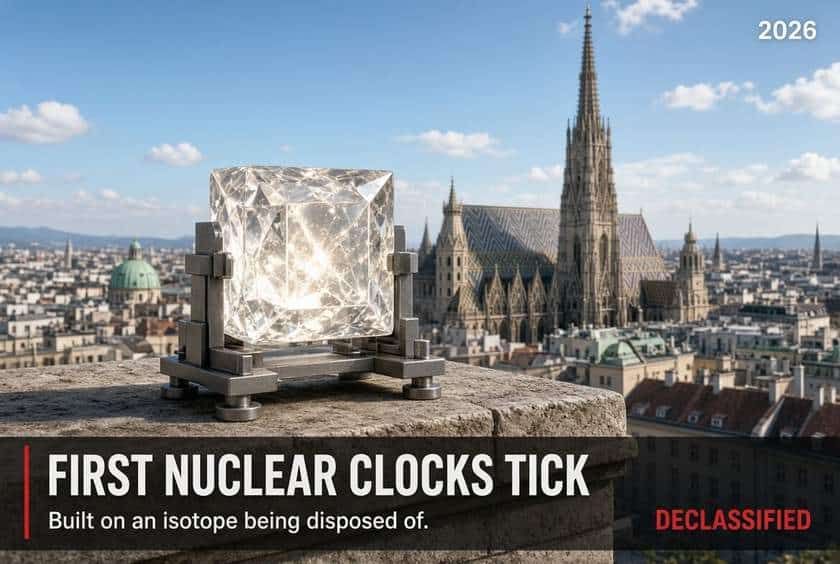
The team in Beijing grew the crystal at the heart of its new clock from 1.4 micrograms of thorium-229. That amount, the researchers wrote in their paper, was “dictated by the severe scarcity” of the isotope, and it left them almost no room to try again if the crystal came out wrong. It came out well enough. On Oct. 7, Nature published two papers, one from Beijing and one from Vienna, that the journal’s own commentary calls “the first implementations of a nuclear clock.”
Both clocks keep time by locking a laser to a transition inside the nucleus of the thorium-229 atom rather than to the electrons around it, as every atomic clock in use does. The Vienna group, led from TU Wien with Germany’s national metrology institute, PTB, ran its clock continuously for a day. The Beijing group, from Tsinghua University, Peking University and the Beijing Academy of Quantum Information Sciences, built one about six times as stable. Neither is yet better than the atomic clocks it is meant to replace, and the Vienna team says so plainly.
The thorium in the Vienna clock came from Oak Ridge National Laboratory in Tennessee, home of a Cold War stockpile of uranium-233 that the U.S. government is in the middle of disposing of, and that DOE says contains most of the world’s thorium-229.
Why a nucleus makes a better pendulum
A clock needs something that oscillates at a steady rate. In an atomic clock, that’s light tuned to the exact frequency that makes an electron jump between two energy levels. A nucleus is more than ten thousand times smaller than the atom around it, according to TU Wien, and so it is far less disturbed by stray electric and magnetic fields. That’s the theoretical edge.
The problem is that nuclear energy levels are usually separated by far too much energy for any laser to bridge. Thorium-229 is the exception. Its nucleus has an excited state only about 8.4 electron volts above its ground state, which puts the transition in the vacuum-ultraviolet range at a wavelength of about 148 nanometers. The Beijing paper calls it “the only known nuclear transition” that current lasers can address directly.
The small energy gap is itself an accident. According to the Vienna paper, it comes from a near-cancellation of two much larger contributions to the nucleus’s energy, the electric repulsion between its protons and the nuclear force, each measured in millions of electron volts. That makes the transition unusually sensitive to any change in the constants of nature, which is why physicists want to compare a nuclear clock against atomic clocks over time.
Two clocks, two approaches
Both teams embedded thorium-229 in small crystals of calcium fluoride and used the nuclei’s absorption of laser light as the signal that keeps the laser on frequency. If the laser drifts, absorption drops, and the system corrects it. The papers describe the differences.
| Clock | Vienna (TU Wien, PTB) | Beijing (Tsinghua, Peking U.) |
|---|---|---|
| Stability | 3 × 10⁻¹² / √τ, approaching 10⁻¹⁵ over 1 day | 5 × 10⁻¹³ / √τ |
| Laser | Continuous-wave, 148 nm | 10-microwatt continuous-wave 148.4 nm, made by four-wave mixing in cadmium vapor |
| Checked against | A single-ion ytterbium clock | Two independently grown crystals, agreeing to within 10⁻¹³ |
| Also showed | New limits on ultralight dark matter | Reproducibility across crystals |
In the table, τ is the averaging time in seconds, and a smaller number means a steadier clock. Beijing’s figure is about six times better than Vienna’s. The Vienna team’s claim is different. TU Wien describes its device as the first stand-alone nuclear clock that stabilizes itself the way conventional atomic clocks do, rather than leaning on an external reference.
The two groups say the parallel results strengthen each other. “I think this is very encouraging because it shows that the concept is robust and not dependent on one particular technical implementation,” Shiqian Ding of Tsinghua University told the American Nuclear Society’s news service.
Fifty years from a guess to a tick
The Vienna paper lays out the history, and it runs longer than most readers would expect.
| Year | Step |
|---|---|
| 1976 | Kroger and Reich, studying the decay of uranium-233, find signs of a very low-energy excited state in thorium-229 |
| 2003 | Ekkehard Peik and Tamm propose a nuclear clock based on it |
| 2016 | The excited state’s existence is proven directly |
| 2022 | Its light is detected, pinning the energy at about 8.34 eV |
| 2024–2025 | Lasers excite the nuclei directly in crystals and thin films |
| Oct. 2026 | Two working clocks published in Nature |
“A nuclear clock was something that physicists dreamt of for almost 50 years,” Thorsten Schumm of TU Wien told the society’s news service. His group has worked toward it since 2008. Peik, who co-proposed the idea in 2003, is a co-author of the Vienna paper.
Not yet better than the clocks it’s meant to beat
Over a full day, the Vienna clock reached a precision of about one part in 10¹⁵, which TU Wien translates as an error of roughly one second in 30 million years. Schumm said that is not yet at the level of the best optical atomic clocks, and told ANS the technology remains “far from its target performance.” The Vienna team expects stronger lasers and better crystals to help, and its paper projects improvements of several orders of magnitude for future devices. Those are projections, not results.
The Vienna team did put its prototype to work. By watching for tiny periodic wobbles and slow drifts in the nuclear transition over periods from 20 seconds to a day, it set limits on one class of proposed dark matter. Those limits, the paper says, compete with the best atomic clocks for dark matter’s coupling to light and go beyond earlier measurements of its coupling to the strong nuclear force.
Where the thorium comes from
The Vienna paper’s acknowledgments thank the Department of Energy’s National Isotope Development Center and Oak Ridge National Laboratory “for providing the 229Th used in this work.” The Beijing paper does not name a supplier.
Thorium-229 is made by the radioactive decay of uranium-233, a material the United States produced in the 1950s and 1960s as a possible reactor fuel, according to the Department of Energy. It never worked out as fuel, in part because of traces of a highly radioactive companion isotope, uranium-232. The government shipped it to Oak Ridge, where it has sat for decades in Building 3019, which DOE calls the world’s oldest operating nuclear facility.
DOE treats that inventory as a hazard. Its contractor, Isotek, has been converting the uranium-233 into a form that can be shipped and disposed of, and as of March 2026 had disposed of 75% of it. Before each batch is processed, Isotek extracts the thorium-229 and ships it to TerraPower, which uses it to produce actinium-225 for experimental cancer treatments. “It’s important to extract Th-229 because that isotope only comes from U-233,” Isotek president Sarah Schaefer said in a DOE release. “Most of the world’s supply of U-233 is stored at ORNL, so once this material is dispositioned, no more Th-229 will be available.”
A clock uses very little. Beijing’s crystal held 1.4 micrograms, while DOE estimates that around 40 grams will go to TerraPower for medical use. Schaefer’s statement concerns the world’s supply as a whole, and DOE has not said how it plans to divide what remains between medicine and physics.
The two papers are in Nature: Vienna’s “A thorium-229 optical nuclear clock with feedback loop” and Beijing’s “A nuclear clock synchronized to 229Th.” DOE’s account of the Oak Ridge uranium-233 project is in its March 2026 update.
Sources
- Toscani De Col, L. et al., “A thorium-229 optical nuclear clock with feedback loop,” Nature (Oct. 7, 2026). Used for: the Vienna clock’s design, stability and dark matter limits, the ytterbium comparison, the 1976–2025 history, the near-cancellation, the Oak Ridge acknowledgment.
- Huang, B. et al., “A nuclear clock synchronized to 229Th,” Nature (Oct. 7, 2026). Used for: the Beijing clock’s laser, stability and crystal reproducibility, “only known nuclear transition,” the 1.4 micrograms and “severe scarcity.”
- Nature, News & Views on the two papers (Oct. 7, 2026). Used for: “the first implementations of a nuclear clock.”
- American Nuclear Society, Nuclear Newswire, “Researchers in Vienna and Beijing report nuclear clock ‘milestone'” (Oct. 9, 2026). Used for: the Ding and Schumm quotes, “far from its target performance,” the teams’ affiliations.
- Scienmag via Bioengineer.org, reporting TU Wien’s release (Oct. 9, 2026). Used for: the stand-alone, self-stabilizing claim, the size of nuclei, one second in 30 million years, Schumm on optical clocks, the 2024 laser excitation.
- Popular Science, “The world’s first nuclear clocks start ticking” (October 2026). Used for: the six-fold stability difference, one second in 30 million years.
- U.S. Department of Energy, “Oak Ridge Partnership Helps Move Cancer Treatments Closer to Market” and “Oak Ridge Project Supports Fight Against Cancer”. Used for: the Schaefer quote, U-233’s origin, the TerraPower extraction, the 40-gram estimate.
- U.S. Department of Energy, “Oak Ridge Launches U-233 Processing Campaign” and “Oak Ridge Hits Midpoint in Uranium-233 Processing Campaign” (March 24, 2026). Used for: U-232, Building 3019, the 75% disposal figure.